

An SST output controller can be designed to establish LV voltage and frequency. That does not make the SST an independent energy source. If its grid input is unavailable, the island needs stored or generated energy connected through a qualified power path.
The service claim should identify both control authority and energy availability. Without those boundaries, grid forming can become a promise of backup power that the hardware cannot sustain.
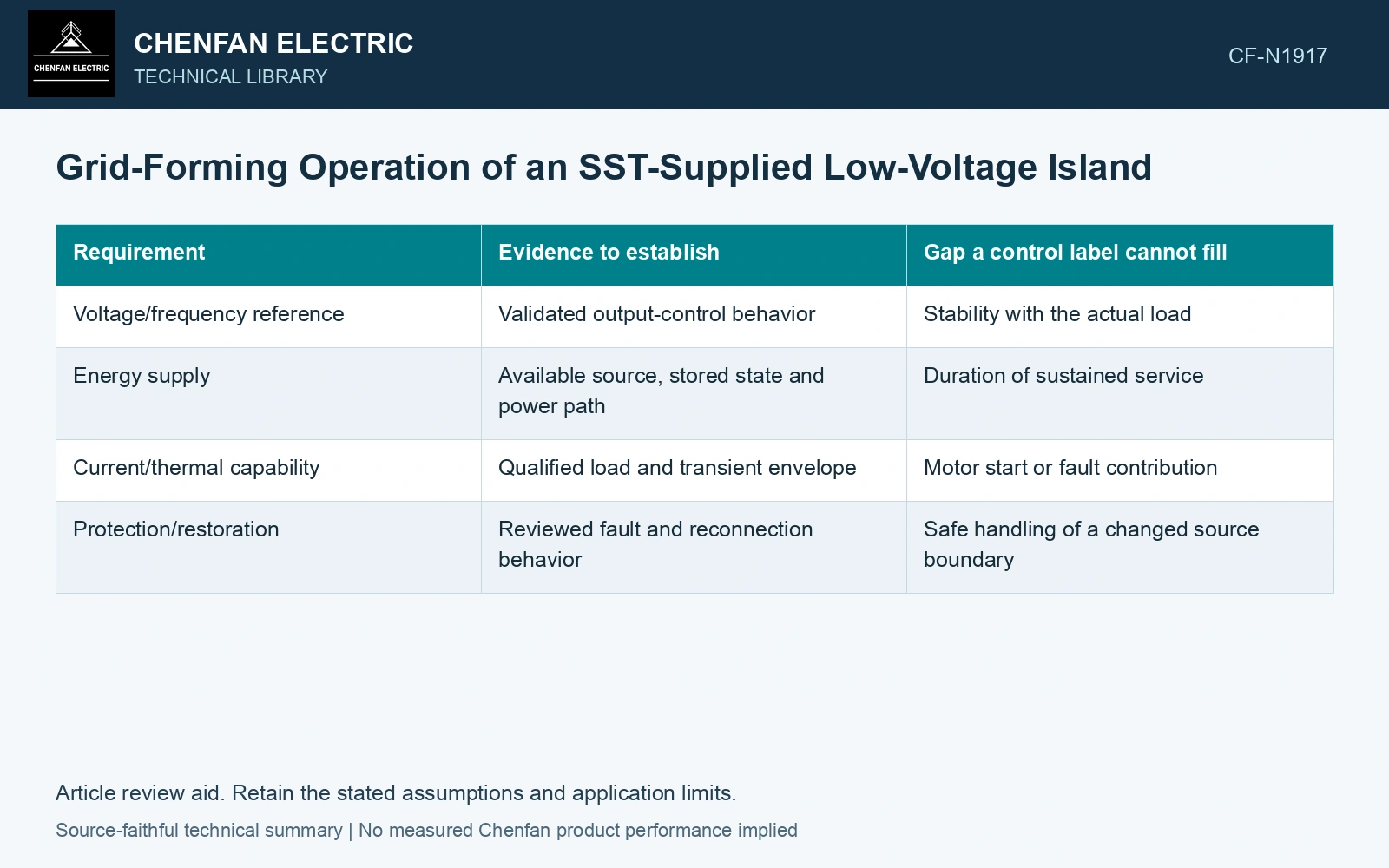
Separate four island requirements
| Requirement | Evidence to establish | Gap a control label cannot fill |
|---|---|---|
| Voltage/frequency reference | Validated output-control behavior | Stability with the actual load |
| Energy supply | Available source, stored state and power path | Duration of sustained service |
| Current/thermal capability | Qualified load and transient envelope | Motor start or fault contribution |
| Protection/restoration | Reviewed fault and reconnection behavior | Safe handling of a changed source boundary |
A battery symbol in another topology does not prove that the particular SST has a battery port. Identify actual interfaces and permitted modes.
Budget energy through the whole service
At a defined island boundary, stored-energy change follows source power minus load and losses. Under an illustrative constant deficit Pdef, a usable energy budget Euse gives interval Euse/Pdef. Joules divided by watts gives seconds. The permitted voltage or state range defines Euse; nominal stored energy is not automatically all usable.
Starting loads and converter losses can change the trajectory. A low steady load may be supportable while a brief start demands current beyond the output stage’s envelope. Energy and current capability are separate checks.
Assess the changed protection environment
A current-limited converter may supply a different fault waveform from the grid-connected system. Existing protection cannot be assumed to retain its sensitivity and clearing behavior. The island study should identify final isolation and remaining energized paths.
Load disconnection and control saturation can also change voltage regulation. Include credible disturbances and measurement failures in the approved validation, not only a smooth steady load.
Review entry and return
The transition into island service has its own initial states and permission requirements. Returning to another source introduces a phase and network boundary. Neither transition is established by demonstrating one stable island operating point.
The NREL inverter-modelling paper represents grid-forming control and current limits in specified network models. Validate the intended island against the actual SST ports, load dynamics, available energy and protection, retaining the model’s demonstrated scope. [1][2]
The completed capability statement should name the source, usable state, loads and transition conditions covered. It gives grid-forming control a precise role while preserving the physical requirement to supply energy. A voltage reference can organize the island; it cannot power the island by itself.
References
- R. W. Kenyon, A. Sajadi, A. Hoke and B.-M. Hodge, Open-Source PSCAD Grid-Following and Grid-Forming Inverters and a Benchmark for Zero-Inertia Power System Simulations, NREL/CP-5D00-78402, April 2021.
- D.-M. Predescu and Ș.-G. Roșu, Solid State Transformers: A Review—Part I: Stages of Conversion and Topologies, Technologies 13, 74, 2025. DOI: 10.3390/technologies13020074.