

An isolated SST output can still have a demanding ground-fault problem. Isolation removes a defined conductive path across the conversion boundary; the DC bus’s voltage to ground follows its own connections, capacitances and faults. Those conditions need an explicit design.
Begin with the actual pole arrangement and ground reference. A two-wire output, a midpoint-referenced bus and a bipolar port need different circuit identities.
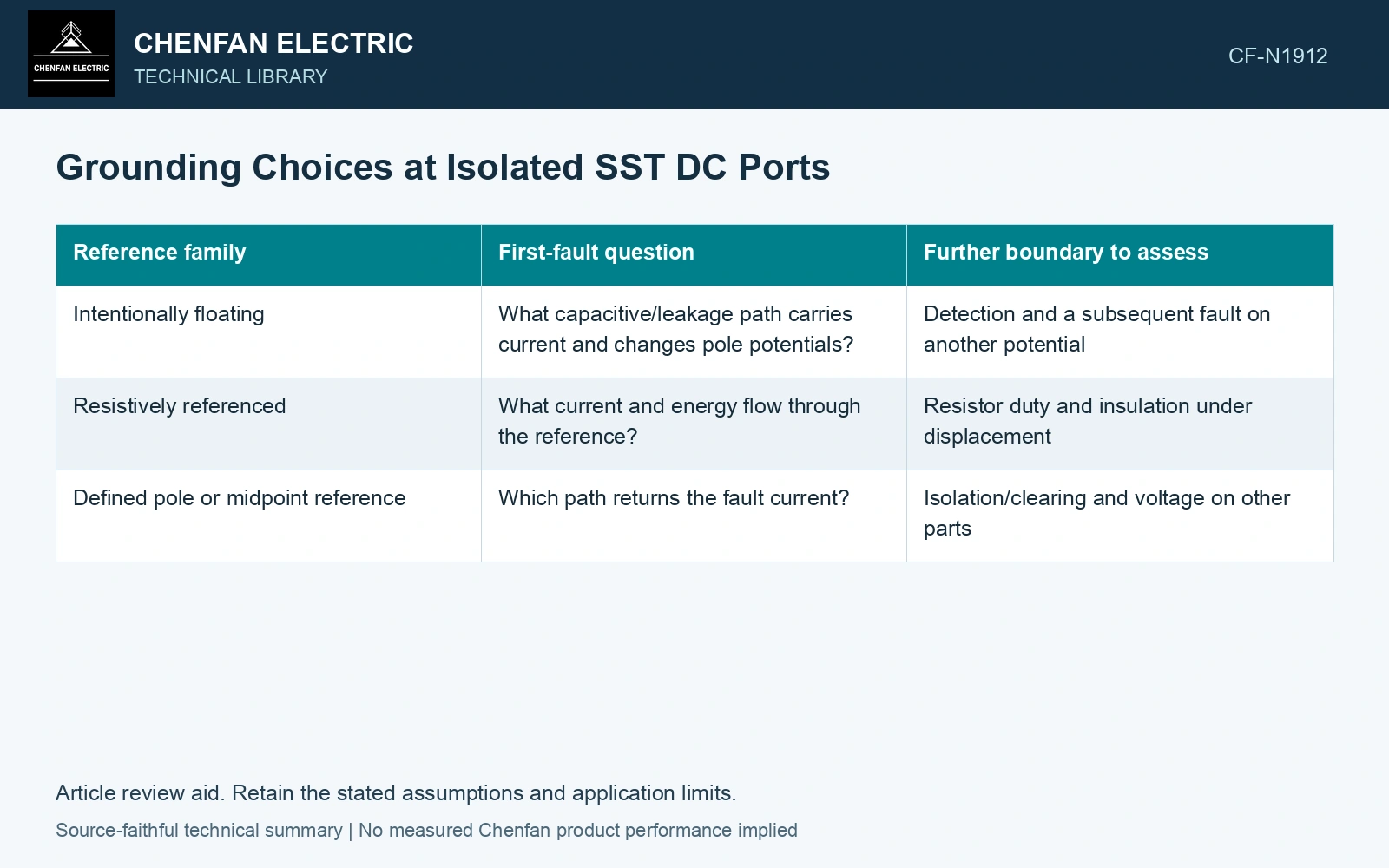
Compare references by their fault paths
| Reference family | First-fault question | Further boundary to assess |
|---|---|---|
| Intentionally floating | What capacitive/leakage path carries current and changes pole potentials? | Detection and a subsequent fault on another potential |
| Resistively referenced | What current and energy flow through the reference? | Resistor duty and insulation under displacement |
| Defined pole or midpoint reference | Which path returns the fault current? | Isolation/clearing and voltage on other parts |
The families do not supply a universal recommendation. Their suitability depends on voltage, service objective, connected equipment and qualified protection.
Track voltage on each insulating boundary
A floating bus need not divide voltage equally to earth. In a fast capacitive redistribution, capacitances and initial charge matter through Q=CΔV [1]. Over longer DC intervals, leakage and intentional references can dominate. A pole-to-earth fault can place the full pole-to-pole voltage on the unfaulted pole’s earth insulation.
Identify pole-to-ground and port-to-port duties separately. Cable, load, sensor and converter insulation may have different boundaries. A nominal DC output voltage describes the pole-to-pole quantity, not every ground-referenced interface.
Include all connected ports
A battery, converter or load can introduce another reference or fault contribution. The isolation stage’s normal barrier does not establish that these downstream devices share the intended grounding arrangement.
The same applies to measurement components and EMI-related capacitances. Their actual connection can affect the reference and transient current. Preserve their circuit data instead of treating them as electrically absent.
Review detection and containment together
For a low-current first fault, the monitor’s coverage and response need verification. For another fault state, the circuit may have a different and more severe path. An alarm for one state does not prove isolation of the other.
The SST review identifies galvanic isolation within particular conversion topologies [2]. That power-path barrier does not set a downstream port’s earth reference. Retain actual pole/earth connections, leakage, capacitance and fault-return circuits when qualifying detection and clearing.
The resulting assessment should show ground reference, fault paths, voltage redistribution and qualified detection/clearing for each relevant state. It gives isolation a precise role in the design while addressing the ground boundaries that remain. Calling the output isolated cannot establish those boundaries on its own.
References
- U.S. Department of Energy, DOE-HDBK-1011/2-92, Electrical Science, Volume 2, 1992.
- J. E. Huber and J. W. Kolar, Solid-State Transformers: On the Origins and Evolution of Key Concepts, IEEE Industrial Electronics Magazine 10(3), 2016. DOI: 10.1109/MIE.2016.2588878.