

Two parallel cable circuits can share the transformer load and operate at different temperatures. One lies deeper, one passes through different ground and their thermal fields overlap unevenly. Calling them identical because their conductor sizes match leaves the relevant installation differences out of the model. [1]
The assessment needs both electrical current sharing and heat transfer. Solving either part under an assumed equal share can conceal the interaction that determines the hotter circuit.
Record each circuit as installed
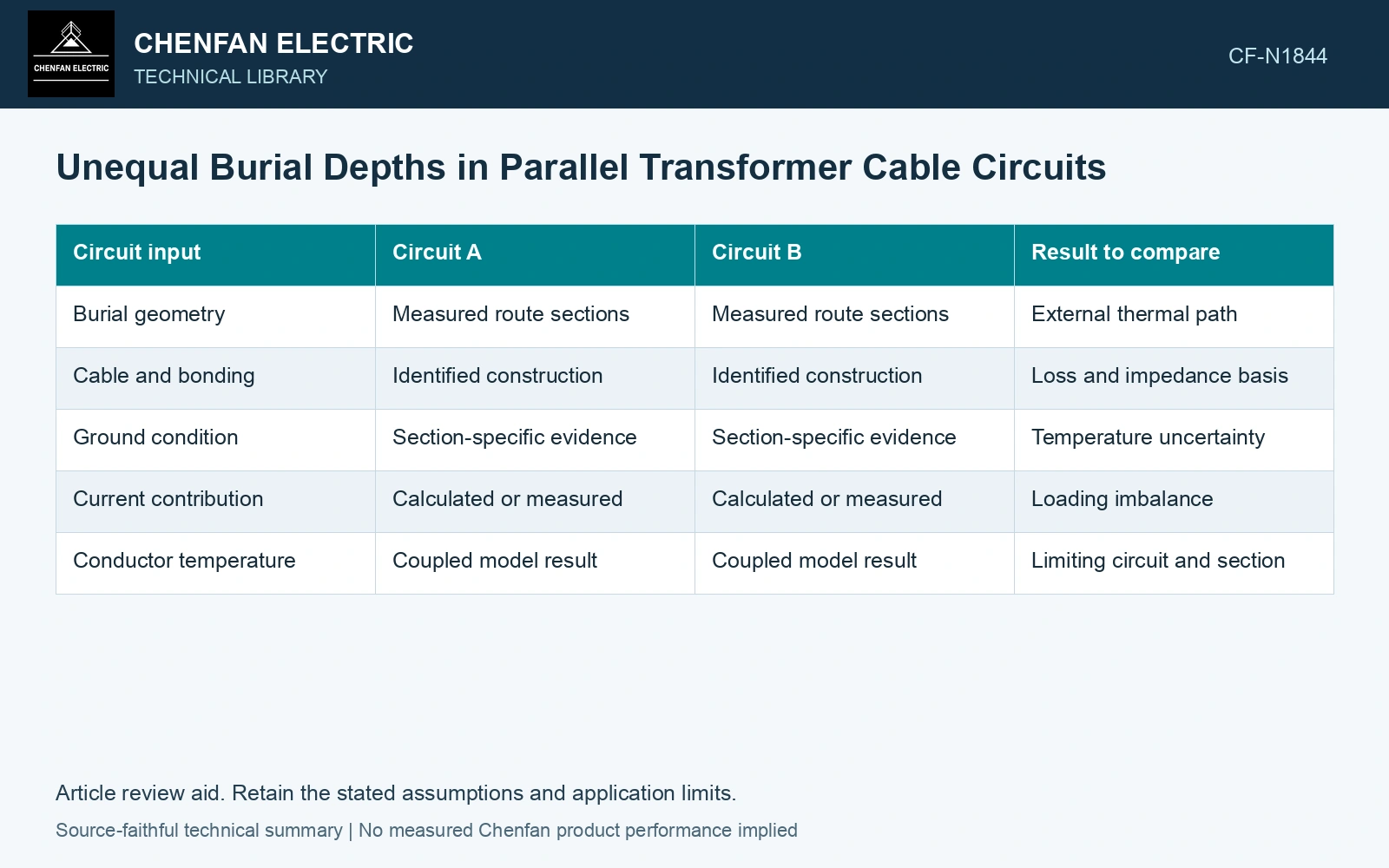
Survey depth, formation, spacing, route length and local changes for each circuit. Include bonding arrangements and joints in the electrical model where relevant. Include soil, backfill and neighboring heat sources in the thermal model. Preserve section identities so a deeper local passage is not spread over the entire route as an average depth.
| Circuit input | Circuit A | Circuit B | Result to compare |
|---|---|---|---|
| Burial geometry | Measured route sections | Measured route sections | External thermal path |
| Cable and bonding | Identified construction | Identified construction | Loss and impedance basis |
| Ground condition | Section-specific evidence | Section-specific evidence | Temperature uncertainty |
| Current contribution | Calculated or measured | Calculated or measured | Loading imbalance |
| Conductor temperature | Coupled model result | Coupled model result | Limiting circuit and section |
Couple the load and temperature questions
In a simplified pair of parallel equivalent branches with equal terminal voltage drop, currents divide according to branch admittances. Each branch impedance includes resistance and reactance. Resistance depends on conductor temperature, while temperature depends on current-generated losses and the environment. This creates an iterative relationship.
The simplification does not replace a full model of phase arrangement, induced metallic-layer currents or unequal connections. It shows why an assumed fifty-fifty split is an input to be justified, not a consequence of identical nameplates.
Depth also changes the thermal path to the ground surface. It may alter interaction with the other circuit and ambient conditions. There is no universal rule that the deeper circuit always has a fixed percentage less capacity; surrounding materials and source geometry still matter.
Inspect the intermediate results
A plausible total can hide an incorrect loss allocation. Likewise, a correct electrical split can be combined with an unsuitable thermal assumption. Check whether the thermal model includes the two circuits’ actual relative positions and loading rather than substituting a standard equal-depth formation.
Solve the electrical split with the resistance at each branch’s own calculated temperature. The heat-transfer relation then supplies the next temperature state until both the common voltage drop and thermal balance agree. [2][3]
Compare unequal branch heat removal
Assumptions per metre: two equal-length, purely resistive parallel branches share 400 A; each has r₂₀ = 0.0005 Ω/m and α = 0.004 K⁻¹. Ambient is 20 °C, external thermal resistances are 1.0 and 1.5 K·m/W, and internal/mutual heating are neglected. For branch k, solve θk = Θk Ik² rk and rk = r₂₀(1 + αθk), with IA + IB = 400 A and IA rA = IB rB. Iteration gives IA = 203.64 A, IB = 196.36 A, temperatures TA = 42.61 °C and TB = 52.70 °C, and a common drop of 0.1110 V/m. Against an assumed 50 °C conductor gate, B fails by 2.70 K despite carrying less current. Reject the total duty under this model and rework the deeper branch’s heat path or load. A qualified buried-cable model must add the omitted interactions. [1][2][3]
References
- IEC, IEC 60287-1-1:2023, Electric cables — Calculation of the current rating — Part 1-1: Current rating equations (100 % load factor) and calculation of losses — General.
- U.S. Department of Energy, DOE-HDBK-1012/2-92, Thermodynamics, Heat Transfer, and Fluid Flow, Volume 2, 1992.
- U.S. Department of Energy, DOE-HDBK-1011/3-92, Electrical Science, Volume 3, June 1992.