

An outsourced tank can arrive with certificates that cover the shop but leave individual seams unidentified. Traceability starts with the finished tank drawing and weld register. Every oil-retaining or specified structural weld needs its process and final evidence attached. [1]
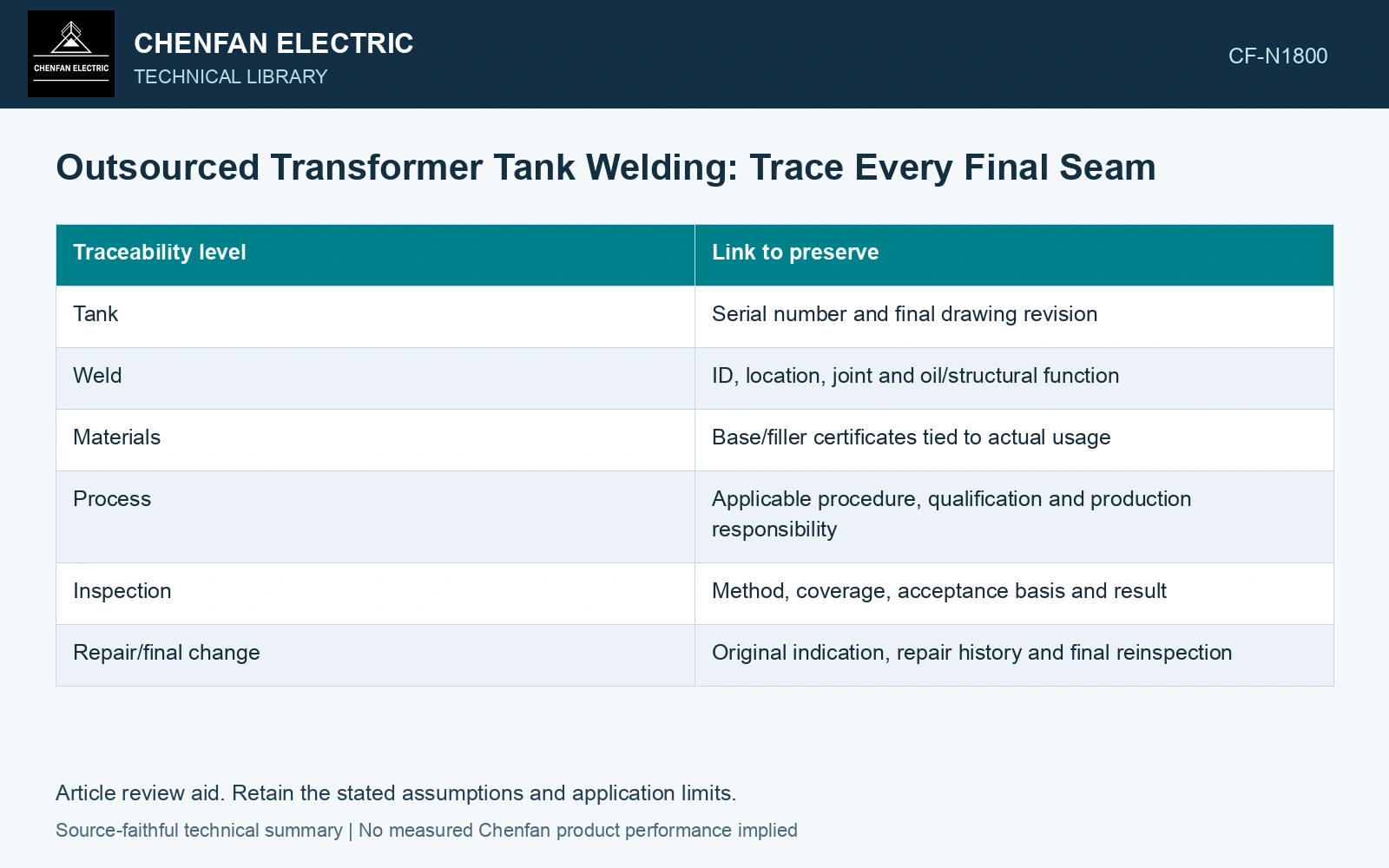
| Traceability level | Link to preserve |
|---|---|
| Tank | Serial number and final drawing revision |
| Weld | ID, location, joint and oil/structural function |
| Materials | Base/filler certificates tied to actual usage |
| Process | Applicable procedure, qualification and production responsibility |
| Inspection | Method, coverage, acceptance basis and result |
| Repair/final change | Original indication, repair history and final reinspection |
Look for seams added late
Brackets, nozzles or attachments added after an initial acceptance can create new welds or affect earlier regions. Update the register and the inspection scope. A delivered configuration should not rely on a report describing a partly completed tank.
Verify that the procedure covers the actual joint, material and thickness under the contract basis. A document number in a register is not proof of coverage unless its revision and scope are reconciled.
Choose NDT using material, weld thickness, welding process, quality requirements and demonstrated coverage. NDT acceptance levels are not a detailed one-to-one translation of weld quality levels. [2]
Audit coverage by finished seam length
Assume the final weld map contains 24 m of specified seams, but traceable final records cover 21 m. Coverage is 87.5%, leaving 3 m unresolved. Close those identified locations against procedure, operator and final examination evidence; a complete supplier certificate list cannot substitute for the missing seam links.
Keep the evidence readable at the weld level
NDT reports should identify examined lengths and limitations. Leak evidence should refer to the final oil-retaining boundary. If several repairs share a report, the location map must still identify which final result belongs to each seam.
References
- U.S. Federal Highway Administration, Bridge Welding Reference Manual, FHWA-HIF-19-088, 2019.
- ISO, ISO 17635:2025, Non-destructive testing of welds — General rules for metallic materials.