

Subtracting polarization and depolarization currents can help separate conduction from slower dielectric response. It works under defined assumptions, including a relaxed initial state, linear response and compatible time windows. Finite charging leaves a term that can be mistaken for conduction. [1]
Define current signs before subtracting
Consider an initially relaxed linear dielectric charged by a fixed DC step. After the fast capacitive switching transient, write polarization current as ipol(t) = Ic + g(t), where Ic is steady conduction and g(t) the decaying response to that step. Currents are amperes and time seconds.
After charging for tc and removing the voltage, signed depolarization current at elapsed time t is g(t + tc) − g(t). If its direction is opposite to charging, its magnitude is g(t) − g(t + tc). Subtracting that magnitude from ipol(t) leaves Ic + g(t + tc).
The remaining term is the diagnostic
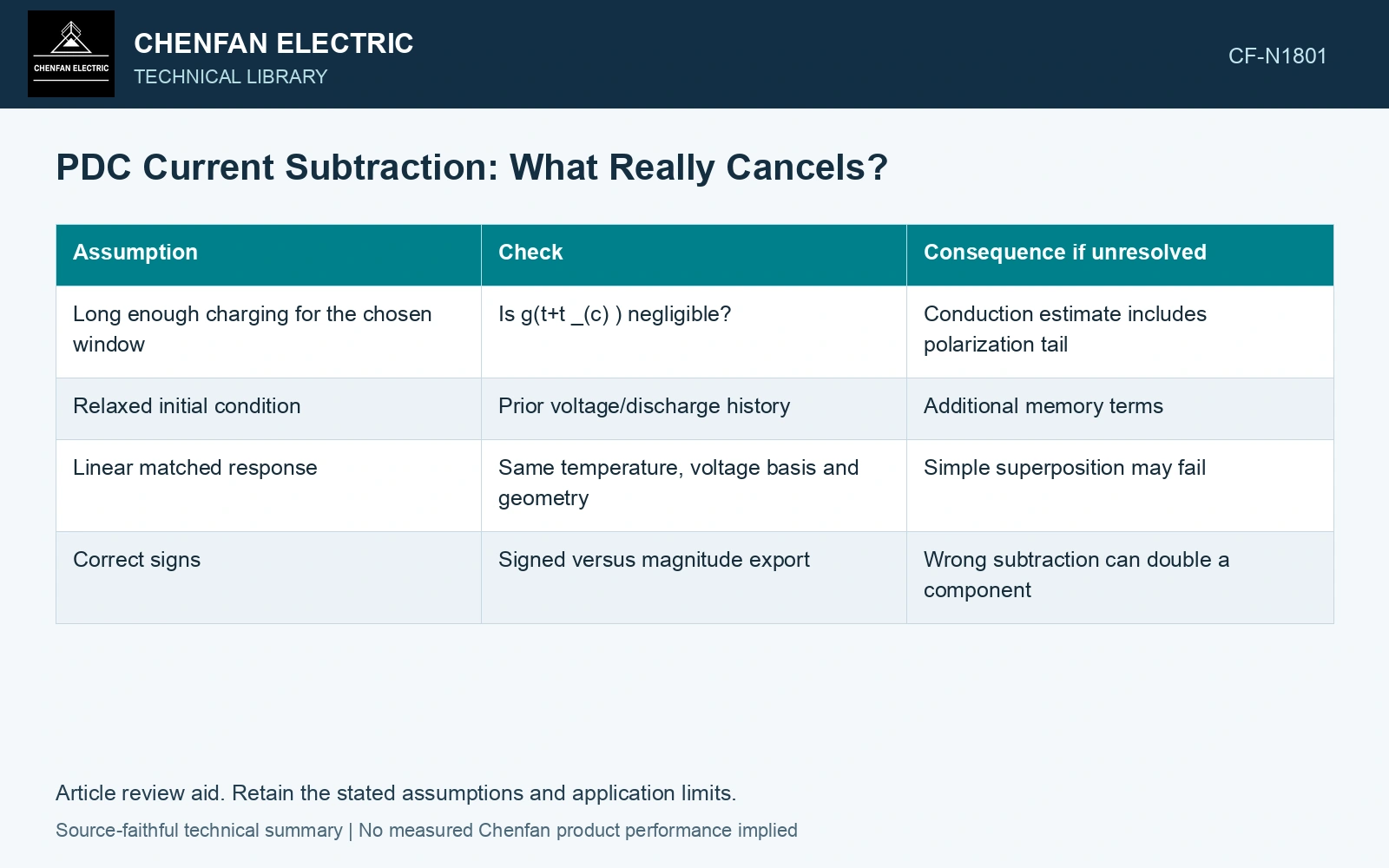
| Assumption | Check | Consequence if unresolved |
|---|---|---|
| Long enough charging for the chosen window | Is g(t+tc) negligible? | Conduction estimate includes polarization tail |
| Relaxed initial condition | Prior voltage/discharge history | Additional memory terms |
| Linear matched response | Same temperature, voltage basis and geometry | Simple superposition may fail |
| Correct signs | Signed versus magnitude export | Wrong subtraction can double a component |
The formula is an illustrative linear response relation, not an instrument-specific extraction procedure. Real oil-paper systems can have broad time scales and changing temperature.
The finite-charge factor in Raxsa and co-authors’ RC formulation preserves the incomplete polarization state. Keep that history in a subtraction-based conduction estimate instead of treating a fitted late tail as fully charged by default. [2]
Reproduce the finite-time subtraction term
Assume conduction is 2 pA and g(t)=100 exp(−t/100) pA. At t=50 s after a 100 s charge, subtracting depolarization magnitude from polarization current leaves 2 + 100 exp(−150/100) = 24.31 pA. The extra 22.31 pA is the finite-charge term, not conduction. Keep signed traces and charging time before deriving conductivity.
References
- IEEE, IEEE C57.161-2018, IEEE Guide for Dielectric Frequency Response Test.
- J. Raxsa, P. Nimsanong, T. Mai-Eiam and P. Yutthagowith, Determination of Dielectric Models Based on Effective Multi-Exponential Fittings, Energies 16, 4615, 2023. DOI: 10.3390/en16124615.