

Bonding a core packet may aim to reduce handling movement, preserve alignment or change structural response. Those are testable objectives. The comparison becomes weak when the bonded packet uses a different steel coil, geometry or restraint and every observed difference is attributed to the adhesive.
Write the intended benefit as one measurable question. For example, does the selected bonded construction retain its joint alignment after a defined handling sequence? Keep magnetic behavior as a separate required outcome. A trial can demonstrate an improvement in one function and a disadvantage in another.
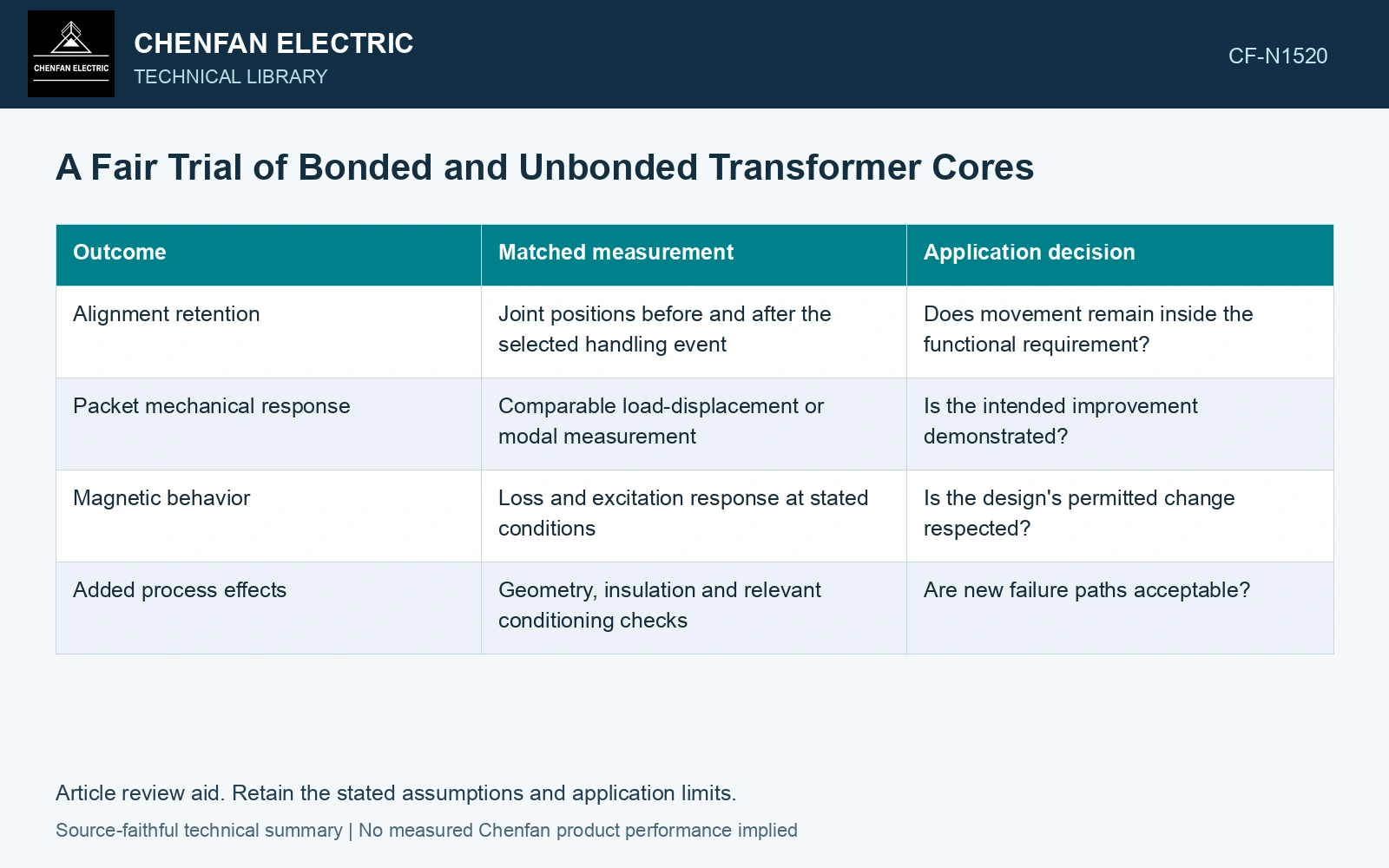
Match the factors that would otherwise explain the result
Use identified material from the same coil or a justified matched allocation. Record cutting, coating, sheet count, joint sequence and net steel area. Bonding may add a thermal cycle; the control needs an appropriate history if the purpose is to isolate adhesive restraint from thermal treatment.
Define the condition in which each specimen is measured: support, clamp load, temperature and elapsed time after assembly or release. If those conditions differ, the trial compares two assembly states as well as two bonding choices.
| Outcome | Matched measurement | Application decision |
|---|---|---|
| Alignment retention | Joint positions before and after the selected handling event | Does movement remain inside the functional requirement? |
| Packet mechanical response | Comparable load-displacement or modal measurement | Is the intended improvement demonstrated? |
| Magnetic behavior | Loss and excitation response at stated conditions | Is the design’s permitted change respected? |
| Added process effects | Geometry, insulation and relevant conditioning checks | Are new failure paths acceptable? |
Avoid compressing these results into one average score. An unacceptable insulation result cannot be compensated by a favorable handling measurement.
Design the trial to detect the relevant difference
Repeat specimens or measurements sufficiently to distinguish the desired effect from normal variation and measurement uncertainty. The required replication follows the difference being sought and the observed variability; there is no universal specimen count.
Randomize or otherwise control production and test order where drift could favor one group. Preserve actual traces and inspection coordinates. Averages without individual observations can hide a bonded construction that performs well most of the time but has a problematic local failure.
Explain a mixed result
If the bonded specimens move less but magnetic response changes, investigate net steel area, residual strain, joint geometry and thermal history. Do not automatically describe the difference as the cost of stiffness. The trial controls and retained observations should identify which explanation remains plausible.
If no magnetic change is resolved, state the test’s detection capability and conditions. That conclusion is narrower and more useful than saying bonding never affects loss. Likewise, a successful handling comparison applies to the event and construction tested.
Adoption should follow the combination of outcomes required by the application. The completed matrix can support adoption, a revised bond pattern, further material qualification or rejection of the approach. Its value lies in identifying the actual benefit and remaining cost of the proposed construction, using matched evidence rather than assuming that bonded cores are inherently quieter or more efficient.
Technical references
- voestalpine. Backlack: Lamination bonding.
- voestalpine. Backlack: Testing methods and production of test specimens.