

A yoke that can be physically opened is not necessarily a yoke that can be reused. Separation may peel the original insulating coating, bend laminations, leave residues or change the geometry that the joint relies on. The repair question is whether a qualified route can separate and restore the construction without leaving an unacceptable functional change.
Identify repairability at design stage where possible. A permanently bonded interface and a system intended for controlled separation create different obligations. Even an adhesive described as reversible does not establish that the coating beneath it survives the reversal process.
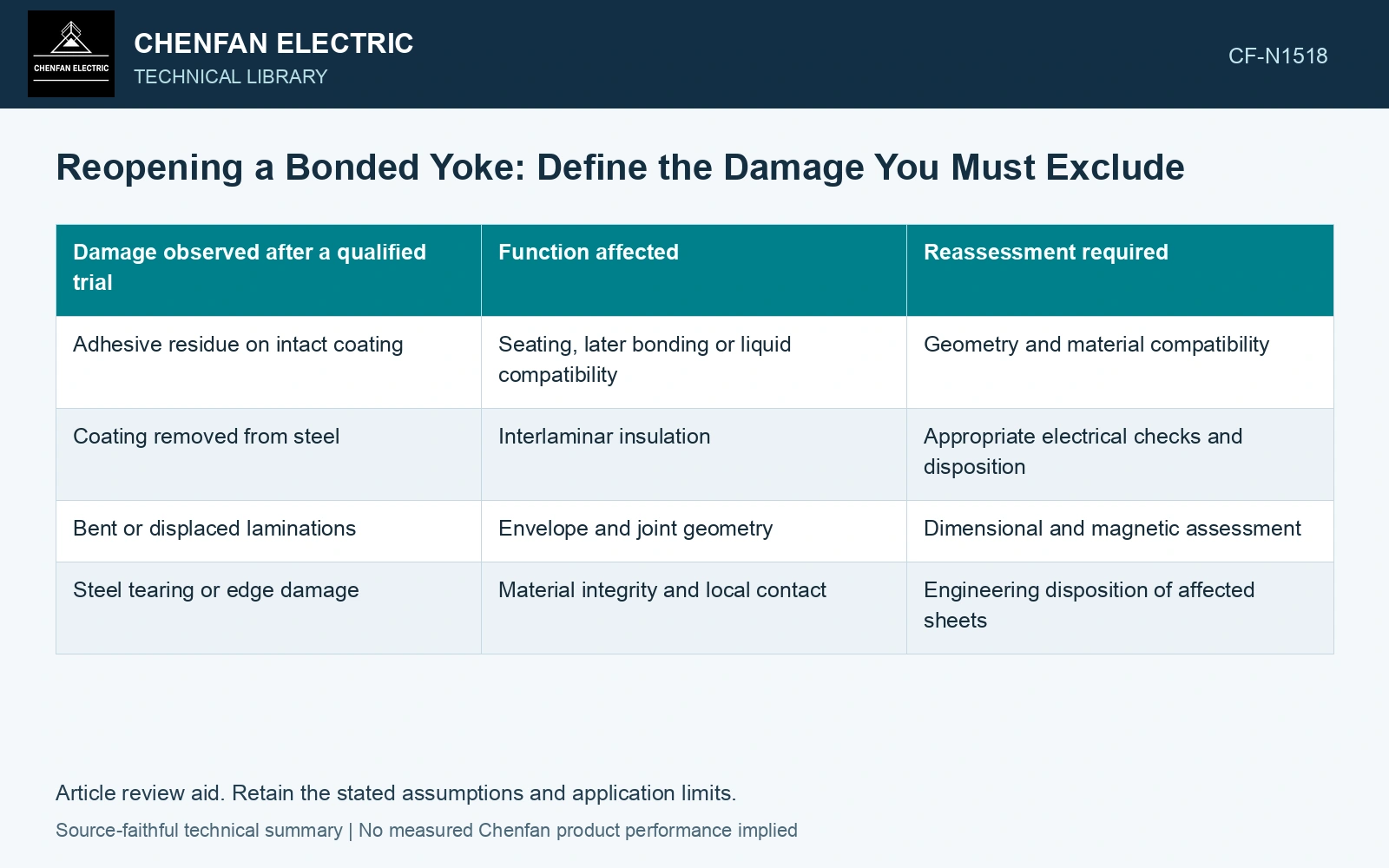
Define the permitted damage classes
Before a trial, agree how damage will be recognized and what consequence it has for reuse. Include steel deformation, condition of cut edges, coating loss, residue and changes in joint seating. Retain an unseparated reference from the same material system for comparison.
| Damage observed after a qualified trial | Function affected | Reassessment required |
|---|---|---|
| Adhesive residue on intact coating | Seating, later bonding or liquid compatibility | Geometry and material compatibility |
| Coating removed from steel | Interlaminar insulation | Appropriate electrical checks and disposition |
| Bent or displaced laminations | Envelope and joint geometry | Dimensional and magnetic assessment |
| Steel tearing or edge damage | Material integrity and local contact | Engineering disposition of affected sheets |
This hierarchy should not be read as a repair recipe. It identifies the evidence needed after the candidate route has been developed and qualified by responsible specialists.
Observe both sides during separation
Map where separation initiates and how it progresses. An interface may open cleanly over one region and transfer coating elsewhere. A successful endpoint photograph can hide the damaging stage of the process.
Record actual process history and fixture loading without extrapolating it to an untested material system. If the proposed method involves heat or chemicals, compatibility and operational controls require their own qualified procedure. Improvised temperature or solvent recommendations are particularly unreliable when the coating and adhesive identities are unknown.
Rebuild the original functions
After separation, inspect individual sheet identity, sequence and geometry before reassembly. Residue removal or replacement coatings may change thickness, surface electrical behavior and joint movement. These changes need evaluation rather than an assumption that the original drawing still describes the rebuilt packet.
Electrical checks should address the actual insulation interfaces that were affected. A core-to-ground test does not by itself establish interlaminar isolation. Magnetic comparisons should use stated excitation and equivalent restraint, with the original or an appropriate matched reference where available.
Document what could not be reconstructed. If original material condition, joint sequence or baseline magnetic evidence is absent, the reuse decision must reflect that uncertainty. A visually restored yoke may still differ in functions that the separation process altered.
For a new bonded design, demonstrate the separation route and the damage it can leave, then define the requalification checks. If intact reopening cannot be established, place the replacement boundary in the repair plan before committing to the bonded construction.
Technical references
- voestalpine. Backlack: Lamination bonding.
- voestalpine. Backlack: Testing methods and production of test specimens.