

Leaving adhesive off the nominal location of a cooling duct does not prove that the finished passage remains clear. Adhesive can move during pressing and curing. A local protrusion may narrow an inlet, bridge a slot or occupy a region that was clear before the packet was closed.
Selective bonding must therefore control both the applied pattern and the cured result. The design also needs sufficient support beside the unbonded passage. Increasing the exclusion area without checking that support can replace an obstruction problem with a local movement problem.
Draw the protected volume
Mark the actual passage, its entrances and exits, and surfaces whose position defines the intended opening. Add the inspection locations available before and after closure. An exclusion line drawn only on one face can overlook adhesive migrating from an adjacent bonded interface.
Use the actual assembly orientation and restraint. The location where adhesive is applied may be accessible, while the location where it finally accumulates may be hidden. A representative process trial should preserve this geometry rather than substitute a flat coupon that has no equivalent passage boundary.
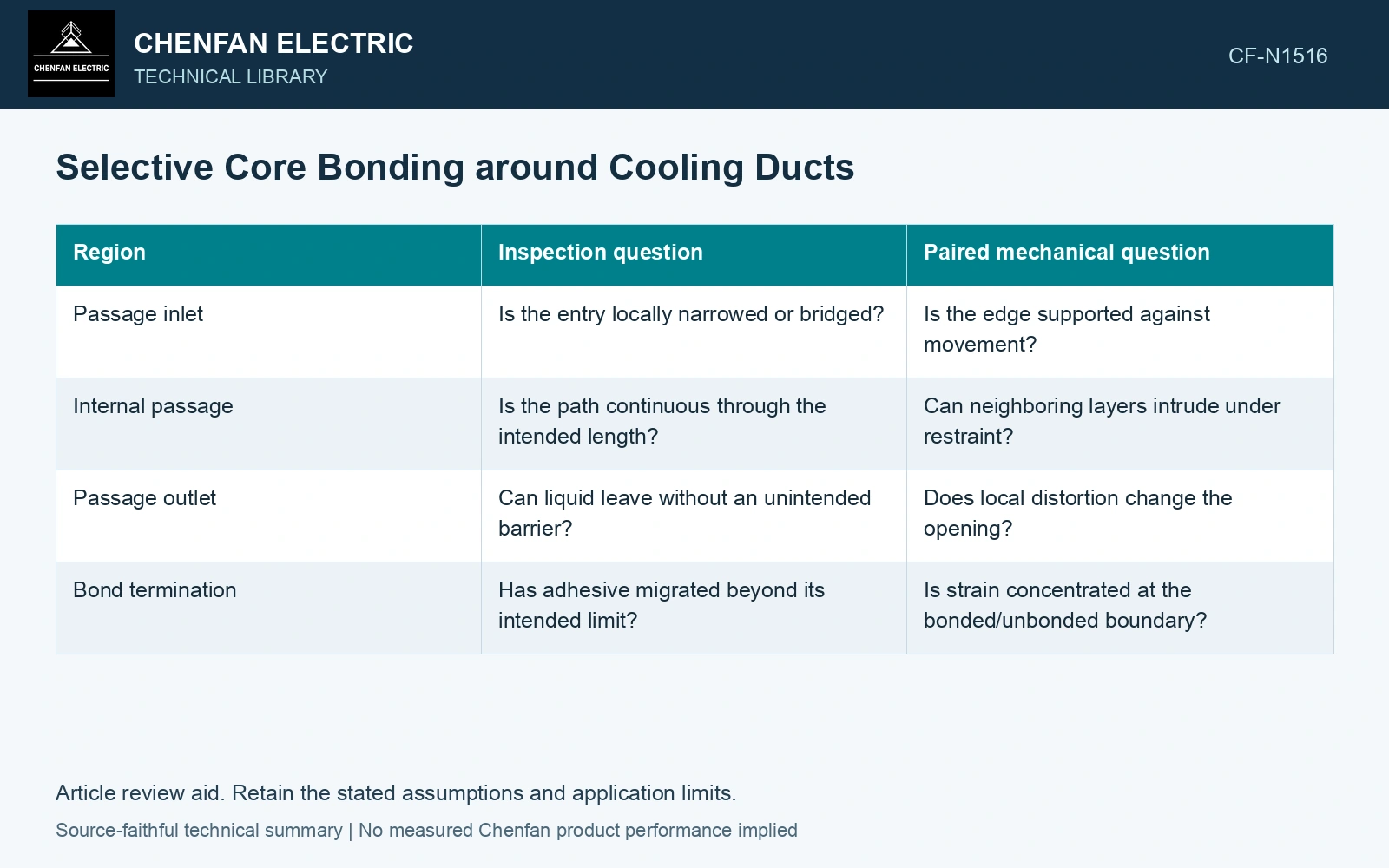
| Region | Inspection question | Paired mechanical question |
|---|---|---|
| Passage inlet | Is the entry locally narrowed or bridged? | Is the edge supported against movement? |
| Internal passage | Is the path continuous through the intended length? | Can neighboring layers intrude under restraint? |
| Passage outlet | Can liquid leave without an unintended barrier? | Does local distortion change the opening? |
| Bond termination | Has adhesive migrated beyond its intended limit? | Is strain concentrated at the bonded/unbonded boundary? |
A visible opening at both ends does not establish internal continuity. Select a justified inspection or controlled passage check capable of resolving the concealed region.
Compare applied and cured patterns
Record the adhesive application map and the final distribution on retained representative specimens. This comparison identifies where pressure, local contact or the process history moves material into a protected zone. Capture specimens from relevant positions and process states rather than examining only an ideal demonstration piece.
Where a measurement cannot reach the interior, use a representative section or another verified method to qualify the process and state the sampling limitation. Avoid claiming every production passage is clear solely because one edge photograph looks clean.
Verify continuity and performance separately
A passage-connectivity check answers whether a path exists under the tested configuration. It does not establish the intended flow distribution or heat removal. Those need the actual liquid, pressure conditions, temperature-dependent properties and wider cooling arrangement where they matter to the design.
Measure geometry under the restraint in which the passage will function. If the unbonded region closes or shifts after assembly loading, the free-state inspection describes the wrong boundary condition. Repeat the relevant support check after the qualified thermal or handling history.
The acceptance drawing should combine protected passage dimensions, accessible inspection points and bond-boundary locations. The design decision then rests on two demonstrated facts: the cooling path retains its required geometry, and the selectively bonded packet remains stable around it. Neither fact can be inferred from the coverage percentage of adhesive.
Technical references
- voestalpine. Backlack: Lamination bonding.
- voestalpine. Backlack: Testing methods and production of test specimens.