

A release film can simplify separation from tooling while leaving a transfer question on the material it touched. The important starting point is the contact map: which lamination face, packet edge or subsequent bonding surface contacted the release material, for how long, and under what process conditions?
Without that map, a laboratory may analyze a clean face and conclude that no residue transferred. It may also detect material on a surface that never participates in the functional joint and overstate its significance. Sampling location must follow the actual process path.
Preserve contact identity
Mark specimens before processing so that release-contact and noncontact surfaces remain identifiable. Include a matched control processed with the same heat and pressure but without the candidate release contact where that comparison is physically possible. Keep packaging and handling materials from introducing new contamination before analysis.
Document whether the film touches bare steel, original coating, cured adhesive or a surface that will later receive adhesive. These are different interfaces. A residue that affects a later bond may have little observable effect on the first bonded joint.
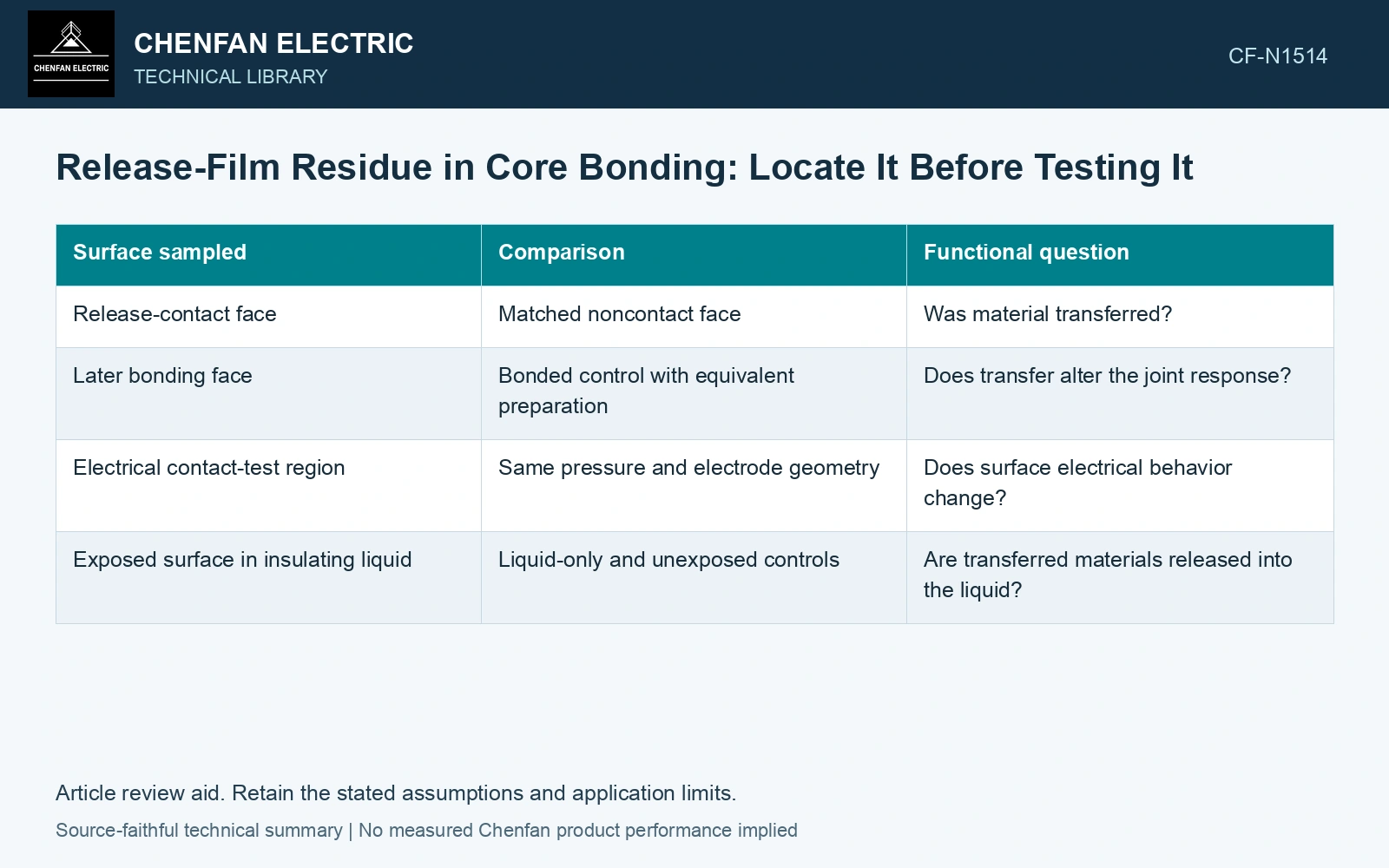
| Surface sampled | Comparison | Functional question |
|---|---|---|
| Release-contact face | Matched noncontact face | Was material transferred? |
| Later bonding face | Bonded control with equivalent preparation | Does transfer alter the joint response? |
| Electrical contact-test region | Same pressure and electrode geometry | Does surface electrical behavior change? |
| Exposed surface in insulating liquid | Liquid-only and unexposed controls | Are transferred materials released into the liquid? |
The matrix avoids treating chemical detection as the sole acceptance criterion. Presence, amount and functional consequence are separate observations.
Avoid a test that removes the evidence
A preparation step performed before surface analysis can wash away, redistribute or modify residue. Preserve an as-processed specimen first. If a cleaning step is proposed, test it as a separate branch with its own coating and compatibility checks. Do not assume that removing a visible film preserves the original lamination insulation.
Surface analysis should state its sampled area and depth or sensitivity. A negative result applies to that method and location. It does not prove that every interface is free from a transferred material. Localized patches may require several mapped observations.
Compare functions individually
Mechanical comparisons should retain the appropriate peel or sliding mode and identify the fracture plane. Electrical comparisons need consistent contact conditions. Liquid-exposure work needs the specified liquid and controlled material-to-liquid ratio. The same residue finding can lead to different dispositions depending on which function is affected.
If a bond change appears only after release contact, repeat the comparison with controlled material lots and handling. That strengthens attribution without claiming a mechanism that the analysis has not established. If no functional change is detected, record the demonstrated exposure and measurement coverage rather than issuing an unrestricted compatibility claim.
The final sampling drawing should show release contact, specimen orientation and the downstream function of every sampled face. That drawing often does more to resolve a residue investigation than collecting a larger chemical report from an unidentified surface.
Technical references
- voestalpine. Backlack: Lamination bonding.
- voestalpine. Backlack: Testing methods and production of test specimens.