


Transformer Core Engineering Notes · CF-N281
A transformer foundation must support the applicable load cases and transfer them through the actual support arrangement. Total operating mass is an important input, but it does not define individual reactions, lateral actions or temporary installation loads. The OEM should supply a coordinated load package for the civil designer rather than a single weight on a general arrangement drawing.
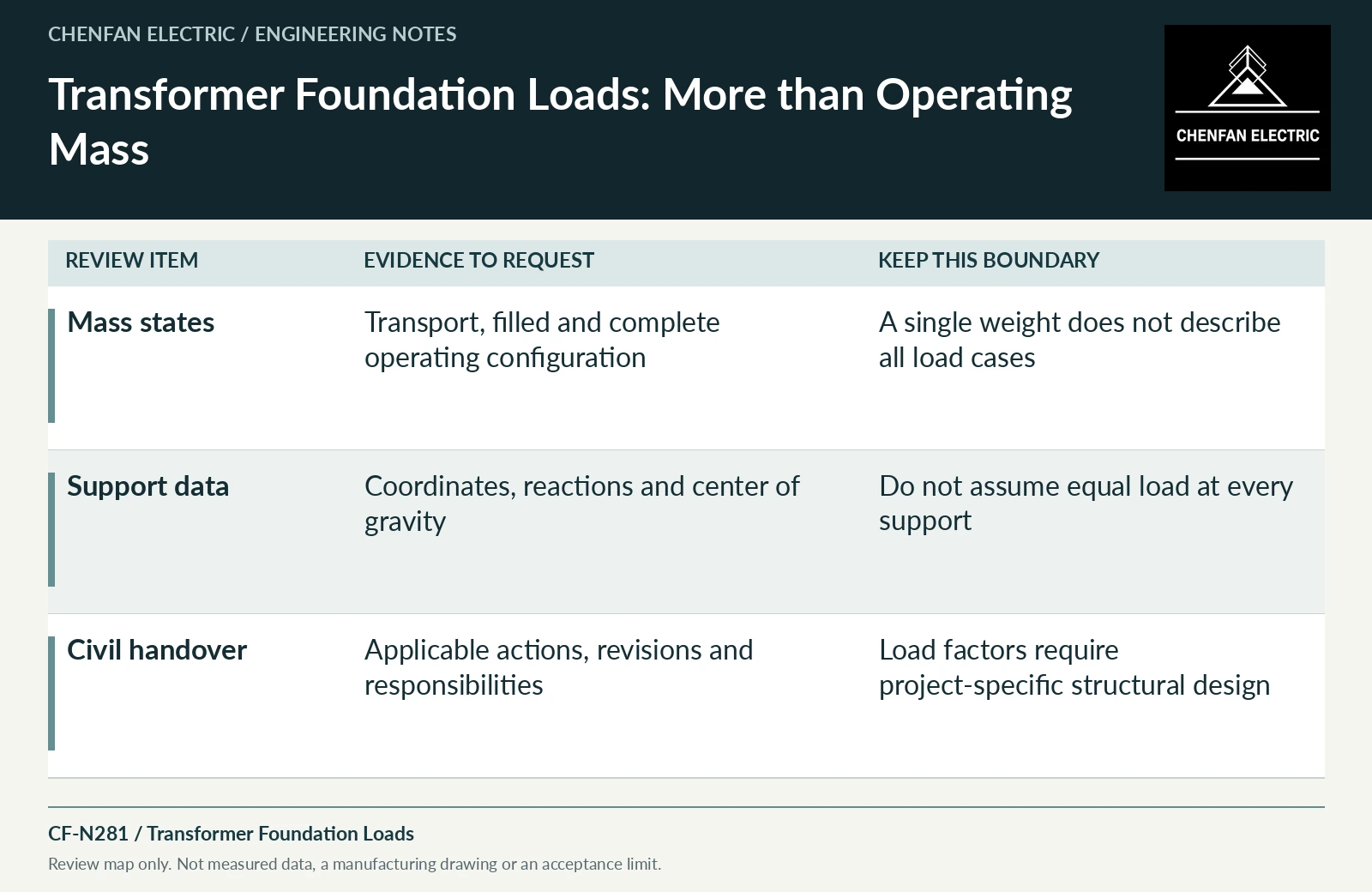
Identify the configuration behind each mass
Distinguish transport, installed-empty, liquid-filled and complete operating states where relevant. Radiators, bushings and other items may be shipped separately and added later. Record the associated center of gravity and support arrangement for the state used in the foundation assessment. A transport mass cannot silently substitute for the final operating mass, and an operating mass alone does not describe the temporary installation sequence.
Provide support reactions and geometry
The civil designer needs the positions and relevant reactions at rails, wheels, pads or other supports. Equal division of total weight is not automatically valid when geometry or loading is asymmetric. State the drawing coordinates, reference levels and any tolerances that matter to load transfer. Keep the reaction data consistent with the OEM’s structural model and the actual installation details.
Separate permanent and exceptional actions
Wind, seismic action, conductor loads and other project-specific forces may require consideration by the responsible designers. Temporary jacking, skidding or lifting operations can impose a different pattern of reactions from normal service. The applicable load combinations and factors belong to the qualified civil and structural design, not to a generic transformer article. Ask for the equipment data needed to perform that design without inventing universal multipliers.
Control changes before concrete is committed
A revised radiator arrangement, liquid volume or base design can change mass distribution and interfaces after the first drawing issue. Establish a revision freeze and a change-notification route between OEM, civil designer and installer. The final foundation package should distinguish confirmed values from preliminary estimates. Recheck anchorage, rail positions and access together so a late equipment revision is not assessed only for overall footprint.
| Review item | Evidence to request | Boundary to preserve |
|---|---|---|
| Mass states | Transport, filled and complete operating configuration | A single weight does not describe all load cases |
| Support data | Coordinates, reactions and center of gravity | Do not assume equal load at every support |
| Civil handover | Applicable actions, revisions and responsibilities | Load factors require project-specific structural design |
References and scope
- IEC 60076-1:2011 — Power transformers: GeneralPublic standard abstract · General transformer scope, interfaces and controlled equipment specification.
- Dry-Type Transformers 1000 Volts and Below — Instruction Bulletin 43006-850-01Manual listing / metadata only · Example of why handling and installation instructions must match the actual product and voltage range.