


Transformer Core Engineering Notes · CF-N282
The center of gravity belongs to a defined physical configuration. Removing liquid, shipping radiators separately or installing accessories later can change that configuration and its balance. Transport and lifting documents should therefore identify the applicable delivery state instead of reusing one unqualified center-of-gravity mark across every stage of the project.
Define the included components
List whether the mass and center-of-gravity data include liquid, radiators, bushings, conservator, packaging and transport fixtures as applicable. Use the actual shipment configuration, not a catalogue illustration. A state described only as “transformer” is ambiguous when major items are handled separately. The document should allow the logistics engineer to identify exactly which assembly the stated coordinates describe.
Use a clear coordinate system
State the origin, axes, units and reference surfaces used for the center-of-gravity coordinates. A dimension measured from the tank edge cannot be compared directly with one measured from a transport frame without conversion. Keep the coordinate convention consistent across drawings. Where a value is preliminary or calculated rather than confirmed, identify that status and the process for issuing final handling data.
Connect balance to the approved handling plan
The handling engineer must evaluate the center of gravity together with lifting points, support locations and the equipment used. Knowing the center of gravity does not establish the capacity of a lifting lug or justify a rigging arrangement. This article supplies no sling-angle rule or load-sharing assumption. The plan must use configuration-specific OEM data and qualified engineering for the actual operation.
Reissue data after configuration changes
Removing transport braces, adding a cooler bank or changing the liquid condition can invalidate an earlier handling state. Establish a check before each materially different operation. The shipment packing list, drawing and handling instruction should agree on the included items. A prominent center-of-gravity symbol is helpful only when its associated state and revision are still correct.
| Review item | Evidence to request | Boundary to preserve |
|---|---|---|
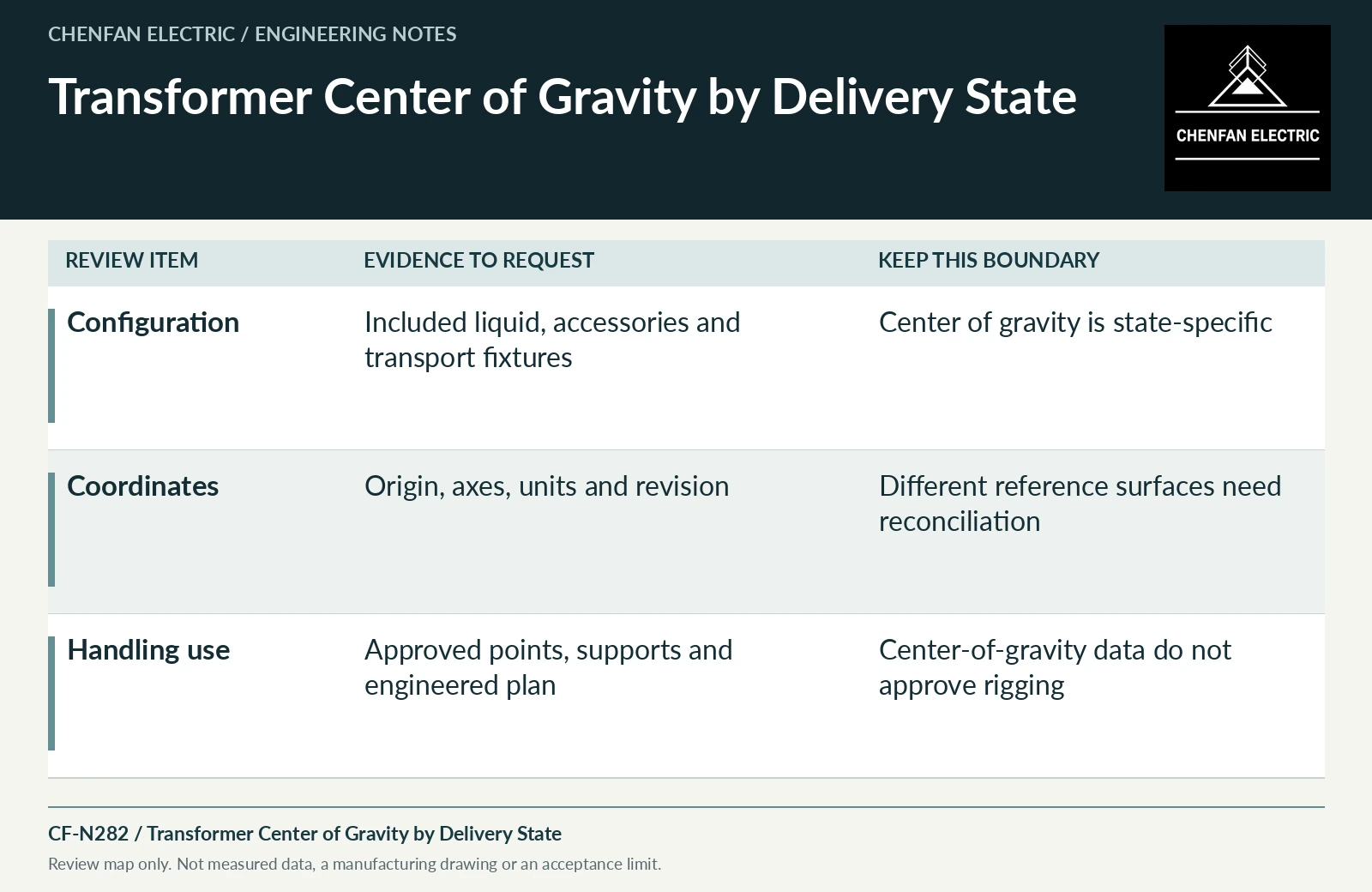
| Configuration | Included liquid, accessories and transport fixtures | Center of gravity is state-specific |
| Coordinates | Origin, axes, units and revision | Different reference surfaces need reconciliation |
| Handling use | Approved points, supports and engineered plan | Center-of-gravity data do not approve rigging |
References and scope
- IEC 60076-1:2011 — Power transformers: GeneralPublic standard abstract · General transformer scope, interfaces and controlled equipment specification.
- Dry-Type Transformers 1000 Volts and Below — Instruction Bulletin 43006-850-01Manual listing / metadata only · Example of why handling and installation instructions must match the actual product and voltage range.