

Transformer Core Engineering Notes · CF-N263
A dry-type transformer’s fire-behavior classification describes performance under a defined assessment framework. It is not a declaration that the transformer cannot burn or that the installation needs no fire planning. Review the classification evidence, the complete equipment arrangement and the site’s separate fire-safety obligations without turning one product label into a blanket safety claim.
Define exactly what was assessed
Ask for the standard edition, classification, tested configuration and report identity. Determine whether the evidence concerns a representative assembly and how its applicability to the supplied design is justified. A material flame test and a transformer fire-behavior assessment are not interchangeable. Avoid repeating unexplained class labels as proof of the behavior of every resin, cable, enclosure accessory and installed arrangement.
Keep the claims within the test scope
Use the exact supported classification rather than phrases such as fireproof, zero fire risk or universally self-extinguishing. Explain whether a claimed result covers the complete offered insulation system. IEC 60076-11 discusses limitations related to climatic, environmental and fire-behavior classes in its public scope. Detailed acceptance requirements must still be checked against the applicable full text and project specification.
Assess the surrounding installation separately
Room construction, adjacent combustible materials, cables, ventilation and access can affect the consequences of an equipment incident. These are installation questions as well as product questions. The responsible fire and electrical designers should determine the applicable local requirements. This article gives no universal separation distance or exemption from containment, detection or suppression measures; those decisions depend on the jurisdiction and site design.
Control substitutions after acceptance
A different insulation formulation, enclosure lining or cable accessory can alter the evidence basis. Record substitutions and have the OEM assess whether the original classification remains applicable. Keep declarations, reports and the delivered bill of materials aligned. A buyer should be able to identify which fire-behavior claim is supported for the supplied transformer without assuming that an earlier report automatically covers every later modification.
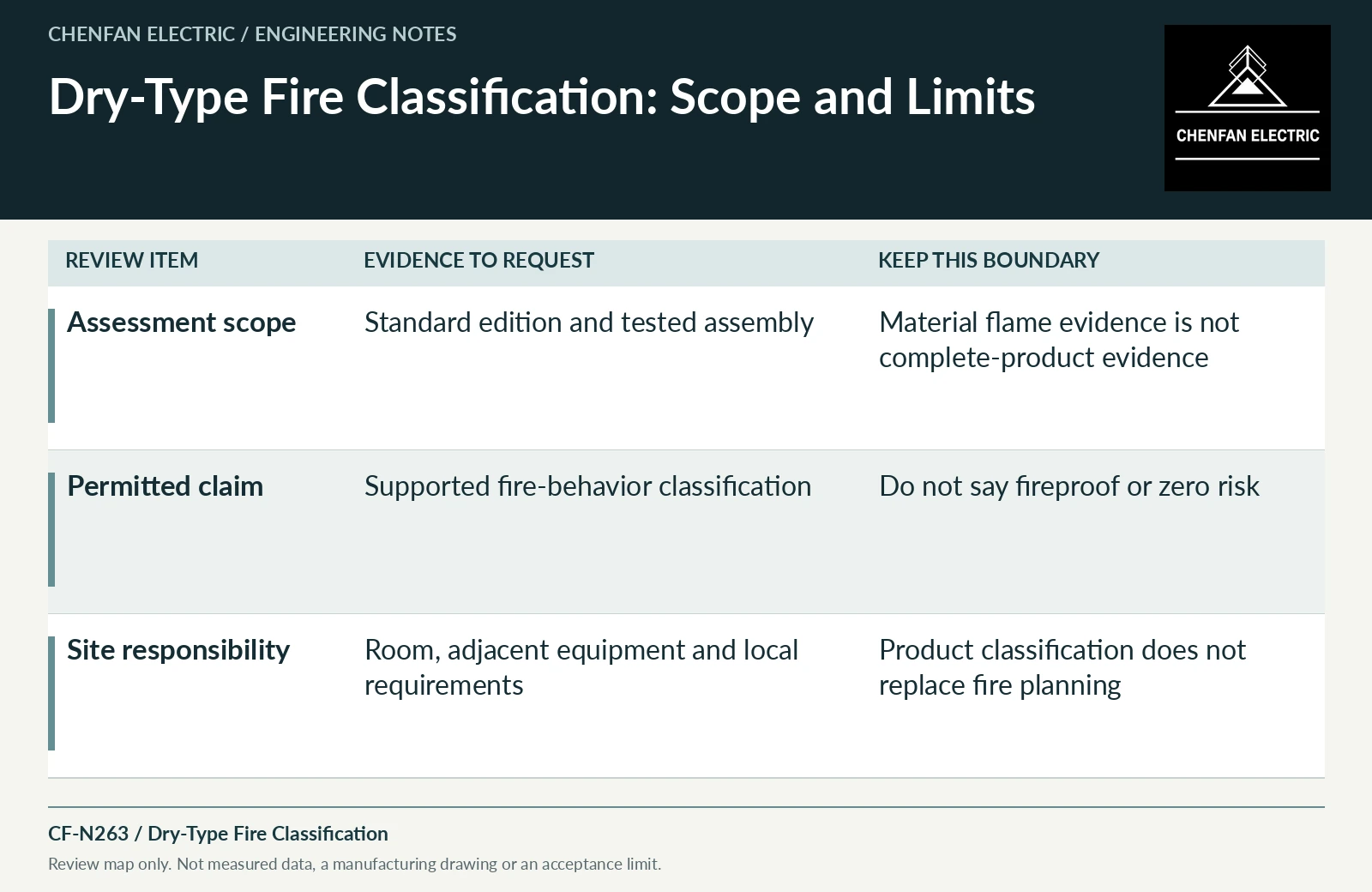
| Review item | Evidence to request | Boundary to preserve |
|---|---|---|
| Assessment scope | Standard edition and tested assembly | Material flame evidence is not complete-product evidence |
| Permitted claim | Supported fire-behavior classification | Do not say fireproof or zero risk |
| Site responsibility | Room, adjacent equipment and local requirements | Product classification does not replace fire planning |
References and scope
- IEC 60076-11:2018 — Dry-type transformersPublic standard abstract · Dry-type requirements and classification within the standard’s voltage/product scope; not a blanket reference for every LV product.
- Transformer Fire Protection (FIST 3-32), redacted releaseHistorical technical manual · Fire protection and installation interfaces; local authority and project requirements remain separate.