

Transformer Core Engineering Notes · CF-N262
An environmental classification is meaningful only with the referenced standard, edition, test scope and product configuration. A bare letter-and-number label does not show that a dry-type transformer is suitable for every dusty, humid or outdoor location. Start with the actual service conditions, then examine the evidence supporting the offered classification.
Translate the site description into conditions
Identify condensation exposure, airborne contamination, ventilation, storage conditions and the expected operating environment. Distinguish a conditioned electrical room from a partially completed building or a sheltered outdoor installation. The word “indoor” does not guarantee clean, dry air. Record exceptional conditions explicitly so suppliers can explain whether their evidence covers them or whether additional protection and qualification are required.
Read the actual certificate or test report
Request the tested product identification, applicable classification and referenced method. Check whether the evidence applies to the offered winding system and construction or relies on an explained design-family extension. A marketing brochure is not the same as a traceable report. Do not invent the meaning of a class from its number, and do not assume that a label from an older edition is identical to one under a different edition.
Separate enclosure protection from transformer class
An IP rating describes a defined enclosure-protection classification. It does not replace environmental qualification of the transformer or establish the internal thermal condition. Cable entries, ventilation openings and installation changes must preserve the enclosure arrangement being claimed. Assess the transformer and enclosure together, while keeping their respective evidence separate enough to identify what each document actually proves.
Carry conditions into installation and maintenance
The accepted service basis should appear in storage instructions, installation requirements and the owner’s maintenance plan. A transformer qualified for one environment can be exposed to a different one during construction. Define how departures are reported and assessed before energization. The final acceptance should connect the class claim to the as-installed equipment and actual site, rather than simply checking that the expected label appears on a data sheet.
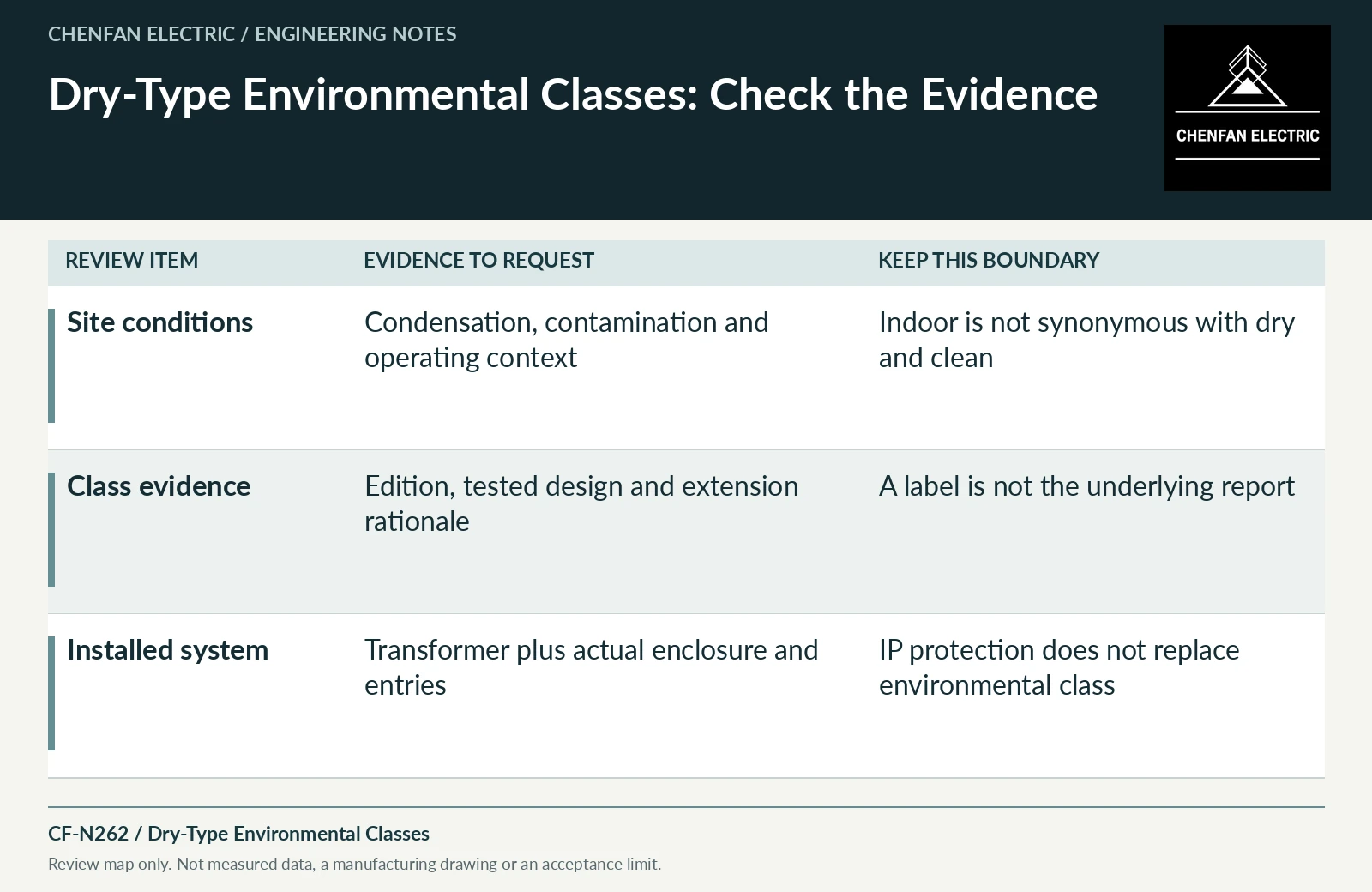
| Review item | Evidence to request | Boundary to preserve |
|---|---|---|
| Site conditions | Condensation, contamination and operating context | Indoor is not synonymous with dry and clean |
| Class evidence | Edition, tested design and extension rationale | A label is not the underlying report |
| Installed system | Transformer plus actual enclosure and entries | IP protection does not replace environmental class |
References and scope
- IEC 60076-11:2018 — Dry-type transformersPublic standard abstract · Dry-type requirements and classification within the standard’s voltage/product scope; not a blanket reference for every LV product.
- IEC 60529:1989+AMD1:1999+AMD2:2013 CSV — Degrees of protection provided by enclosuresPublic standard abstract · Enclosure ingress-protection classification; it does not establish transformer thermal capacity.