


Transformer Core Engineering Notes · CF-N265
Adding fans changes the cooling arrangement, but the resulting transformer capacity must be specified and supported. Terms such as assisted capacity, forced-air rating or overload capability can describe different obligations. A purchase order should identify the declared ratings, required equipment, service conditions and permitted duration instead of relying on an unexplained fan-uplift percentage.
Separate declared rating from temporary duty
A declared forced-air rating is not automatically a short-time overload, and a time-limited loading allowance is not continuous capacity. Ask the OEM which applies and request matching evidence under the dry-type framework of IEC 60076-11 and the loading scope of IEC 60076-12. Nameplate, data sheet and controls must agree for each cooling state. A liquid-immersed temperature-monitoring guide does not establish the dry-type fan-assisted rating.
Identify what must run for each rating
List the required fan groups, their supplies and control conditions. Consider whether a single failed supply or controller removes all forced cooling. A remaining fan count does not necessarily translate proportionally into remaining capacity because airflow distribution matters. Define the accepted duty following each relevant failure, rather than expecting an operator to calculate a new rating from the fraction of motors still running.
Check the components exposed to higher current
A higher transformer load affects terminals, leads, connections and associated equipment as well as winding temperature. The complete current path and protection coordination need review. Do not upgrade the external circuit simply by changing a cooling label, or assume the transformer is the only limiting component. The installed enclosure and room ventilation must also remove the heat associated with the proposed operating state.
Include controls and maintenance in acceptance
Verify the agreed fan-start logic, feedback, alarms and failure response through approved tests. Record the final settings and any maintenance assumptions that support the rating. Fans that exist on the bill of materials but cannot reliably establish the required airflow do not support the promised duty. The owner should receive an operating table that distinguishes natural cooling, forced cooling and unavailable-cooling conditions clearly.
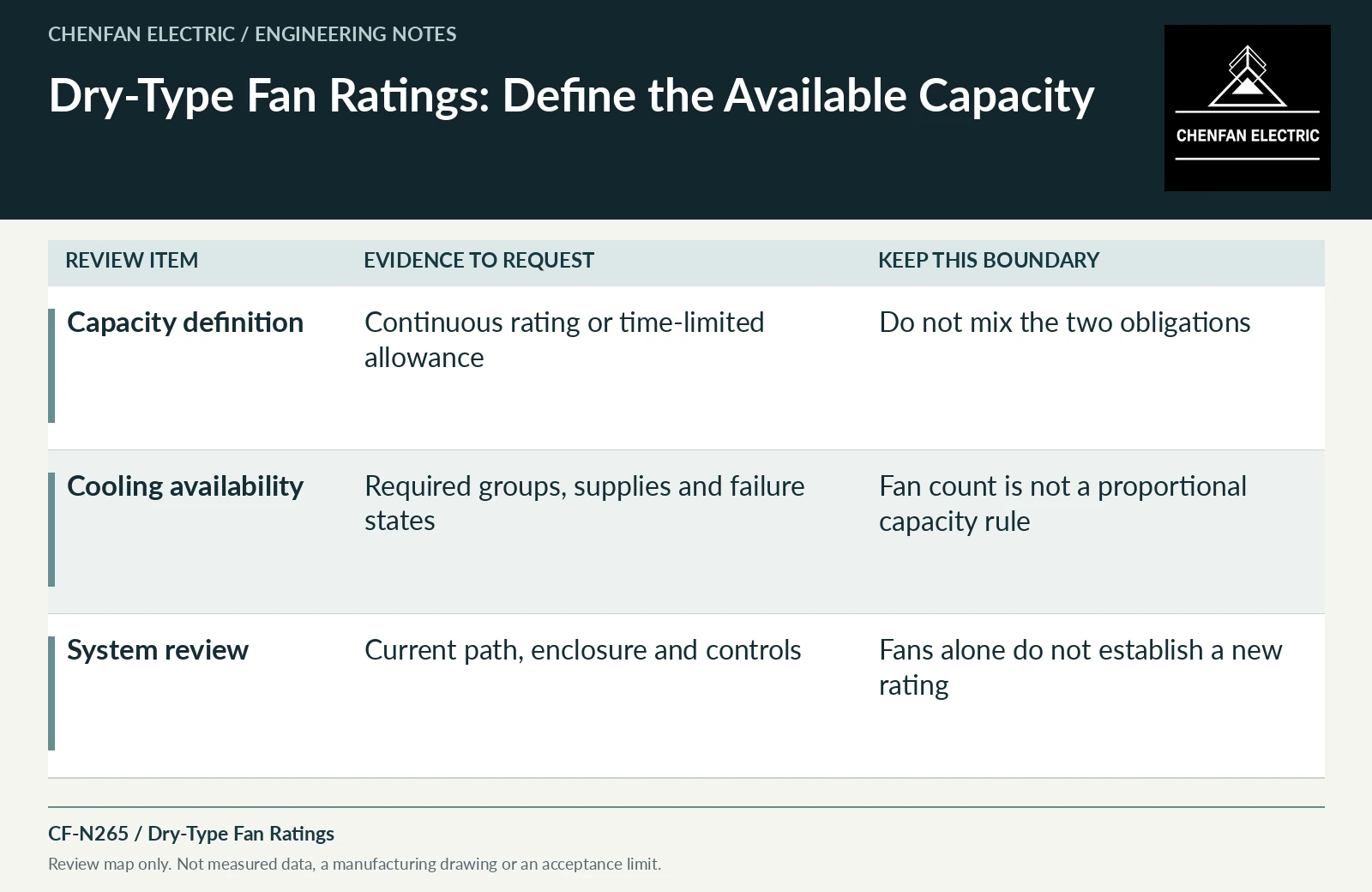
| Review item | Evidence to request | Boundary to preserve |
|---|---|---|
| Capacity definition | Continuous rating or time-limited allowance | Do not mix the two obligations |
| Cooling availability | Required groups, supplies and failure states | Fan count is not a proportional capacity rule |
| System review | Current path, enclosure and controls | Fans alone do not establish a new rating |
References and scope
- IEC 60076-11:2018 — Dry-type transformersPublic standard abstract · Dry-type requirements and classification within the standard’s voltage/product scope; not a blanket reference for every LV product.
- IEC 60076-12:2008 — Loading guide for dry-type power transformersPublic standard abstract · Dry-type transformer loading, temperature and ageing scope; not a liquid-immersed loading guide.
- IEC 60076-1:2011 — Power transformers: GeneralPublic standard abstract · General transformer scope, interfaces and controlled equipment specification.