

Transformer Core Engineering Notes · CF-N219
Changing insulating liquid requires more than checking the liquid’s own dielectric strength. Paper, pressboard, coatings, adhesives and sealing materials remain in contact with it throughout service. Their combined electrical, thermal and mechanical behaviour must be suitable for the intended conditions. “Compatible with ester” is too broad unless the actual liquid and material grades are identified.
Build a material-contact inventory
List the solid insulation, winding coatings, internal paint, adhesives and elastomers exposed to the selected fluid. Include small components that may be absent from the main bill of materials, such as joint treatments or sensor encapsulation. Ask the material and liquid suppliers which combinations have supporting evidence. A certificate for one pressboard grade does not establish compatibility for every adhesive, seal or coating used elsewhere in the transformer.
Define what compatibility means in the project
A compatibility assessment may need to consider dimensional stability, mechanical retention, liquid contamination and electrical properties after exposure. The relevant temperature, time and oxygen conditions should represent the intended use rather than an arbitrary short soak. Separate material screening from complete insulation-system qualification. An acceptable laboratory result for one property does not prove unchanged ageing behaviour or a higher operating temperature for the finished transformer.
Revisit processing as well as service
Liquid viscosity and wetting behaviour affect the assumptions used for impregnation and processing. Confirm that the manufacturing procedure is approved for the selected material-liquid system and tank capability. Do not transfer a mineral-oil filling schedule to another liquid without review. Dryness, gas removal and handling controls remain important even when a fluid can dissolve more water. Greater water solubility in the liquid is not permission to accept wet solid insulation.
Make substitutions traceable
The approved combination should identify product grades and the evidence used, not only generic material families. A later change of varnish, adhesive or seal supplier may require a focused compatibility review even if the winding drawing is unchanged. In a retrofill project, document remaining original materials and residual liquid. The transformer OEM must decide whether existing qualification remains applicable; the new fluid’s product brochure cannot make that decision on its own.
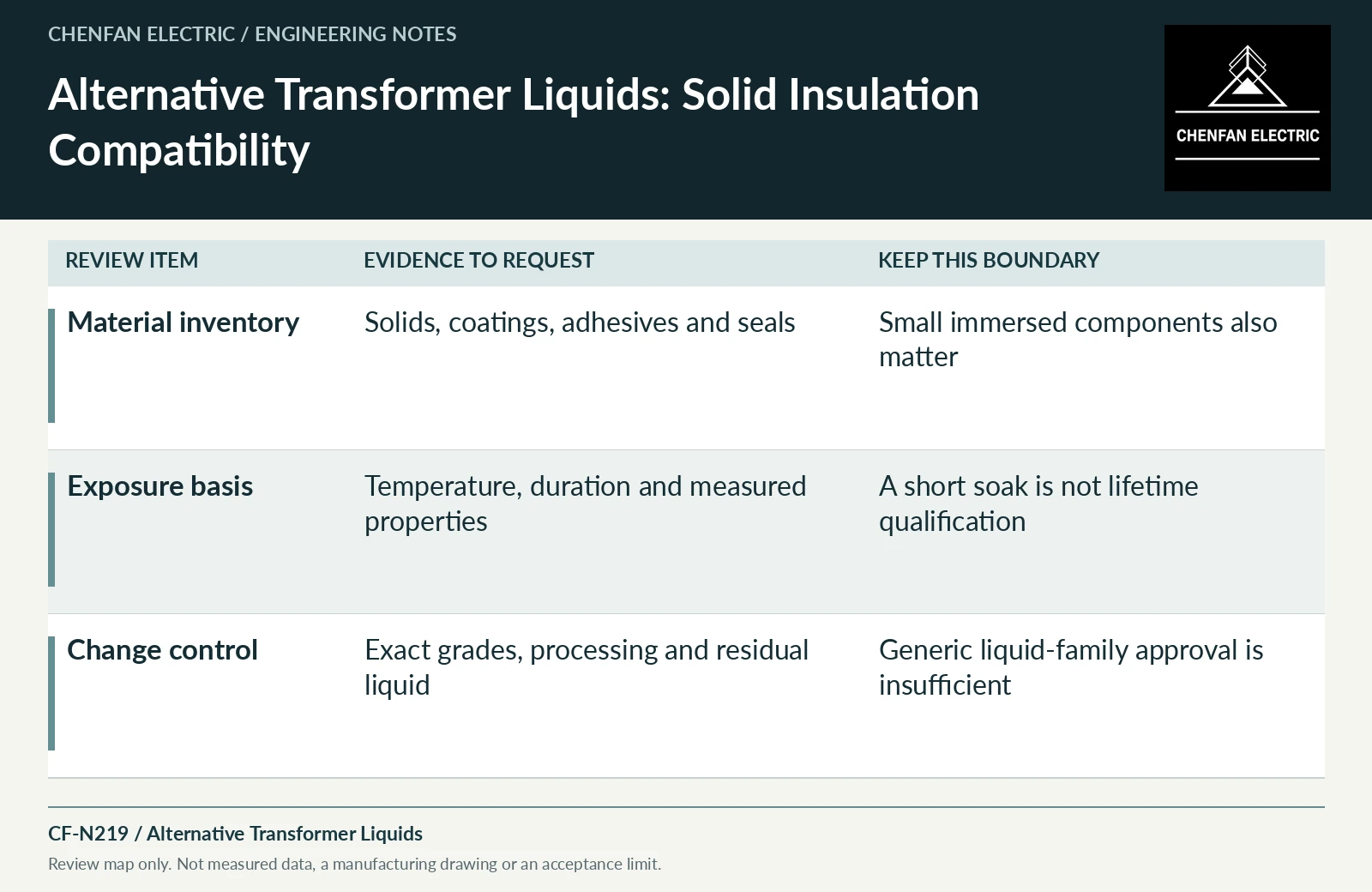
| Review item | Evidence to request | Boundary to preserve |
|---|---|---|
| Material inventory | Solids, coatings, adhesives and seals | Small immersed components also matter |
| Exposure basis | Temperature, duration and measured properties | A short soak is not lifetime qualification |
| Change control | Exact grades, processing and residual liquid | Generic liquid-family approval is insufficient |
References and scope
- IEEE C57.100-2022 — Thermal Evaluation of Insulation Systems for Liquid-Immersed TransformersPublic standard abstract · Thermal evaluation of insulation systems for liquid-immersed transformers; not a dry-type qualification reference.
- IEC 60076-14:2013 — Liquid-immersed power transformers using high-temperature insulation materialsPublic standard abstract · High-temperature insulation materials in liquid-immersed transformer systems; no automatic dry-type or retrofit rating transfer.
- Retrofilling with FR3 fluidManufacturer application page · Retrofill is an equipment/material/process review, not a nameplate uprating by fluid substitution alone.
- IEEE C57.162-2025 — Interpretation of Moisture Related Parameters in Liquid Immersed Transformers and ReactorsPublic standard abstract · Moisture-related interpretation for liquid-immersed transformers; this is not a DGA guide.