


Transformer Core Engineering Notes · CF-N220
A drawing shows an arrangement, but not every assumption that makes it electrically acceptable. Dielectric review also needs the voltage duty, material condition, model boundaries and verification evidence. The most useful review meeting links these items to specific interfaces rather than collecting drawings and certificates that cannot be traced to one another.
Ask what electrical conditions the geometry represents
Identify service voltage, insulation levels, relevant transients, connections and any special operating states. A drawing without conductor potentials can hide the significance of a close approach. Confirm which tap and terminal arrangements are covered by the analysis. The reviewer should be able to move from a stated project requirement to the relevant model or test, then back to the drawing feature that must be controlled in production.
Ask which material assumptions are hidden
Field calculations and insulation criteria depend on the selected liquid and solids, not only their dimensions. Request the material data basis, intended condition and treatment of temperature or moisture where relevant. Clarify whether a property is measured, supplied by a manufacturer or assumed for preliminary design. Substituting a material with the same thickness does not necessarily preserve the electrical or processing assumptions used in the original review.
Ask how the verified geometry reaches production
Identify minimum clearances, edge treatments, support positions and permitted substitutions. The production inspection plan should check the details on which the design relies. A calculation performed on an idealized geometry is not evidence that the assembly was built that way. Conversely, an inspection photograph confirms a visible arrangement but not its electrical capability. Keep the analytical, manufacturing and test records separate enough to understand, and linked enough to audit.
Close the review with decisions, not vague confidence
Record each unresolved input, its owner and the evidence needed before release. Distinguish an accepted design feature from a provisional assumption. If a previous test is used, state why it represents the new design and where it does not. The review is complete when the relevant boundaries and actions are clear, not when every document carries a reassuring standard number. Public standard abstracts help identify scope; they do not replace the full acceptance requirements.
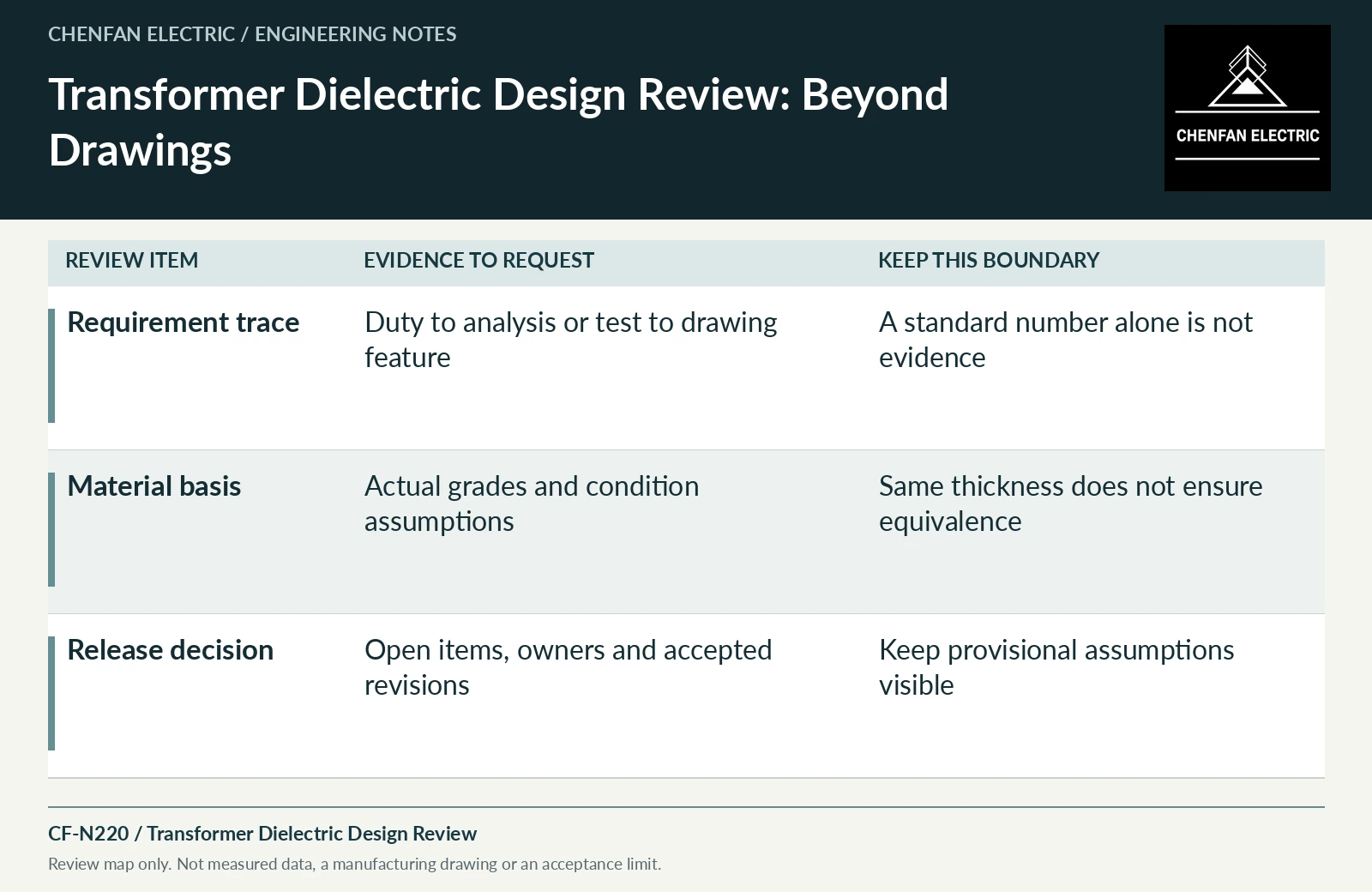
| Review item | Evidence to request | Boundary to preserve |
|---|---|---|
| Requirement trace | Duty to analysis or test to drawing feature | A standard number alone is not evidence |
| Material basis | Actual grades and condition assumptions | Same thickness does not ensure equivalence |
| Release decision | Open items, owners and accepted revisions | Keep provisional assumptions visible |
References and scope
- IEC 60076-3:2013+AMD1:2018 CSV — Insulation levels and dielectric testsPublic standard abstract · Insulation levels, dielectric testing and external clearances; the article does not reproduce test values or design distances.
- IEEE C57.100-2022 — Thermal Evaluation of Insulation Systems for Liquid-Immersed TransformersPublic standard abstract · Thermal evaluation of insulation systems for liquid-immersed transformers; not a dry-type qualification reference.
- IEC 60076-5:2006 — Ability to withstand short circuitPublic standard abstract · Thermal and dynamic short-circuit capability; calculation and verification apply to the actual design.