


Transformer Core Engineering Notes · CF-N218
A test level is a specified applied stress under defined conditions. A design margin is the allowance between the predicted duty and an adopted design capability or criterion. They are related, but not interchangeable. A certificate showing a passed test cannot be converted into an unrestricted percentage margin for every operating condition.
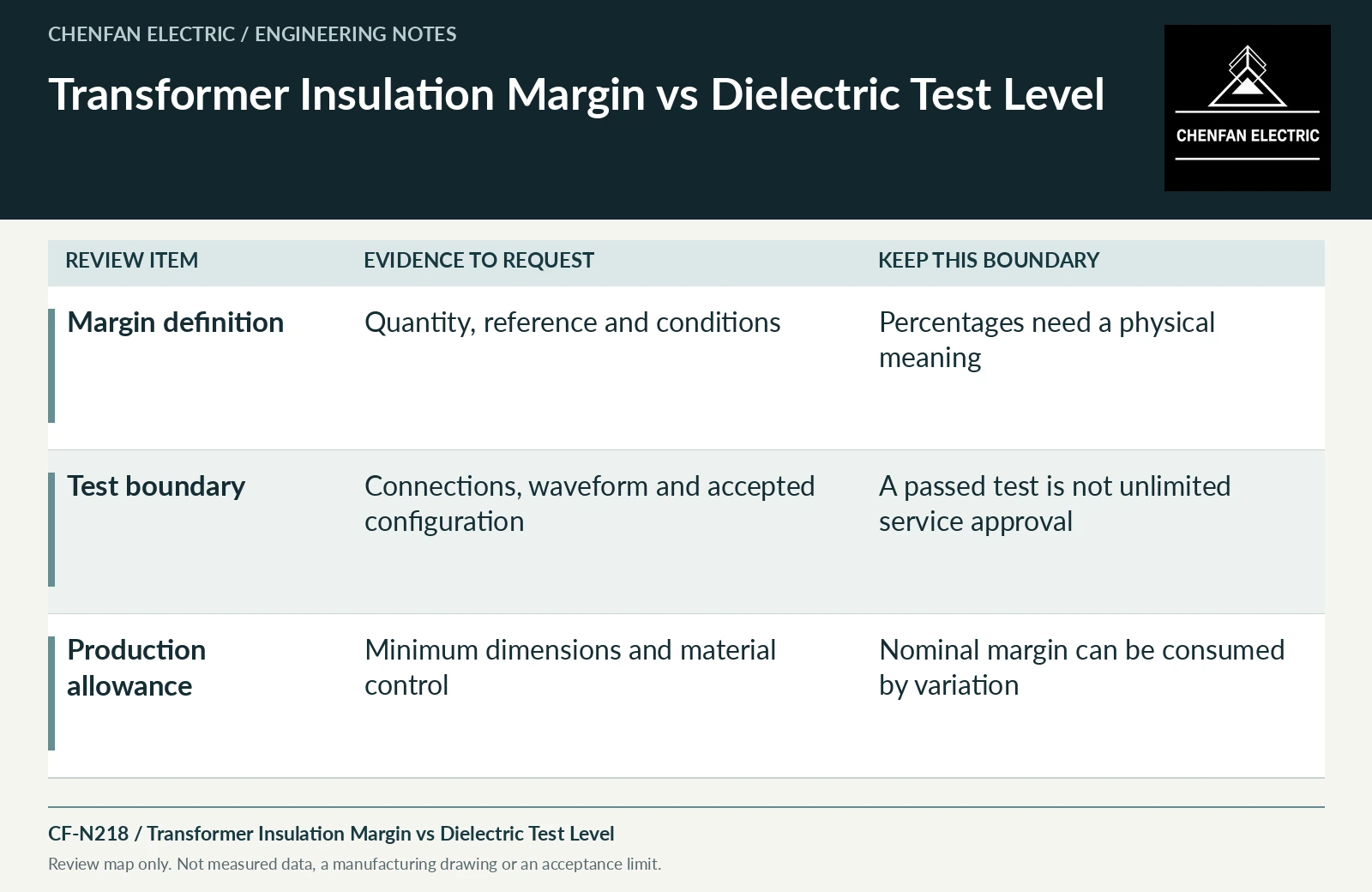
Define the two sides of any margin
A statement such as “20% insulation margin” is incomplete unless the numerator, denominator and physical quantity are identified. Is it referring to calculated field strength, voltage, clearance or another criterion? Are both values based on the same waveform, material condition and geometry? Ask for the definition before comparing suppliers. A larger distance may change field distribution, but its percentage increase is not automatically the same percentage increase in withstand voltage.
Test results have stated boundaries
A dielectric test is conducted with specified connections, waveform, duration and acceptance criteria. Its result should be read within those conditions and the tested configuration. Service can include different transients, contamination or ageing that the test is not intended to reproduce directly. This does not make factory tests unimportant; it means their role must be described accurately. Ask which part of the insulation design each test supports and which assessments remain analytical.
Allowances must survive manufacturing variation
A nominal drawing can include a design allowance that is consumed by conductor movement, insulation compression or assembly tolerance. Distinguish nominal dimensions from minimum controlled dimensions. If the supplier claims a calculation margin, ask whether the evaluated geometry includes the relevant tolerances. Changes in material or liquid also need review because the original design criterion may not apply unchanged. A margin is useful only when its assumptions remain true in the delivered unit.
Write a clearer requirement
Instead of demanding a vague “extra-safe insulation design,” specify the project service conditions, applicable insulation levels and required evidence. Ask the OEM to identify critical interfaces and its treatment of uncertainty and production variation. Do not increase test voltages informally to seek reassurance; changes to the test programme need an agreed engineering basis. The objective is an auditable design and acceptance process, not a marketing percentage detached from the physical insulation system.
| Review item | Evidence to request | Boundary to preserve |
|---|---|---|
| Margin definition | Quantity, reference and conditions | Percentages need a physical meaning |
| Test boundary | Connections, waveform and accepted configuration | A passed test is not unlimited service approval |
| Production allowance | Minimum dimensions and material control | Nominal margin can be consumed by variation |
References and scope
- IEC 60076-3:2013+AMD1:2018 CSV — Insulation levels and dielectric testsPublic standard abstract · Insulation levels, dielectric testing and external clearances; the article does not reproduce test values or design distances.
- IEEE C57.100-2022 — Thermal Evaluation of Insulation Systems for Liquid-Immersed TransformersPublic standard abstract · Thermal evaluation of insulation systems for liquid-immersed transformers; not a dry-type qualification reference.