

A long overhead feeder changes the lightning exposure seen by a transformer because line shielding, footing resistance, tower/pole geometry, flashover behavior, surge propagation and arrester placement all matter. Insulation coordination should use the actual line configuration and lightning environment rather than selecting transformer impulse level from distance alone.
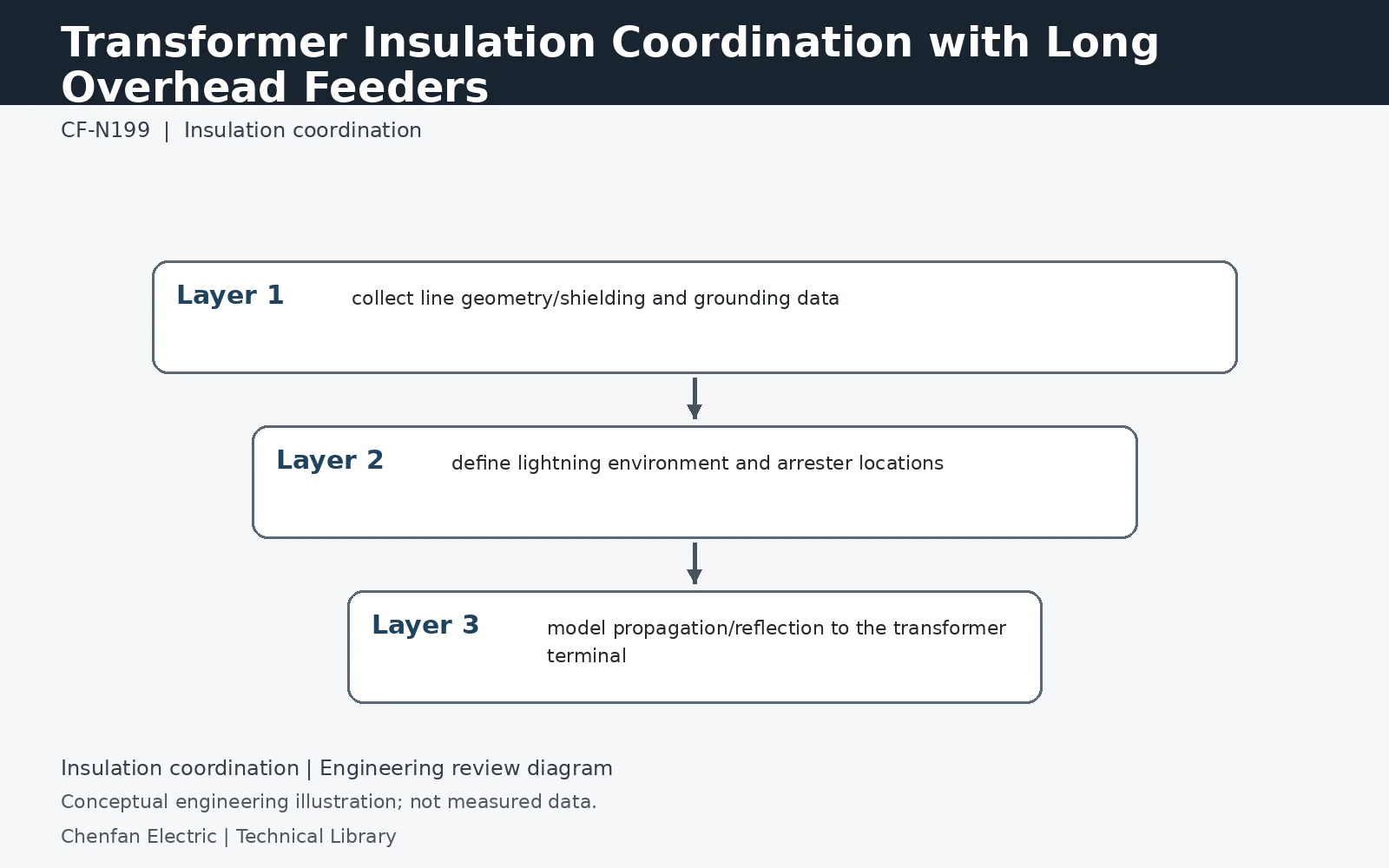
Length is an exposure input, not a direct withstand formula
A longer overhead route can change the number and location of possible lightning interactions, but terminal stress also depends on how waves propagate, attenuate and reflect along the line. The nearest critical span or transition may matter more to a particular waveform than the total route length. Retain the line geometry, insulation arrangement and relevant lightning environment. Do not infer a required transformer impulse level from kilometres of feeder without an insulation-coordination basis.
Grounding and shielding alter the incoming surge
Shield wires, pole or tower grounding, insulator flashover behavior and line arresters affect the surge that can reach the transformer. Their performance depends on the actual installation and the applicable lightning case, not simply on whether the drawing contains a shield-wire symbol. Include credible grounding and soil assumptions and identify uncertain inputs for sensitivity analysis. A single nominal footing-resistance value may not represent every structure or the fast transient behavior being modeled.
Preserve the terminal protection arrangement in the study
At the transformer end, model arresters, their leads and earth reference, and any overhead-to-cable transition. Compare the resulting terminal stress with the specified insulation duty and document the governing cases. Moving an arrester, replacing a terminal span with cable or changing station grounding can alter the result without changing the transformer. The procurement record should therefore retain the line and terminal arrangement that underpins the selected withstand level.
Technical reference framework
[1] IEC 60071-1:2019 — Insulation co-ordination, Definitions, principles and rules.
[2] IEC 60071-2:2023 — Insulation co-ordination, Application guidelines.
[3] IEC 60076-3:2013 + AMD1:2018 — Insulation levels, dielectric tests and external clearances.