

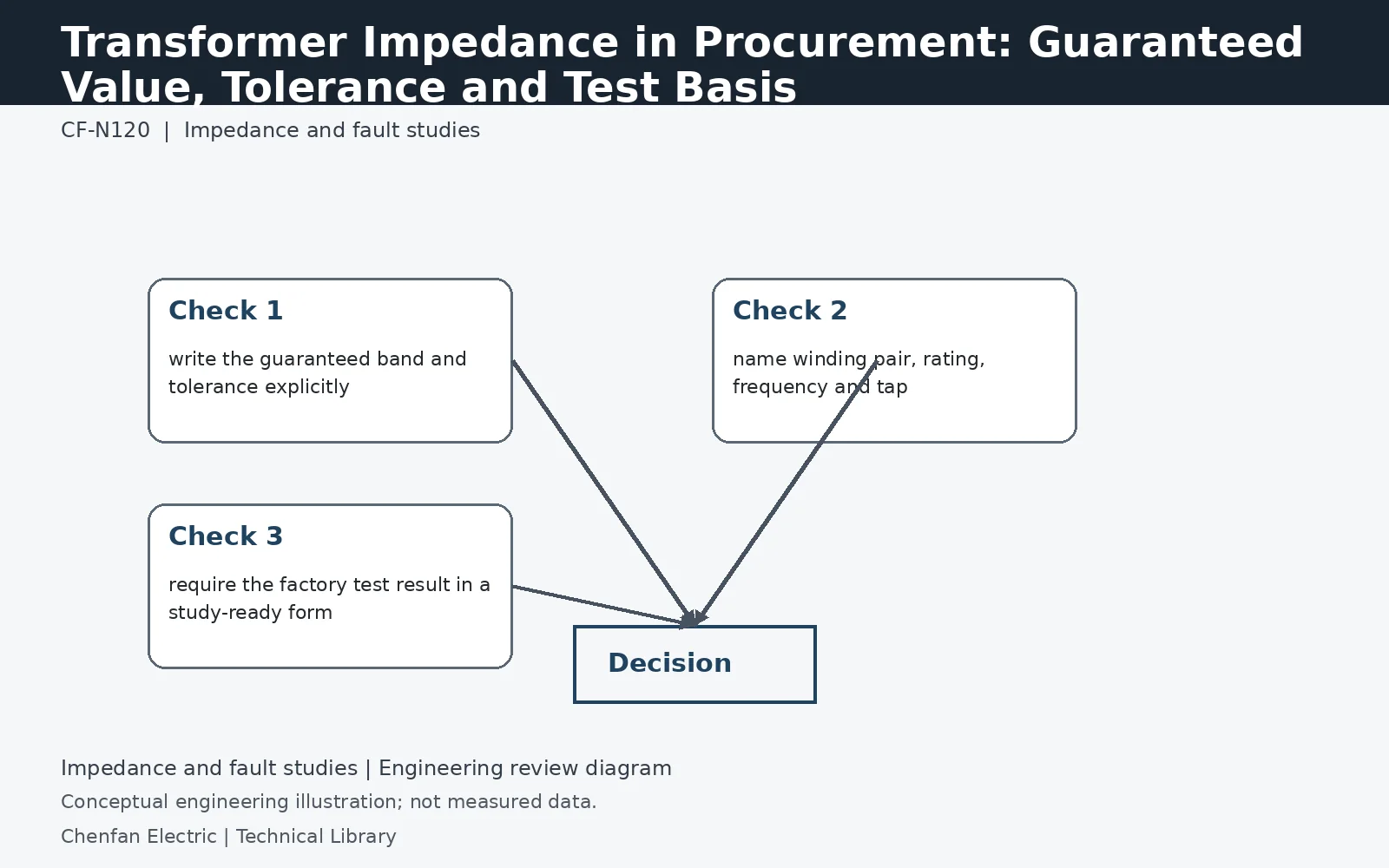
A procurement impedance requirement needs three things: the guaranteed value or band, the applicable tolerance, and the test/reference basis. Without all three, the study team cannot tell whether a factory result is acceptable or whether the as-built unit still meets fault-current and voltage-drop assumptions. The requirement should also say which winding pair, rating, frequency, tap and reference temperature apply.
Distinguish a nominal target from an acceptance band
“Impedance 6%” leaves the acceptance rule unresolved. If an illustrative contract permits ±10% of that stated impedance value, the resulting band is 5.4% to 6.6%, not minus 4% to plus 16%. The tolerance is relative to the target unless the contract explicitly uses percentage points. Conversely, if the system study accepts only 5.8% to 6.2%, a nominal 6% with the wider tolerance is not sufficient. Agree the actual allowed interval and do not combine incompatible tolerances from different standards.
Define the measurement and correction basis
State the winding pair, rated MVA, reference winding voltage, frequency, principal or specified tap and reference temperature. For a three-winding unit, repeat the information for every required pair. Request measured load loss or equivalent R/X information where the fault or parallel study needs impedance angle. Specify how the factory report distinguishes raw measurement from corrected declaration. A test at another temperature is not automatically unacceptable, but its correction and comparison method must be defined before the result is used for acceptance.
Close the loop between supplier and study engineer
Before order placement, send the lowest and highest acceptable impedance cases to the supplier and confirm manufacturing feasibility. After testing, return the as-built results to the study engineer and verify that fault duty, voltage performance and parallel sharing remain acceptable. Record any concession against those system consequences, not only against a percentage deviation. Keep a separate review for future spare compatibility. A signed deviation approval should identify the exact equipment and revised study; it should not quietly redefine the original specification for every later purchase.
Technical reference framework
[1] IEC 60076-1:2011 — Power transformers, General.
[2] IEC 60076-5:2006 — Ability to withstand short circuit.
[3] IEC 60076-8:1997 — Application guide.
[4] IEEE C57.109-2018 — Liquid-immersed transformer through-fault-current duration.