

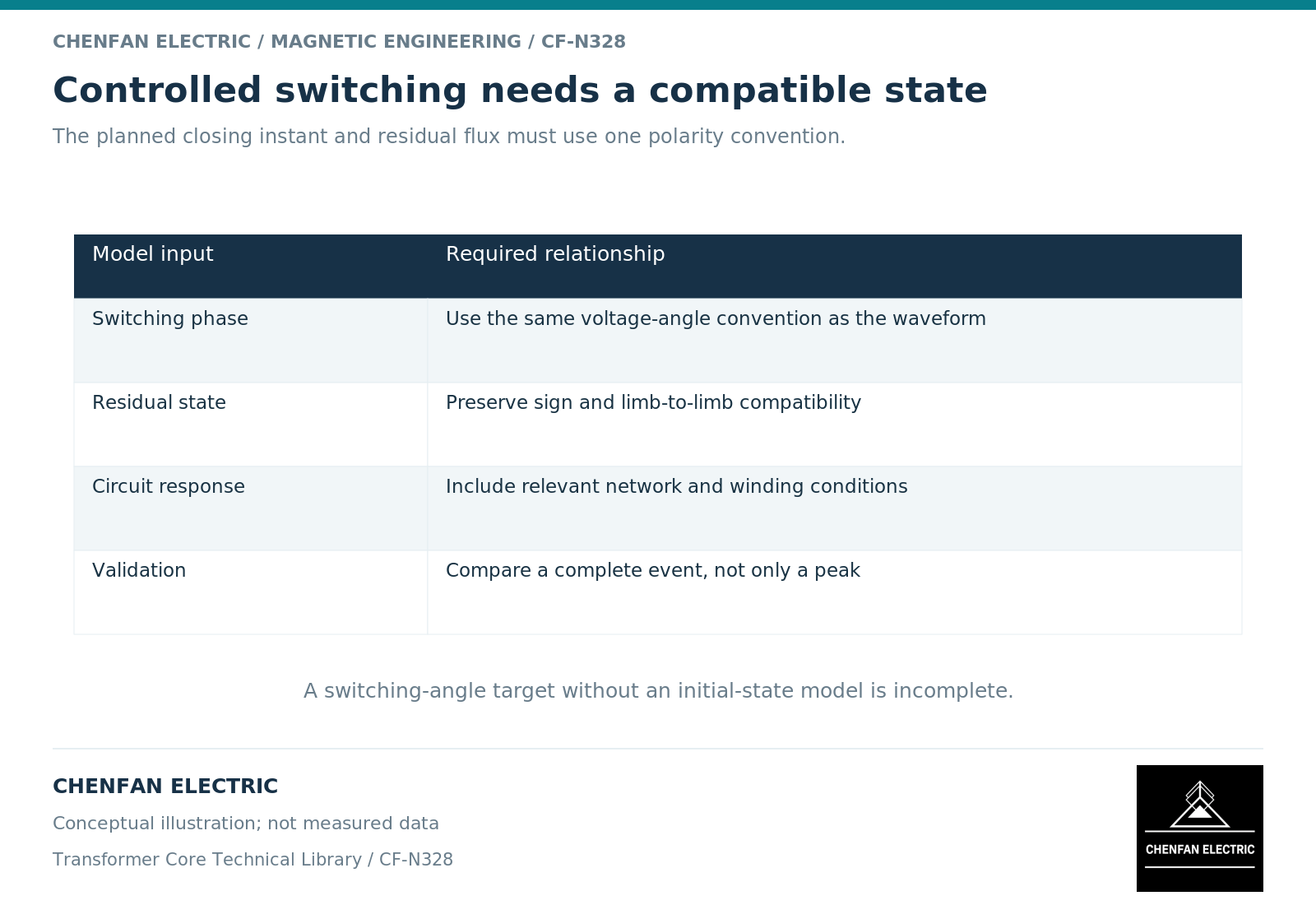
A controlled-switching model needs a residual-state estimate that is consistent with its core representation and electrical phase reference. A controller’s intended closing instant is only one input. State uncertainty, actual pole timing and circuit conditions must remain visible when predicting the next flux excursion.
The target is a flux trajectory, not a clock angle alone
The induced-voltage integral determines the flux change after closing. The residual state shifts that trajectory. [1] A closing strategy that is favorable for one residual polarity can be less favorable for another.
Consequently, the model should identify the residual state used for each case and explain how it was obtained. Possible origins include a measured-record estimate, a prior simulation or a bounded assumption. These are not equivalent evidence, even when they produce the same numerical input.
For a multi-limb core, the state must also respect magnetic coupling. A controller model that treats phases independently may need an explicit justification for the transformer topology and switching sequence under study.
Keep estimate, prediction and observation separate
The state estimator produces an inferred starting condition. The electromagnetic model predicts the response to a selected closing event. A field record, when available, provides an observation against which those predictions can be checked.
Do not tune the residual state retrospectively until every event matches and then describe the model as independently validated. That exercise may identify a plausible state, but it does not prove that the estimator would have known the state before closing.
A defensible comparison preserves the inputs available at the time of prediction. Any later parameter adjustment should be documented as recalibration and checked against a separate event.
Include the nonlinear and timing boundaries
The magnetizing characteristic, reference winding, leakage representation and source circuit influence the resulting current. Saturation-model guidance highlights the consequences of branch placement and limited high-field data. [2]
The timing input should distinguish a requested operation from actual electrical closing. Pole spread, prestrike assumptions where relevant and event-time uncertainty belong to the study definition; a perfectly synchronized ideal switch is not automatically a model of installed equipment.
This article gives no switching settings or breaker-selection rule. Those decisions require the responsible equipment and system specialists, the actual transformer data and the applicable operating constraints.
Evaluate robustness rather than one favorable event
| Variable | Useful study treatment |
|---|---|
| Residual-state estimate | Supported range and estimation error |
| Closing instant | Actual timing range, not only a command value |
| Source condition | Relevant network equivalents |
| Core characteristic | Identified nonlinear range and extrapolation limits |
| Model validation | Separate events not used for tuning |
Report both the nominal prediction and the cases that control the outcome. A strategy that performs well only at one exact residual value may be less useful than a less aggressive approach with a wider supported range.
The handover should also state what happens when the state estimate is unavailable or unreliable. A model can evaluate such cases without pretending that a missing measurement has been supplied. The operating disposition itself remains outside an article’s authority.
A sound controlled-switching assessment therefore links estimation quality to predicted electromagnetic behavior. It does not promise the absence of inrush from a selected angle alone, and it does not turn a fitted residual state into a measured property of the core.
References
[1] Lloyd Dixon / Texas Instruments. Magnetics Design 1 – Introduction and Basic Magnetics.
[2] Manitoba Hydro International / PSCAD. The Classical Approach.