

A white spot on a GOES sheet is a location to investigate, not a diagnosis.
Calling it “coating failure” from a photograph can be as misleading as dismissing it as cosmetic.
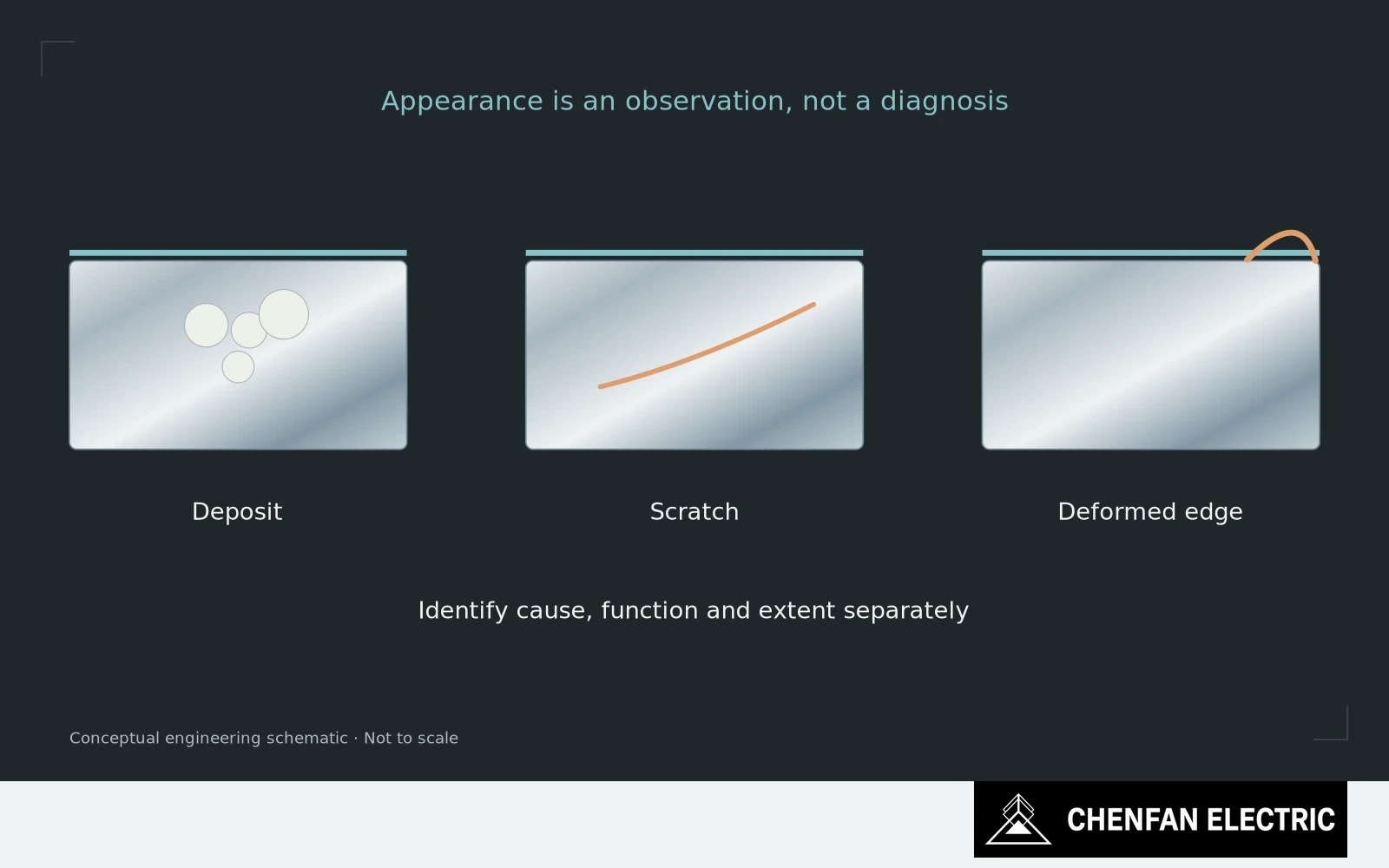
Describe the feature before naming the defect
Begin with morphology and distribution. Is the feature a loose deposit, a stain, a change in colour, an indentation or a region where coating appears removed? Does it repeat at a consistent strip position or occur only where a packet contacted handling equipment?
Those observations help select the next check. They do not, by themselves, establish the chemistry or electrical consequence. A repeated mark can indicate a common process source; a random mark can still be functionally serious.
Compare affected and unaffected areas under controlled inspection conditions. Lighting and viewing angle can exaggerate a surface difference. Where a residue is suspected, preserve a representative sample before any approved cleaning trial so that the original condition remains available for examination.
Separate cause, function and affected extent
A scratch needs its own assessment. Its location, extent, depth and relation to adjacent contacts matter more than a generic description such as “minor.” A shallow mark in the coating is not equivalent to a deformed sheet edge or exposed steel at a loaded interface.
Separate three questions: what caused the feature, what function may be affected, and how much material shares the condition. These questions may need different evidence. A magnetic test alone may not identify a contaminant, and a chemical identification alone may not establish acceptability in the finished assembly.
Ask the producer to interpret unusual coating appearances against the actual supplied coating system. Product-specific guidance is useful; a statement about a different grade or coating is not automatic permission to accept this one.
Keep investigation from creating a repair problem
For disposition, define the inspection boundary. If the visible feature is only the exposed portion of a larger packet, the assessment should state whether hidden surfaces were examined or remain uncertain. Do not convert limited access into an assumption of uniformity.
Avoid creating a repair problem while investigating an appearance problem. Unapproved abrasion, solvents or surface treatments can alter the very coating function being assessed.
A defensible decision links an identified condition to an agreed functional criterion and a known extent. The best defect label is the one the evidence supports, even when that means keeping the condition under investigation rather than giving a photograph a confident name.
Practical takeaway
A visible white spot or scratch does not identify its cause or electrical severity.
Chenfan Electric manufactures custom transformer cores according to customer drawings. Where applicable to the specified material and core design, agreed process controls include burr height below 0.02 mm and stacking factor above 97%. Measurement methods and acceptance conditions are defined for each order.