

“Both sides coated” leaves the most useful coating questions unanswered.
What electrical contact behaviour was measured, under which conditions, and will the surface remain suitable after the intended manufacturing route?
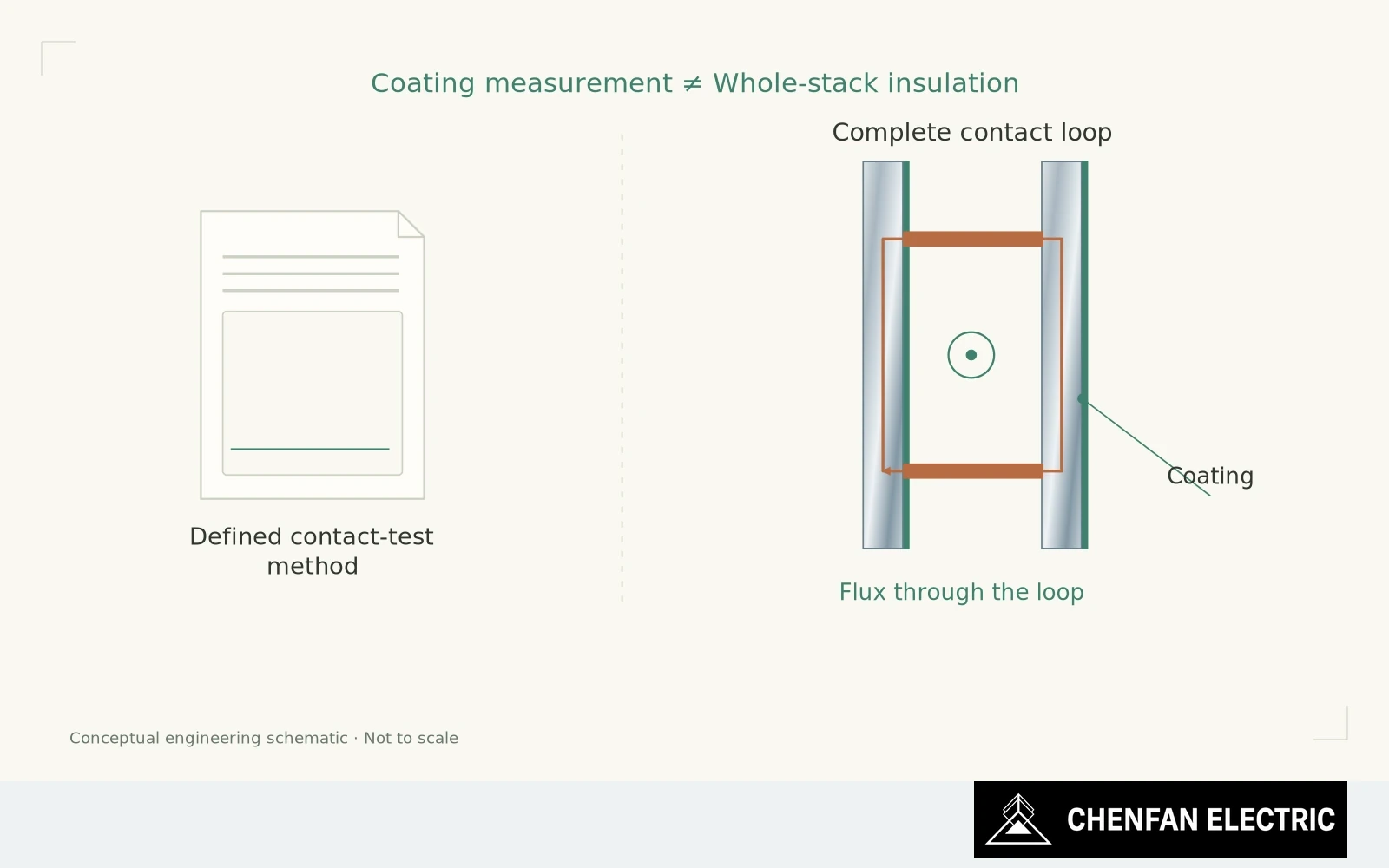
Use a defined surface-insulation test
A surface insulation result is method-dependent. Contact arrangement, applied pressure, specimen condition and the reported quantity matter. A resistance number without its method and units cannot be compared reliably with a producer’s specification or another laboratory’s result.
That is why a coating check should not be reduced to a continuity test with improvised probes. The question is not whether a meter can find any conductive spot. It is whether the specified coating function is demonstrated by an appropriate, reproducible evaluation.
The finished stack adds another level. Damaged regions, cut edges, burrs and contact with conductive hardware can create paths that are absent from an intact sheet specimen. A local contact does not automatically establish a harmful circulating-current loop; the complete electrical path and linked flux matter.
Connect sheet condition to actual electrical paths
Inspection therefore needs to connect surface condition to assembly geometry. Locate the damage, identify what it can contact and examine whether other connections complete a path. The severity cannot be inferred from coating thickness alone.
Processing compatibility also belongs in the specification. A coating’s response to heat treatment, contact materials and subsequent manufacturing should match the actual route. Do not infer the survival of laser domain refinement from a statement that the insulation coating itself is annealing resistant.
For incoming material, retain the producer’s coating designation and agreed test basis. For processed laminations, focus additional checks on operations capable of damaging that surface. For a completed core, assess relevant interlaminar and structural insulation interfaces rather than expecting one incoming-sheet measurement to cover everything.
Match coating evaluation to the manufacturing stage
Sampling should reflect the concern. A broad coating-consistency check and an investigation of one damaged contact region answer different questions. Neither should be presented as a universal substitute for the other.
A useful supplier response explains the surface system, the evaluation method and the controls that preserve it. “We use insulated CRGO” provides none of that evidence.
The purchasing requirement should describe the electrical and processing function to be maintained. Simply increasing coating thickness or demanding a larger unexplained resistance number can miss the failure path you actually need to control.
Practical takeaway
The presence of coating says little without a defined contact-resistance method and processing boundary.
Chenfan Electric manufactures custom transformer cores according to customer drawings. Where applicable to the specified material and core design, agreed process controls include burr height below 0.02 mm and stacking factor above 97%. Measurement methods and acceptance conditions are defined for each order.