

Consider a passing replacement core and a corrective-action report marked “problem solved.”
That proves the replacement met its acceptance checks. It does not establish why the original core failed or whether the next production batch is protected.
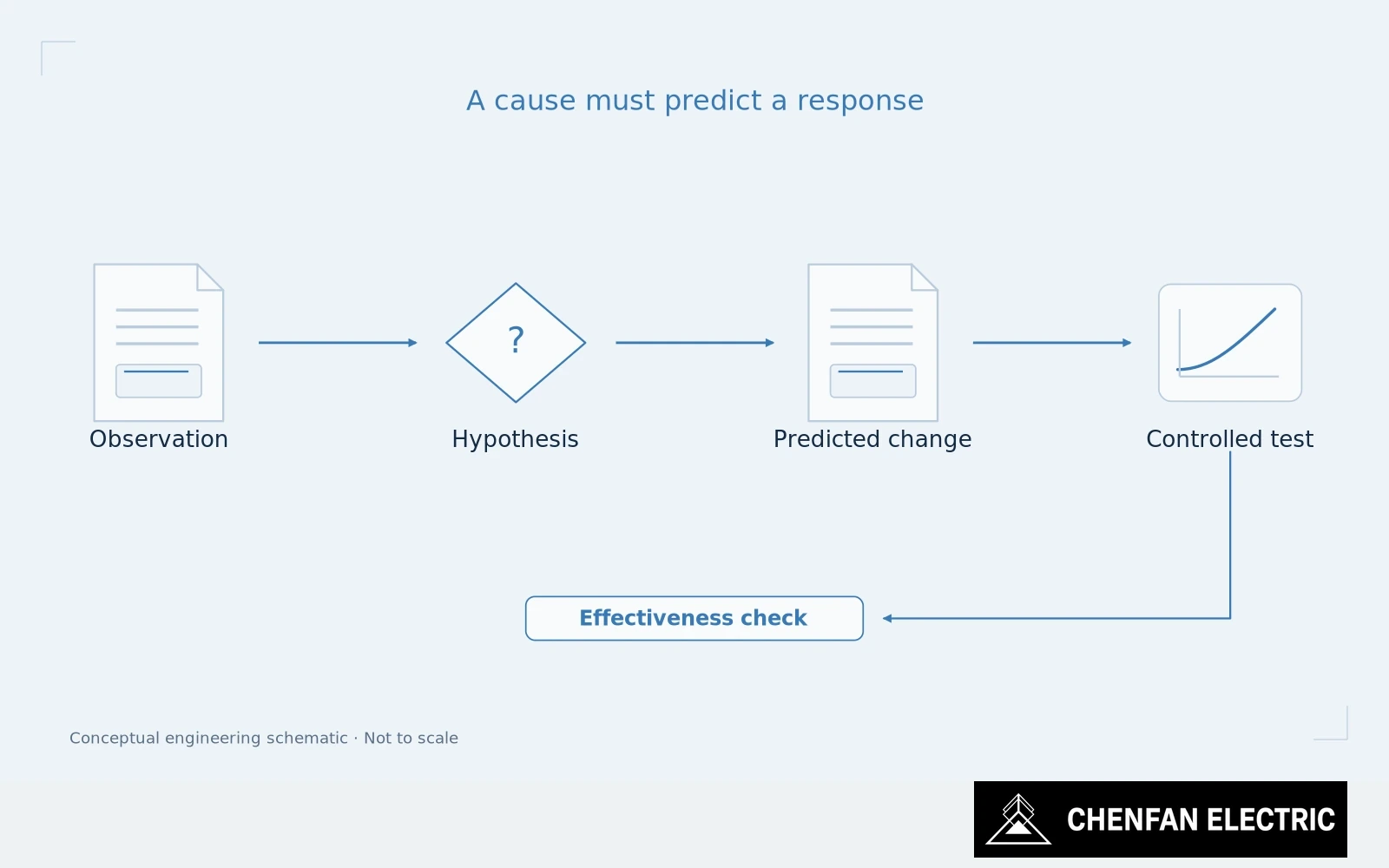
Write a prediction before the intervention
A root-cause claim needs a prediction. If the proposed cause is wrong step sequencing, what physical evidence should remain in the affected joints? What change should follow when that sequence alone is corrected? What alternative explanation would produce the same test symptom?
Write those expectations before the intervention. Otherwise, a successful rebuild can be made to fit almost any explanation afterwards.
Consider a suspected clamping problem. A lower loss after adjustment is useful evidence, but the adjustment may also have reseated a joint or changed the test support. Calling the cause “excessive pressure” requires separating those effects sufficiently to support that conclusion.
Retain evidence for accepted and rejected explanations
This does not mean every investigation needs an elaborate experiment. It means the strength of the conclusion should match the strength of the evidence. A verified dimensional mismatch, a traced wrong packet and an undocumented operator impression are different evidence classes.
Retain the rejected explanations too. If material variation was considered and ruled out by a controlled comparison, record the comparison and its limits. A list of possible causes without evidence against the alternatives remains a hypothesis list.
The corrective action must then address the mechanism. “Operator retrained” is incomplete when an ambiguous packet label or an uncontrolled program revision made the error possible. The control should prevent the mistake, detect it before it becomes hidden, or stop the process when identity is uncertain.
Verify that corrective action controls the failure mechanism
Define an effectiveness check that challenges the revised control under normal production conditions. Another carefully supervised sample may demonstrate care, not a robust correction. Include the relevant restart, changeover or handoff that originally allowed the failure.
Keep the conclusion narrow where evidence is limited. “Sequence error confirmed in this assembly” is stronger than an unsupported claim that all future loss variation has been eliminated.
For a quality manager, the decisive question is not whether a new core passed. It is whether the proposed cause explains the original evidence, predicts the response to correction, and leads to a control whose effectiveness can be demonstrated.
Practical takeaway
A successful replacement can leave the original failure mechanism completely unproven.
Chenfan Electric manufactures custom transformer cores according to customer drawings. Where applicable to the specified material and core design, agreed process controls include burr height below 0.02 mm and stacking factor above 97%. Measurement methods and acceptance conditions are defined for each order.