

The instruction “grind until it fits” should stop a core rework review, not finish it.
Removing an interference can change more than the dimension that caused the rejection.
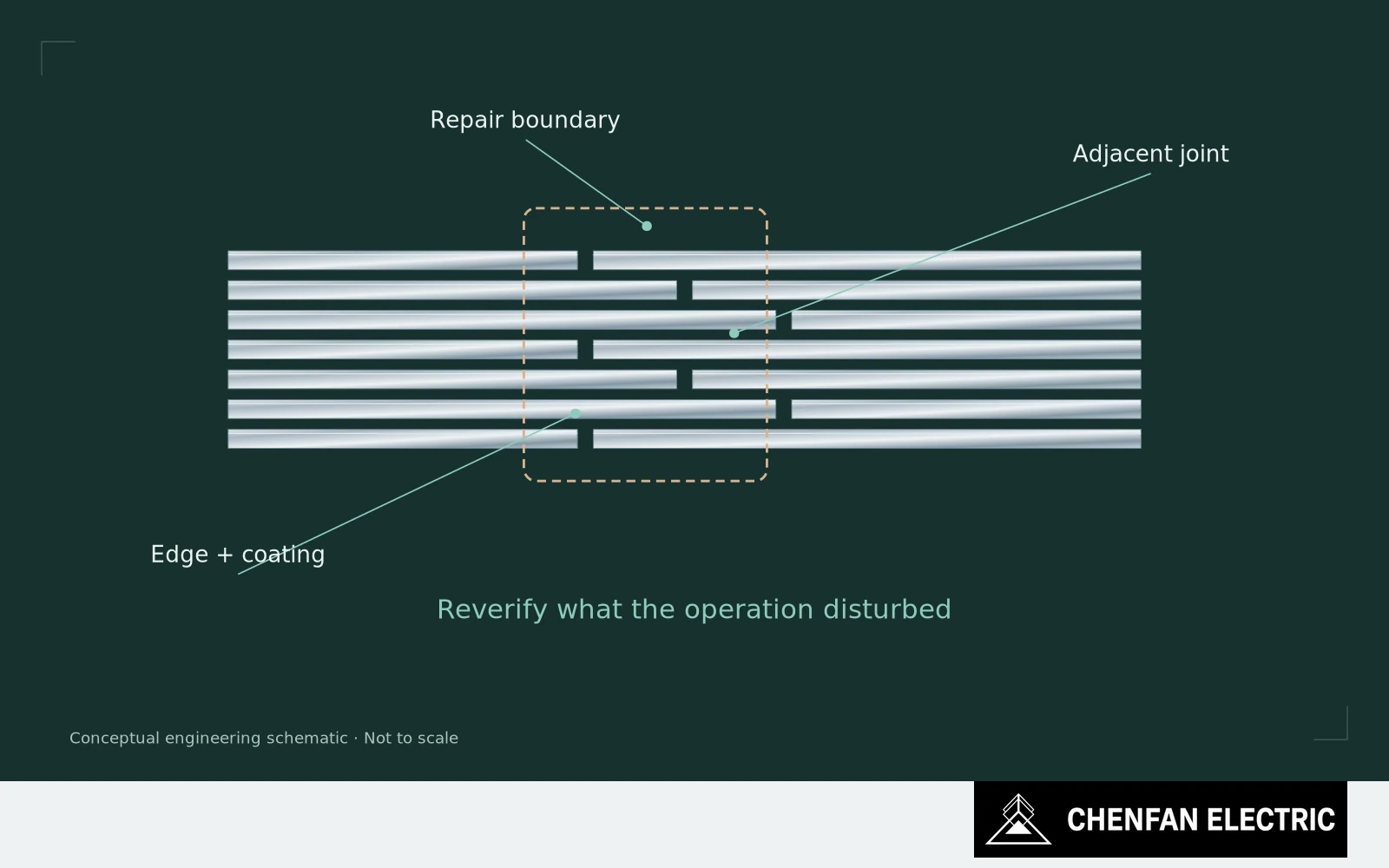
Identify the repair and the design boundary
A repair decision starts with the affected feature and the proposed operation. Repositioning a packet, replacing a damaged lamination, modifying a clamp and removing metal from a cut edge have different consequences. They should not share a generic sign-off called “rework completed.”
Cut-edge work can introduce deformation, burrs or debris. Manipulating a joint can disturb the layer sequence or seating. A revised clamp interface can change how load reaches the stack. These are possible mechanisms to assess, not a claim that every repair necessarily worsens loss.
First establish whether the repair preserves the released design. If iron section, joint geometry, insulation clearance or the intended mechanical load path changes, the decision has moved beyond restoring workmanship. Engineering needs to approve the changed configuration.
Recheck the functions disturbed by the operation
Then define what evidence the repair invalidates. A previously accepted dimension outside the affected area may remain valid. A magnetic test performed before substantial restacking may no longer describe the delivered assembly. Repeating every inspection indiscriminately can waste effort; repeating only the failed measurement can miss the actual risk.
Use the repair boundary to select verification. Check the repaired feature, neighbouring interfaces that were disturbed, cleanliness and coating condition where relevant, and the appropriate electrical response when the magnetic or insulation state could have changed.
Preserve identity and the final release record
Heat treatment deserves a separate decision. It is not a universal way to undo mechanical damage. The grade, coating and domain-refinement route must be compatible with the proposed treatment; a heat-resistant coating does not by itself establish that a domain-refinement benefit will survive.
The rework record should identify the original defect, approved method, replaced parts, affected checks and final release state. Preserve the connection to the original core identity rather than making its history disappear behind a new test sheet.
Some repairs are technically sound and commercially sensible. Others consume the available assurance without restoring the original design condition. The distinction is made by a controlled repair route and evidence, not by how neat the corrected surface looks.
Practical takeaway
A dimensional correction can invalidate earlier magnetic and mechanical acceptance evidence.
Chenfan Electric manufactures custom transformer cores according to customer drawings. Where applicable to the specified material and core design, agreed process controls include burr height below 0.02 mm and stacking factor above 97%. Measurement methods and acceptance conditions are defined for each order.