

“It passed here” and “it does not work here” are observations, not mutually exclusive verdicts.
A useful investigation begins by establishing what happened between those two states.
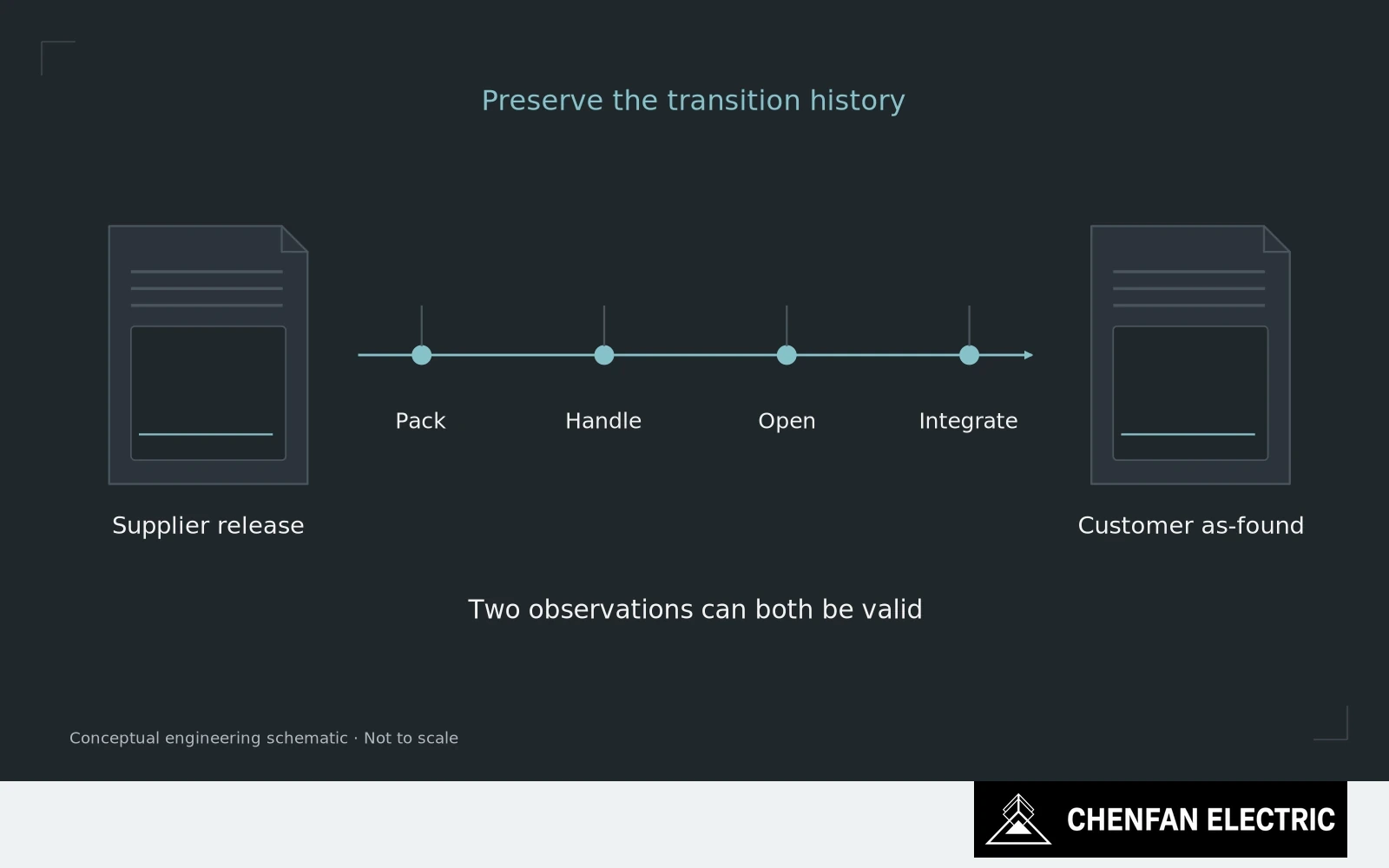
Preserve the as-found state and transition timeline
Preserve the customer’s as-found condition. Record the assembly identity, packaging and support condition, visible observations, relevant dimensions and the exact test or fit problem. Do this before corrective handling removes the evidence.
Then identify the supplier’s last verified state. Which drawing revision and configuration were released? Was the core tested before or after a particular restraint change? What remained to be done by the receiving factory?
Build a timeline of the actual transitions: packing, loading, transfers, unloading, storage, restraint removal, winding installation and any reassembly. Not every transition will be relevant. The timeline prevents an assumed sequence from becoming the basis for assigning cause.
Separate test differences from physical changes
Now compare the complaint with the original acceptance requirement. A different test voltage, frequency, connection or calculation boundary may explain an electrical discrepancy without any change in the core. A winding interference may concern an interface that was not included in the supplier’s dimensional check.
Where a real change is demonstrated, narrow the location and mechanism. Movement at a defined interface, loss of packet identity or a changed restraint state should be investigated with evidence appropriate to that condition. A shock indicator alone does not identify a magnetic defect; an intact crate does not prove that nothing moved inside.
Containment and responsibility should not be confused. Both parties can protect the assembly and agree the next discriminating check before they have established who owns the cause.
Explain both the factory pass and the receiving problem
Avoid simultaneous corrective actions. Restacking, reclamping and changing the test setup together may make the problem disappear while leaving the mechanism unresolved. Where intervention is necessary, record what changes and what result is expected.
The closure record should reconcile the two observations: why the original checks passed, why the receiving condition differed or was interpreted differently, and what control now prevents recurrence.
A complaint is not resolved technically by choosing the more authoritative-looking report. It is resolved when the evidence explains how the core moved from the released condition to the condition the customer actually encountered.
Practical takeaway
Supplier release and customer failure can both be valid observations of different states.
Chenfan Electric manufactures custom transformer cores according to customer drawings. Where applicable to the specified material and core design, agreed process controls include burr height below 0.02 mm and stacking factor above 97%. Measurement methods and acceptance conditions are defined for each order.