

Tolerance should follow sensitivity.
A critical relationship can deserve close control while a nearby non-functional dimension does not.
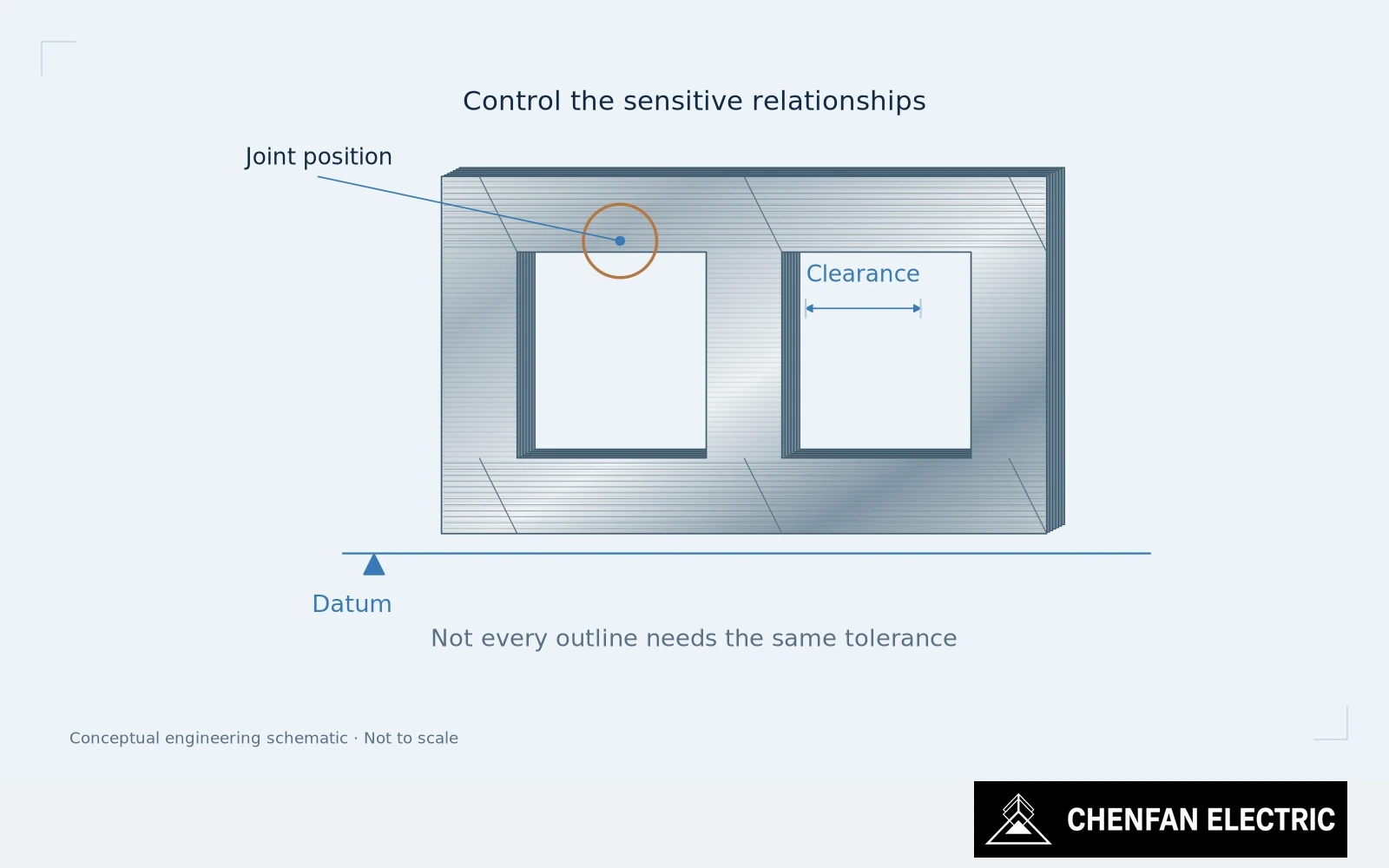
Trace the function and dimensional chain
Giving both the same narrow tolerance is not automatically good engineering.
Begin with the assembly function. A dimension controlling winding clearance or the relationship between limbs can directly affect fit. A feature governing the intended step-lap arrangement may influence the magnetic transition. Other dimensions may have little effect within a wider, justified range.
The drawing should make those relationships visible through appropriate datums. Tightening individual lengths does not necessarily control squareness, position or the complete dimensional chain. The factory can make every listed length accurately and still assemble the wrong relationship.
Balance process and measurement capability
Evaluate the chain before assigning limits to its parts. Which deviations act in the same direction? Which can compensate? Which share a common setup or reference? A statistical combination that assumes independent variation is not justified simply because it produces a more comfortable result than a worst-case assessment.
Measurement capability must be considered alongside manufacturing capability. A narrow tolerance without a suitable measurement procedure can create false disagreement or missed deviations. The measurement state, access and reference surfaces need to be defined.
Then assess the cost of control. Some limits can be improved through a better datum or fixture without slowing every operation. Others require different tooling, more inspection or selective assembly. The technical benefit should justify the intervention.
A practical review can classify dimensions by function and consequence, then identify the small number driving the assembly or magnetic risk. This directs attention toward the limits whose variation actually changes the outcome.
Verify that tighter limits improve the intended outcome
Do not use a broad cost argument to relax a genuinely critical tolerance. The alternative may be a design change that reduces sensitivity, but that change must be approved and verified. Manufacturing difficulty does not make the original function disappear.
After a tolerance change, check whether the expected improvement appears in the relevant interface or performance result. A better inspection histogram is useful only if it represents the function the change was intended to protect.
The strongest drawing is not the one with the smallest numbers after every plus/minus sign. It is the one that controls the important relationships at a level the design needs and the measurement process can establish.
Practical takeaway
Tight tolerances are valuable only where variation changes a required function.
Chenfan Electric manufactures custom transformer cores according to customer drawings. Where applicable to the specified material and core design, agreed process controls include burr height below 0.02 mm and stacking factor above 97%. Measurement methods and acceptance conditions are defined for each order.