

Before tightening a specification, name the failure it is supposed to prevent.
If nobody can connect the new limit to a function, the document may be getting harder to satisfy without becoming more useful.
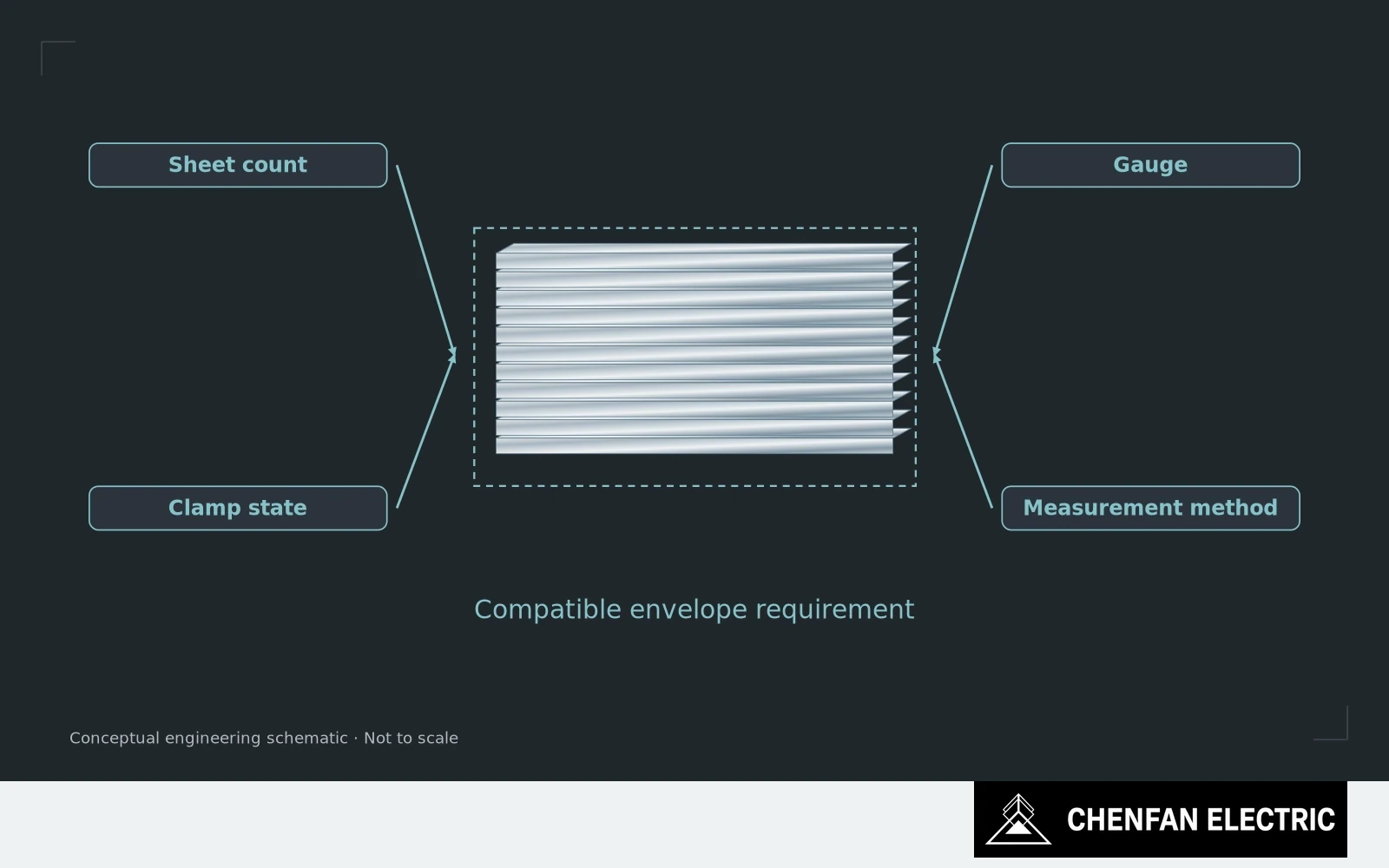
Check compatibility and measurement capability
A transformer-core specification usually combines material requirements, geometry, magnetic acceptance and process conditions. Those requirements must be compatible. Tightening one in isolation can create a conflict elsewhere in the assembly.
For example, demanding an increasingly compact external stack while also freezing sheet count, material condition and the clamping arrangement may leave no legitimate route to compliance. The problem is not solved by instructing the factory to use more force.
Similarly, a very narrow geometric limit has limited value if the measurement method cannot reliably distinguish the allowed range. The supplier and buyer may then disagree about acceptance even when they inspect the same unchanged core.
Separate process prescriptions from functional limits
Every critical requirement should therefore identify the object, condition, limit and verification method. State whether a magnetic value concerns a material specimen or an assembled core. State the mechanical condition in which an interface is measured. Define how an uncertain or borderline result is handled.
Then ask whether the requirement is prescriptive or functional. Prescribing a process can be justified where that process has been qualified. Prescribing every internal detail may unnecessarily exclude an alternative route that delivers the required function, unless interchangeability or other constraints genuinely demand it.
This does not argue for vague specifications. A vague requirement transfers the decision to the moment of disagreement. The aim is precision about what matters, not maximal restriction on everything that can be written down.
Justify each demanding clause with a verification method
Review legacy clauses with the same discipline. A limit copied from a different core family may no longer correspond to the relevant geometry, operating point or assembly sequence. Its history is not a technical justification.
For purchasing, a more demanding clause should have an explainable benefit and an achievable verification route. Ask the supplier to identify conflicts before award, not to accept them silently and seek concessions during production.
The specification is effective when it prevents the intended failure and produces a reproducible acceptance decision. More severe wording, by itself, achieves neither.
Practical takeaway
An unconnected tighter limit can create conflicts rather than prevent a defined failure.
Chenfan Electric manufactures custom transformer cores according to customer drawings. Where applicable to the specified material and core design, agreed process controls include burr height below 0.02 mm and stacking factor above 97%. Measurement methods and acceptance conditions are defined for each order.