

A lower core purchase price is not necessarily an engineering cost reduction.
It may be a commercial concession, a scope change, a process improvement or a transfer of performance risk. Those should be identified separately.
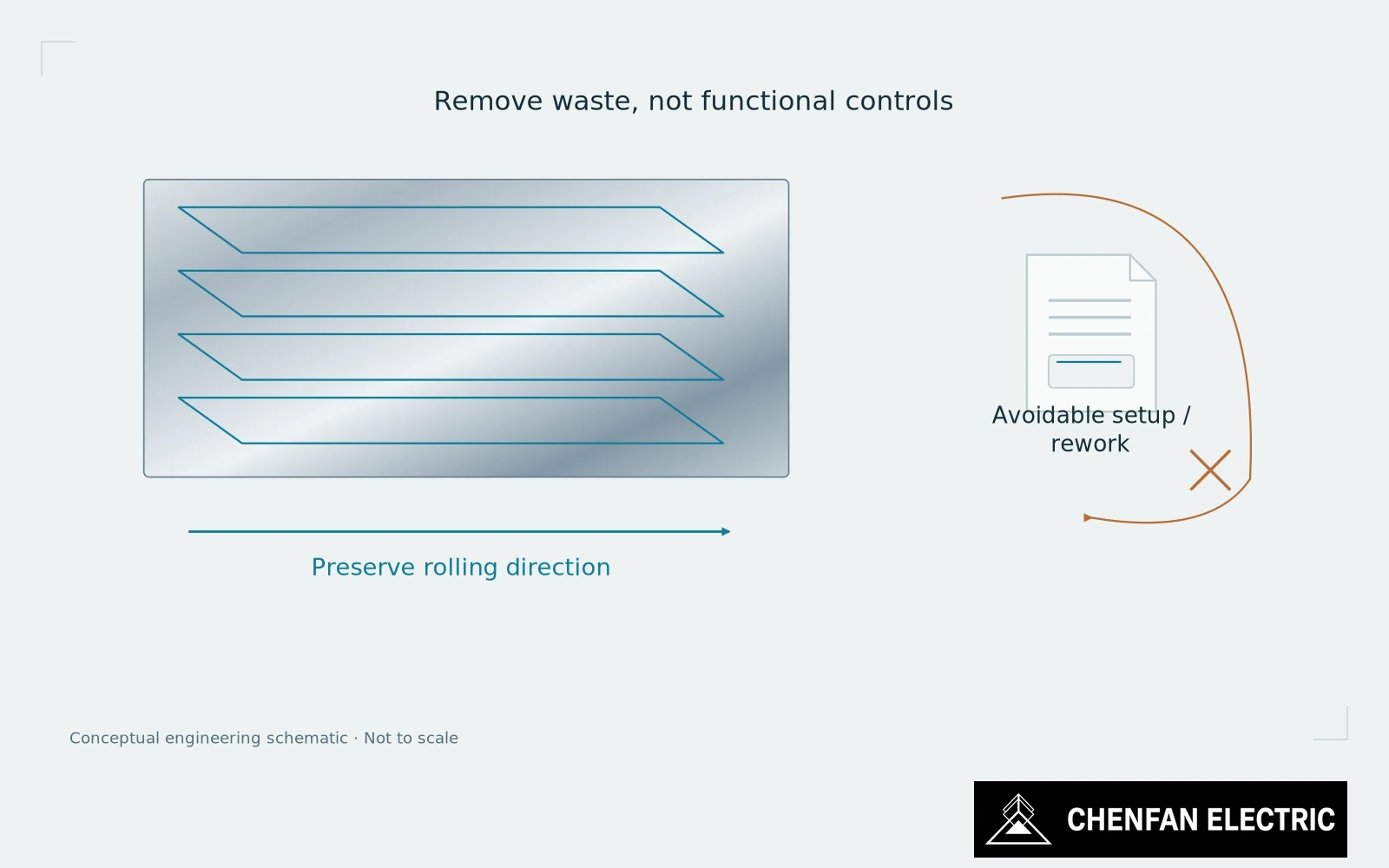
Protect the required function while removing waste
Begin with the constraints that cannot be traded away casually: functional geometry, agreed magnetic performance, material compatibility and required delivery state. A proposal that violates one of these is a redesign request, not an equivalent cheaper offer.
Then look for avoidable work. Repeated setup, preventable sorting, unclear packet identification and duplicated inspection can consume resources without improving the accepted core. Removing their causes is different from simply deleting the controls that reveal them.
Material utilization is another legitimate opportunity, but only within the approved magnetic geometry and rolling direction. A revised strip plan can be beneficial; an unreviewed change to the joint is not the same type of saving.
Separate redesign from commercial negotiation
Changes to material grade, core section or operating induction require a wider calculation. They can alter no-load loss, excitation demand and other transformer design choices. Evaluate the complete revised design and its loss allocation, rather than assuming the original acceptance margin remains available.
Separate recurring savings from one-time effort. A tooling or process change may require qualification before it reduces unit cost. For a small order, the qualification cost may dominate; for a repeated family, it may be justified. The answer depends on the real program, not an invented production volume.
Negotiating supplier margin can reduce the invoice without changing the physics. That is a valid commercial action, but it should not be reported as a reduction in manufacturing waste or transformer loss. Keeping the categories separate makes the next decision more honest.
Verify where savings actually occur
Ask each cost-down proposal to show what physically or commercially changes, what remains equivalent, what must be requalified and where the saving recurs. A proposal that cannot answer those points has not yet established its mechanism.
Do not let a short-term target erase the evidence needed to verify the saving. First-pass yield, accepted core performance and receiving work should remain visible after implementation.
The useful cost-down question is not “which line can we cut?” It is “which cost can disappear while the required function and control remain intact?” Start there before spending the design margin.
Practical takeaway
Invoice reduction, waste removal and design-risk transfer are different mechanisms.
Chenfan Electric manufactures custom transformer cores according to customer drawings. Where applicable to the specified material and core design, agreed process controls include burr height below 0.02 mm and stacking factor above 97%. Measurement methods and acceptance conditions are defined for each order.