

The next dollar should go to the active limitation, not automatically to a higher GOES grade.
A core-loss improvement budget is a marginal decision: what additional verified reduction can each feasible change buy in this particular design?
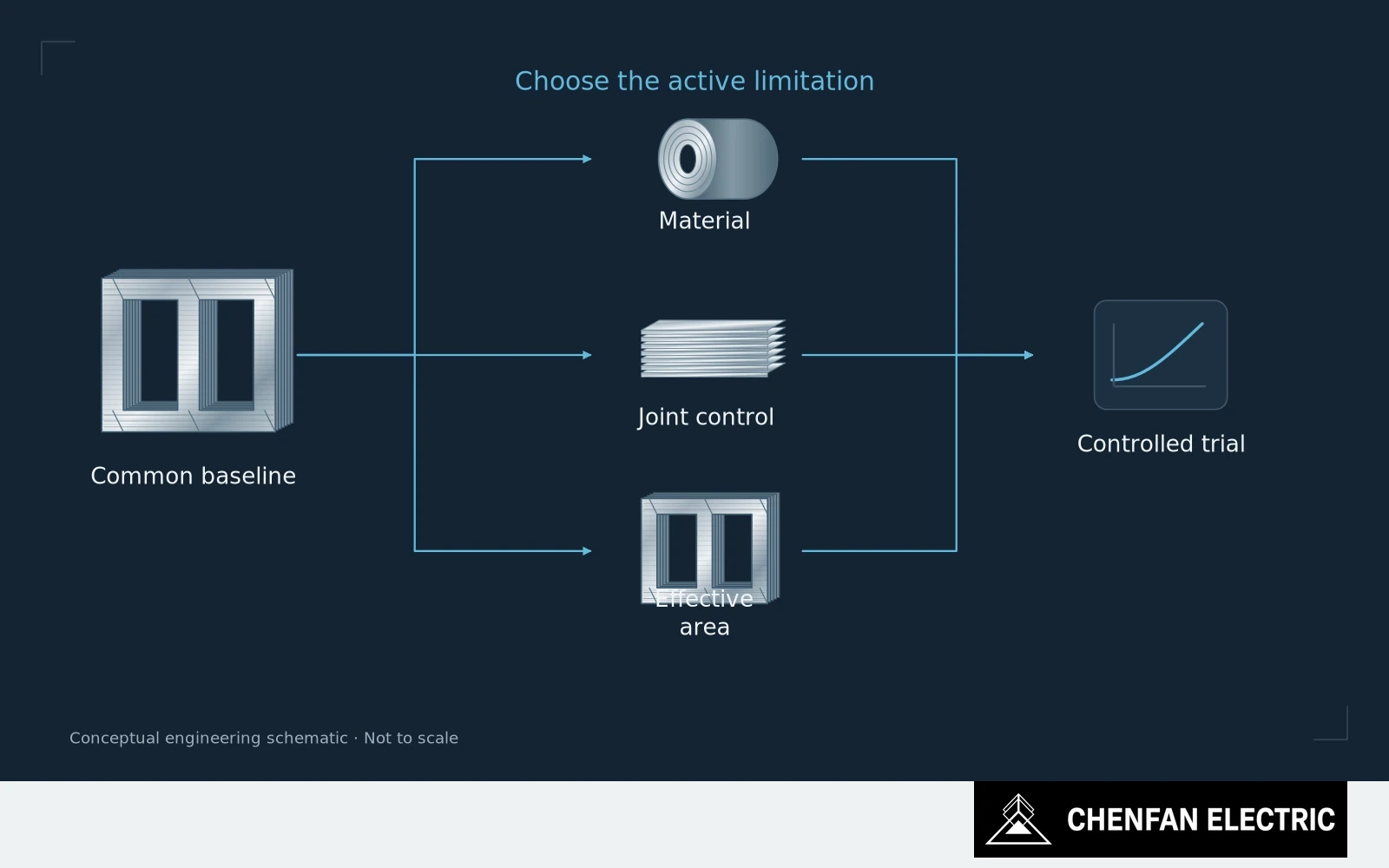
Identify the active design or process constraint
If the operating induction is driving a steep rise in loss and excitation demand, a section or turns review may be relevant. If the design is sound but the joint is not reproduced consistently, a material upgrade may leave the avoidable variation in place.
If the manufacturing route is already controlled and the material characteristic dominates the remaining loss, better GOES may be the most direct lever. These are conditional cases, not a ranking that applies to every core.
Build the comparison around a common baseline. For each option, estimate the change in accepted no-load performance and the complete incremental cost. Include affected tooling, qualification and surrounding transformer changes where they genuinely occur.
Compare incremental benefit, cost and uncertainty
Then state the confidence in the estimate. A predicted saving smaller than the combined model and measurement uncertainty is not yet a demonstrated improvement. It may still justify a trial, but should not be booked as an achieved result.
The options can interact. A joint change and a material change may not deliver the sum of their separately predicted benefits. A better manufacturing route may also reduce scatter without moving the mean very much. That can be valuable where production margin is the actual constraint.
Use a focused experiment to resolve the most important uncertainty. Hold the other relevant conditions stable and choose a comparison that can distinguish the candidate’s effect. Changing grade, section, joint and clamping together may produce a better core without showing which expenditure mattered.
Verify the intervention before repeating the investment
The final choice also depends on the program horizon. A recurring material premium and a one-time process improvement have different cost patterns. Evaluate them against the actual order family and expected use of the improvement, not a generic payback claim.
A clear decision record can be compact: baseline, candidate, expected benefit, cost, uncertainty and verification result. Its value is that the next budget discussion starts with evidence rather than the same preferred solution.
Spend where the measured or credibly predicted response is useful. Once that limitation is reduced, reassess the next dollar; the best first intervention need not remain the best second one.
Practical takeaway
The highest-return intervention changes with the active design or process limitation.
Chenfan Electric manufactures custom transformer cores according to customer drawings. Where applicable to the specified material and core design, agreed process controls include burr height below 0.02 mm and stacking factor above 97%. Measurement methods and acceptance conditions are defined for each order.