

Ask for the sequence, not the record result.
A supplier’s lowest measured core loss tells you what was achieved once. A production history can begin to show what the next comparable core is likely to do.
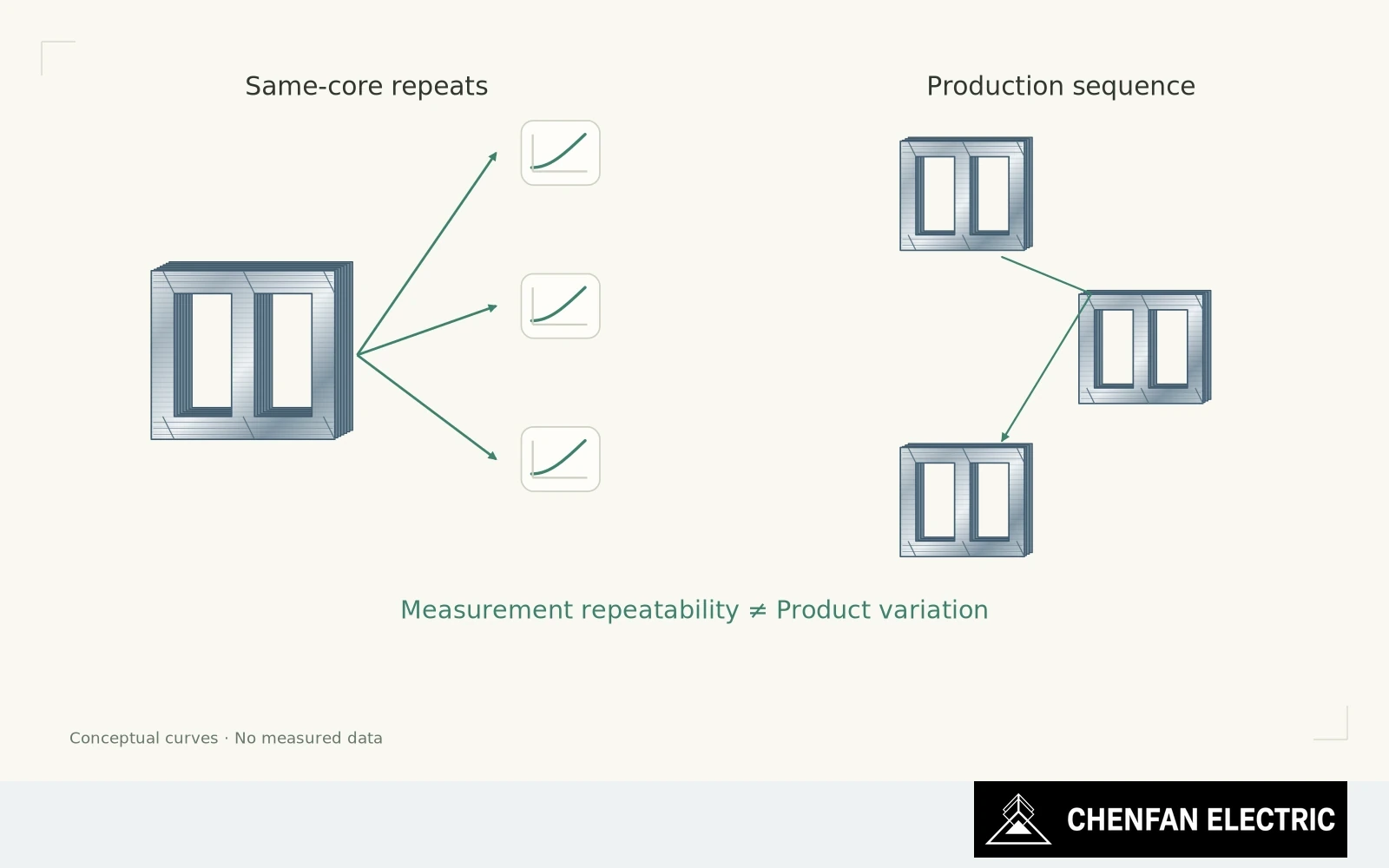
Compare a defined family in manufacturing order
The word comparable carries most of the technical weight. A mixed list of different designs, masses, frequencies and induction levels is not a repeatability study merely because every row contains watts.
Start with a defined design family and a consistent test basis. Preserve the order of manufacture and test. A time-ordered record may reveal a shift after a material change, tool intervention or assembly change that disappears inside one overall average.
Separate the first-pass result from the final released result. Both are useful, but they answer different questions. A history that includes only the successful retest can conceal how much sorting, adjustment or rework was required to achieve acceptance.
Separate measurement variation from product variation
Next distinguish measurement repeatability from product variation. Repeating the test on one unchanged core helps characterize the measurement process. Testing different cores adds manufacturing and material variation. These should not be presented as interchangeable demonstrations.
A narrow spread is not automatically reassuring either. It may reflect rounding, an insensitive measurement arrangement or selected reporting. Check the resolution and the underlying records before celebrating an unusually tidy table.
For low-volume power-transformer work, avoid manufacturing a confident capability index from a handful of unrelated units. Statistical capability claims depend on adequate evidence and appropriate assumptions, including process stability. Where the dataset is limited, show the observations and their limitations directly.
Use the record to choose the next qualification step
The procurement decision can still improve without a sophisticated index. A transparent sequence, known process changes and consistent explanation of deviations provide more usable evidence than a single exceptional result with no manufacturing context.
Use the record to decide the next qualification step. A stable family may support a controlled extension; a shifted sequence may require investigation before increasing order volume. Do not turn a historical average into a blanket guarantee for every new geometry.
The supplier worth relying on is the one whose ordinary production can be explained. The best core in the archive should be an observation in that record, not the entire basis for approving the next batch.
Practical takeaway
A time-ordered production sequence is more informative than the supplier record result.
Chenfan Electric manufactures custom transformer cores according to customer drawings. Where applicable to the specified material and core design, agreed process controls include burr height below 0.02 mm and stacking factor above 97%. Measurement methods and acceptance conditions are defined for each order.