

The first sample may have passed through a production route that no later order will receive.
That possibility should be investigated before the sample becomes the basis for a volume approval.
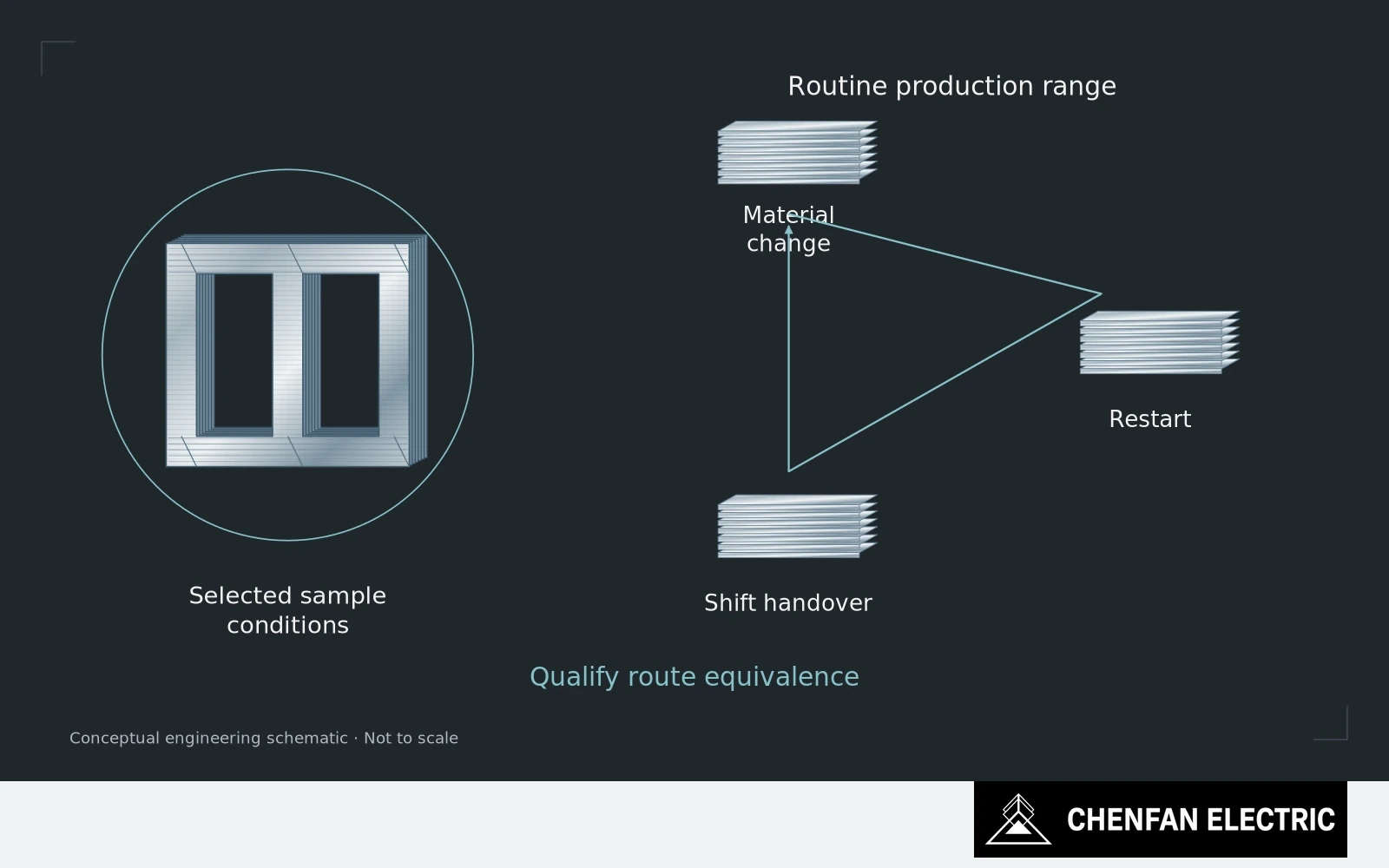
Compare the sample route with routine production
A development build can receive unusual attention: selected material, freshly serviced tooling, a senior operator and repeated engineering review. Those choices are not inherently wrong. The problem begins when they are absent from the approved production definition.
During regular output, coil changes, tool wear, shift handovers and queue pressure introduce a broader operating range. The question is whether the controls that made the sample successful remain effective across that range.
Compare the sample route with the proposed production route operation by operation. Who approved the cutting program? How were packets identified? Were any sheets replaced or joints restacked? Was the reported magnetic result first-pass or obtained after adjustment?
Include normal changes and interruptions
Then identify which conditions are intended to remain fixed and which will vary. A legitimate change of operator is different from an unapproved change in material treatment. A scheduled tool intervention should have a defined verification step rather than being treated as an unexplained disturbance.
The qualification should include normal production transitions, not only uninterrupted operation under ideal conditions. For example, demonstrate how identity and sequence are preserved when a job is paused and resumed. The exact trial plan depends on the design and factory; there is no universal sample count that proves every process.
Measurement consistency deserves the same review. An expert laboratory setup used for the sample may not represent the routine test station unless the methods and results have been related properly.
Preserve a baseline that later orders can reproduce
Keep a controlled baseline that includes the successful recipe and the evidence supporting it. Subsequent changes can then be evaluated against something more precise than “make it like the sample.”
For the buyer, the right response to an excellent first core is not suspicion. It is a request to demonstrate how the conditions responsible for that result are embedded in ordinary work.
Volume approval should therefore follow a repeatable route, not a ceremonial sample. The transition to production is complete when the factory can identify what must stay the same, detect what changed and respond without depending on the same individual being present every time.
Practical takeaway
A successful first sample may depend on conditions missing from routine production.
Chenfan Electric manufactures custom transformer cores according to customer drawings. Where applicable to the specified material and core design, agreed process controls include burr height below 0.02 mm and stacking factor above 97%. Measurement methods and acceptance conditions are defined for each order.