

A stress-relief operation can remove something you paid to keep.
That is the uncomfortable question behind domain-refined GOES: which part of its magnetic performance will survive your manufacturing route?
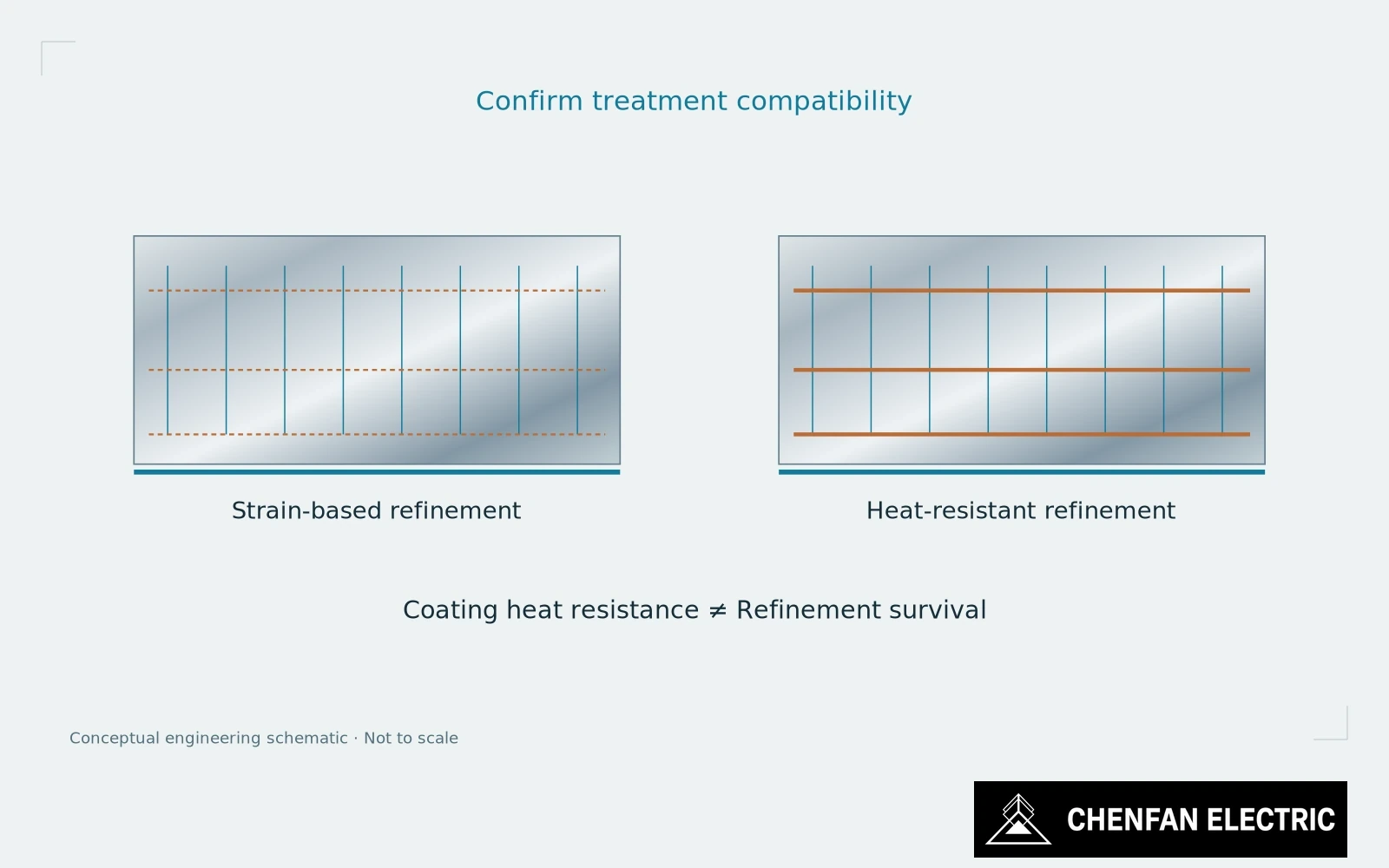
Distinguish heat-resistant refinement from coating
Some domain-refinement treatments use controlled local strain to narrow magnetic domains and reduce a component of eddy-current loss. Stress-relief annealing can remove that benefit. Other treatments create heat-resistant refinement, for example through appropriate groove-forming processes.
These are not interchangeable products simply because their thickness and quoted W/kg look similar. JFE distinguishes non-heat-resistant and heat-resistant domain-refined products in its material offering. The treatment class matters before a thermal process is approved.
There is a second trap. A coating can withstand a stated thermal cycle while the domain-refinement effect does not. Coating heat resistance is not evidence that the original magnetic-loss advantage survives the same cycle.
Review the actual thermal and mechanical route
The material review therefore needs the actual sequence: incoming condition, cutting, any intermediate heating, assembly, drying or other thermal exposure. Ask the steel producer about the specific temperature, duration and atmosphere involved. Do not replace that discussion with a generic claim that the steel is “annealable.”
Ordinary transformer drying and stress-relief annealing are also not the same treatment. Calling every thermal exposure destructive would be just as misleading as assuming every refinement is heat-proof.
Mechanical processing remains relevant even where no incompatible heating occurs. A refined sheet still has cut edges, joints and a clamped working condition. The improvement measured under the producer’s test conditions does not specify the size of the improvement in every core geometry.
Qualify the material through the intended process
For qualification, retain a reference from the delivered material and evaluate representative processed material or cores through the intended route. Keep the comparison at a matched operating point. A change of grade, refinement treatment or thermal route should not disappear inside a purchasing substitution.
The practical decision is quite specific: select the refinement for the process you will actually use, then preserve that process identity in production.
Before authorizing a heat treatment, who has confirmed that it protects the magnetic characteristic named in the purchase order?
Practical takeaway
A treatment intended to relieve manufacturing stress can erase a purchased domain-refinement benefit.
Chenfan Electric manufactures custom transformer cores according to customer drawings. Where applicable to the specified material and core design, agreed process controls include burr height below 0.02 mm and stacking factor above 97%. Measurement methods and acceptance conditions are defined for each order.