

The torque wrench clicks. The core is still not telling you whether the clamp load is right.
A clamping system has several jobs: maintain geometry, prevent unacceptable movement and provide the restraint assumed by the design. The magnetic assembly also experiences the pressure distribution created by that system.
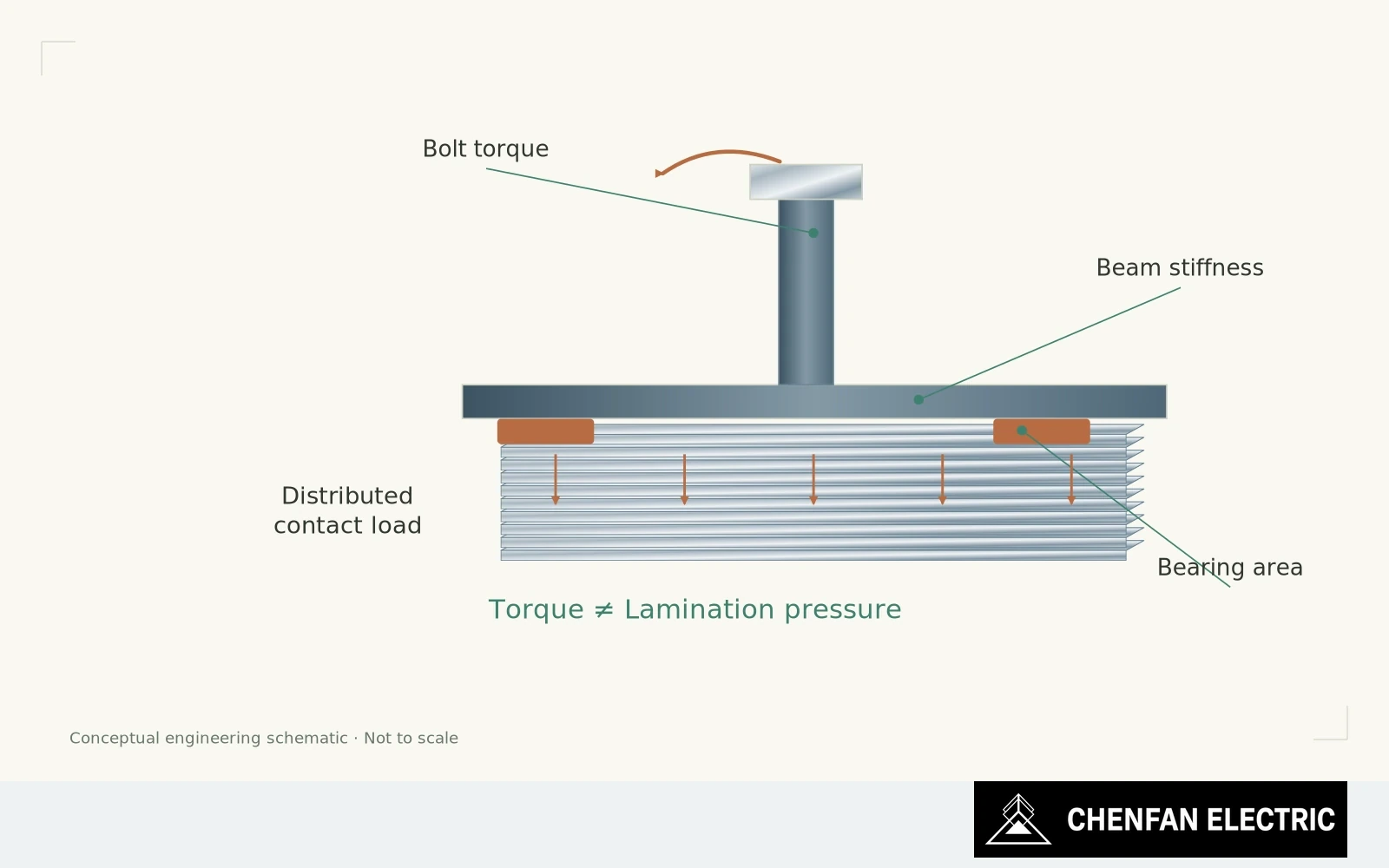
Define a design-specific restraint window
Too little restraint can allow movement or an unstable joint condition. Increasing restraint can change contact, stiffness and vibration response. It can also impose an undesirable stress state on the laminations. The useful target is an approved operating window, not the highest force the fasteners can deliver.
That window belongs to a particular structure. Clamp span, bearing area, insulating pads, stack geometry and support arrangement determine how the load reaches the steel. Transferring a torque value from a smaller core or a different clamp design does not reproduce the same pressure distribution.
Noise does not provide a simple adjustment rule either. Tightening may suppress one movement while changing a structural resonance or magnetic stress response elsewhere. JFE’s vibration work distinguishes material magnetostriction from the vibration of the assembled structure; a quieter local observation does not automatically establish lower total loss or standardized sound performance.
Check magnetic and structural response together
Qualification should therefore observe mechanical stability and magnetic response together. Use the design-approved load range and a controlled tightening sequence. Record loss, exciting current and the relevant vibration or sound measure at defined states, with the same excitation and support conditions.
Do not interpret one favourable point as a universal optimum. Repeatability matters, including what happens after the approved handling operation and after the joint has settled as specified by the process. Any retightening requirement should come from the validated design, not from an operator’s instinct to remove every visible gap.
Make the accepted clamped state reproducible
For purchasing, the useful question is how the supplier establishes and reproduces the clamped state. A photograph of heavy steelwork cannot answer it. Nor can a certificate listing fastener sizes without the assembly procedure and inspection basis.
Where the buyer supplies the clamp design, responsibility should be explicit. The core maker may control assembly execution while the transformer designer controls the load requirement and insulation interfaces.
A well-designed clamp makes the mechanical state reproducible. The acceptance target is not “tight”. It is stable geometry with a magnetic and structural response that has been verified for the intended assembly.
Practical takeaway
A torque reading does not establish the pressure distribution or magnetic suitability of a clamp.
Chenfan Electric manufactures custom transformer cores according to customer drawings. Where applicable to the specified material and core design, agreed process controls include burr height below 0.02 mm and stacking factor above 97%. Measurement methods and acceptance conditions are defined for each order.