

A water heater can shift electrical input while drawing on stored thermal energy. PNNL’s end-use model distinguishes thermostatic cycling from instantaneous electrical demand [1]. Retain service reserve and recovery instead of treating every heater as an interchangeable kW block.
Use service constraints supplied by the appliance owner
Record the permitted operating envelope, relevant appliance protections and required service. Do not replace those settings with a generic temperature recommendation. The scheduling model should identify the thermal state it estimates, the measurements available and the uncertainty left by unobserved water use.
A tank balance tracks input, draw-off and heat loss. For a uniformly mixed approximation, sensible energy change is mcₚΔT [2]. Stratification and actual draw patterns may require more states; choose the model for the service decision rather than inferring usable hot water from electrical on/off alone.
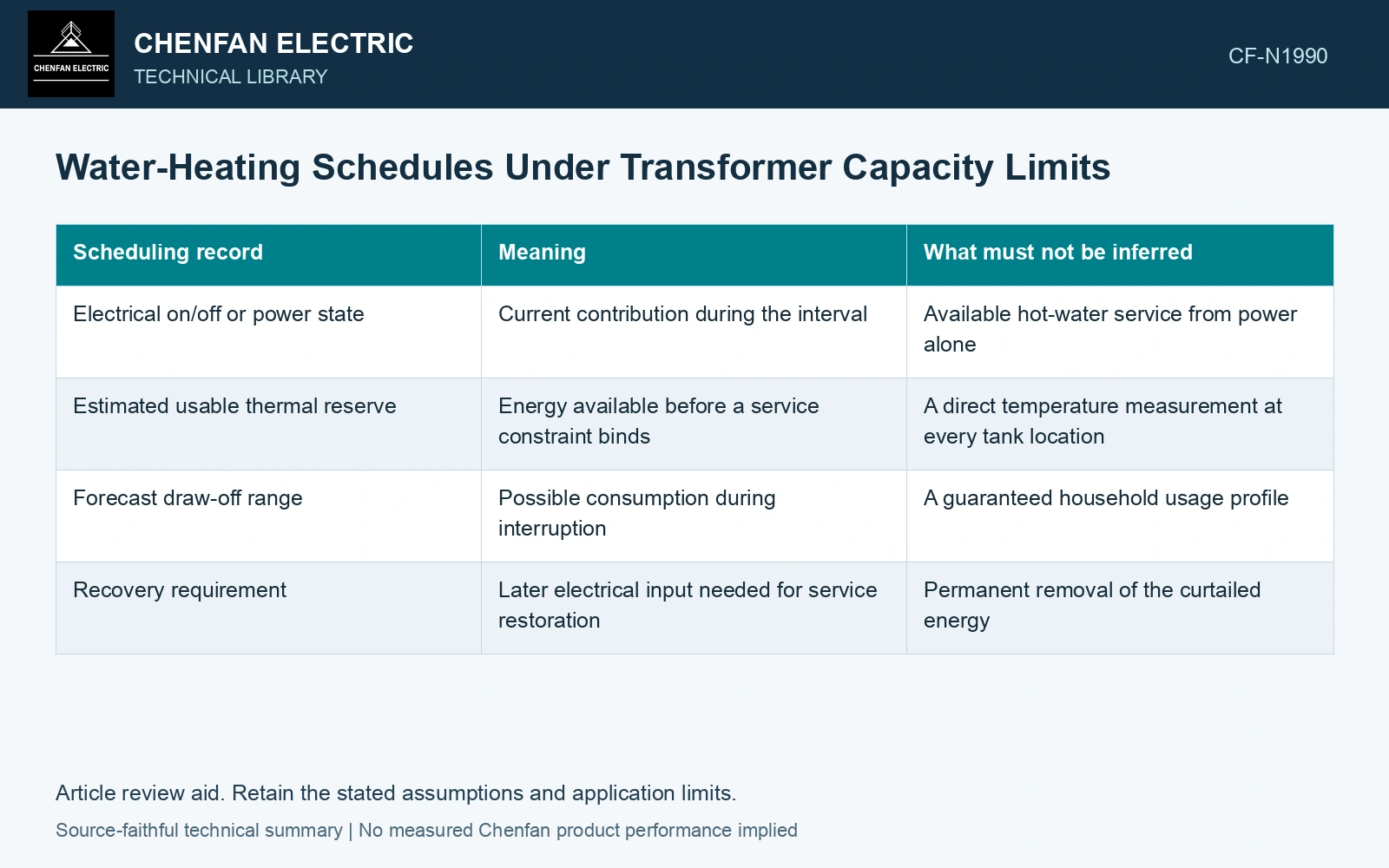
| Scheduling record | Meaning | What must not be inferred |
|---|---|---|
| Electrical on/off or power state | Current contribution during the interval | Available hot-water service from power alone |
| Estimated usable thermal reserve | Energy available before a service constraint binds | A direct temperature measurement at every tank location |
| Forecast draw-off range | Possible consumption during interruption | A guaranteed household usage profile |
| Recovery requirement | Later electrical input needed for service restoration | Permanent removal of the curtailed energy |
Allocate interruptions according to remaining flexibility
Two heaters drawing the same power can have different interruption allowances. One may have a well-observed thermal reserve and another may be near its service boundary. Allocate according to the credible reserve and operating permissions, while respecting each heater’s phase connection and the transformer’s current and thermal conditions.
If draw-off is uncertain, test the proposed interruption against plausible consumption rather than only the forecast mean. The controller should expose an infeasible service requirement instead of quietly relaxing it. Appliance safety controls remain independent and may override the scheduling command; their operation is part of the actual availability.
Include recovery in the transformer trial
Record when heaters resume, which actually respond and how the transformer current changes. A simultaneous recovery can create a second constrained interval. Compare release schedules with equivalent service restoration, not merely equivalent event duration.
Assume ten water heaters each need 4 kWh before the same deadline, giving 40 kWh total. If the verified transformer active-power headroom is assumed to be 10 kW for 3 h, only 30 kWh can be delivered in that interval. The 10 kWh shortfall remains even with perfect scheduling and no switching delay. Move part of the heating to another qualified interval or revise the service commitment; sequencing cannot create missing energy capacity. Recheck phase current and recovery when multiple heaters are re-enabled.
When the trial leaves water-heating services unfinished, distinguish unavailable appliance-state information from insufficient transformer headroom. Check the recovery load before committing the same resource pool to another event. Better state observation, a revised release order and a smaller commitment address different causes.
References
- K. P. Schneider, J. C. Fuller, F. K. Tuffner and R. Singh, Evaluation of Conservation Voltage Reduction (CVR) on a National Level, PNNL-19596, July 2010.
- U.S. Department of Energy, DOE-HDBK-1012/2-92, Thermodynamics, Heat Transfer, and Fluid Flow, Volume 2, 1992.