

Jain evaluates EV control against a defined load/thermal history [1]. A day-ahead schedule uses predicted load and available flexibility. Alyami’s scheduling model assumes static capacity and accurate predictable loads [2]; a plan facing forecast/participation error needs corrective resources that remain available.
Record the error sources separately
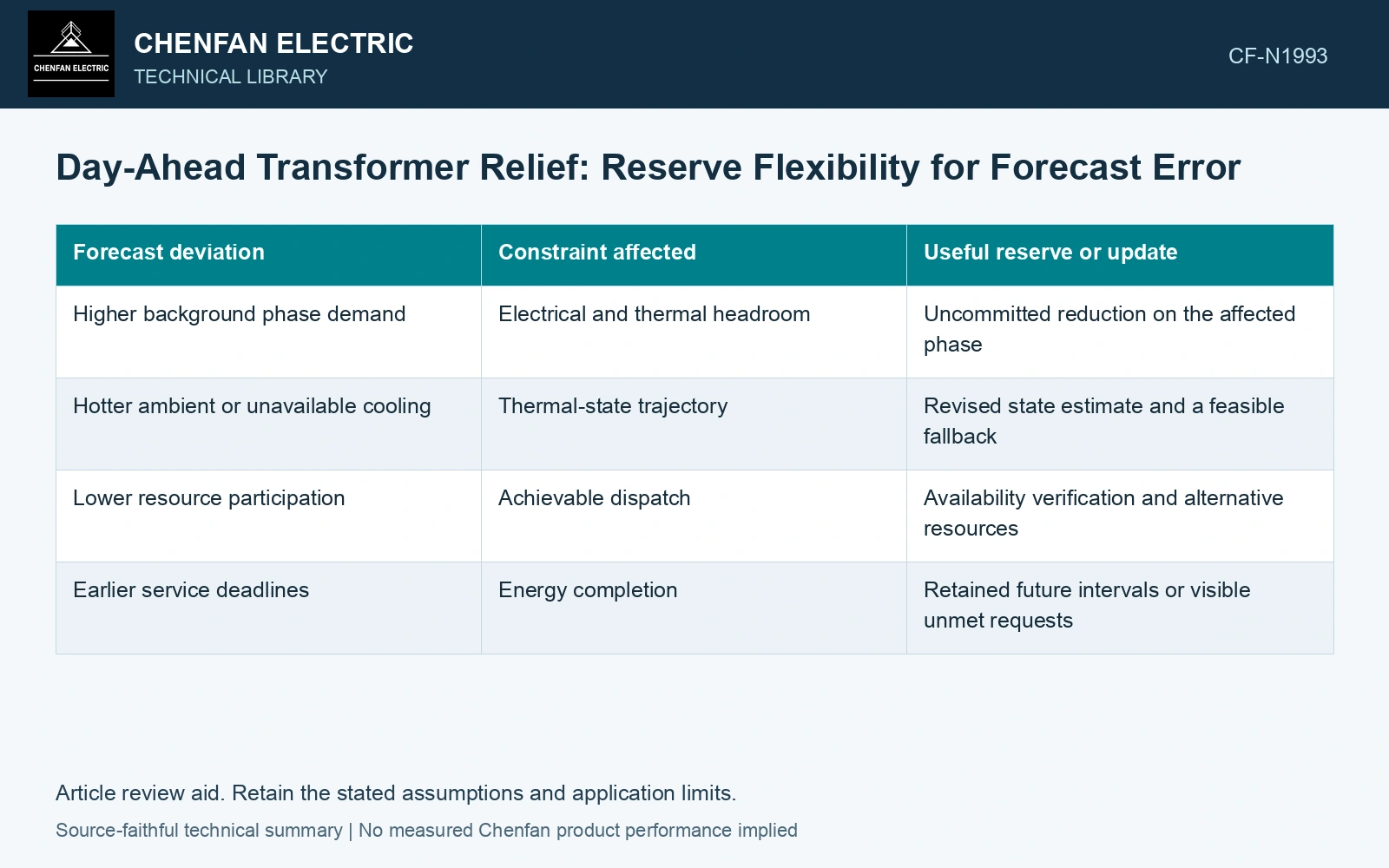
Nonflexible load, ambient conditions, device availability and service requests can all depart from prediction. They do not affect the schedule in the same way. Extra nonflexible demand consumes electrical margin, hotter ambient conditions can reduce thermal margin, and a disconnected resource removes an action the controller expected to use.
| Forecast deviation | Constraint affected | Useful reserve or update |
|---|---|---|
| Higher background phase demand | Electrical and thermal headroom | Uncommitted reduction on the affected phase |
| Hotter ambient or unavailable cooling | Thermal-state trajectory | Revised state estimate and a feasible fallback |
| Lower resource participation | Achievable dispatch | Availability verification and alternative resources |
| Earlier service deadlines | Energy completion | Retained future intervals or visible unmet requests |
Reserve an action that exists at the time of need
An aggregate reserve in kW should identify which resources can supply it, on which phases and for how long. A charger expected to disconnect before the critical interval is not a reserve for that interval. A battery at its protected energy reserve may have a power rating but little available discharge duration.
Test the day-ahead schedule under several plausible combinations of errors. Do not assume every adverse deviation is independent or sum arbitrary worst cases without a defined scenario. The objective is a reviewable envelope of uncertainty and corrective capability, with the combinations and their basis visible.
Roll the plan forward using actual state
At each update, retain energy already delivered and obligations still outstanding. Replace the starting thermal state with the best available estimate based on actual history. Reoptimizing from an assumed cool initial condition can manufacture capacity that the transformer has not recovered.
Compare the fixed plan with a rolling plan under the same realized demand and resource participation. Report phase currents, thermal conditions, corrective actions and unmet services. A rolling plan should not receive credit merely because it was allowed to change the customer requirements after observing the error.
Use forecast failure to improve a specific input
Assume fixed voltage and unity power factor at one boundary, so the following kVA changes add algebraically. Project envelope is 500 kVA; uncontrolled forecast 550 kVA with one-sided error allowance 20 kVA requires 70 kVA relief. A fictional 80 kVA portfolio with 25% unavailable delivers 60 kVA; residual loading is 510 kVA. Reserve another qualified 10 kVA block or reduce the commitment. Ratings alone cannot supply response after a resource leaves or exhausts its permitted energy.
A correct forecast with poor device participation needs an execution correction. A consistent weather-related demand bias needs a forecasting correction. Keep those errors separate when changing reserve, so additional margin does not conceal a fault in the control path.
References
- A. Jain and M. Karimi-Ghartemani, Mitigating Adverse Impacts of Increased Electric Vehicle Charging on Distribution Transformers, Energies 15, 9023, 2022. DOI: 10.3390/en15239023.
- S. Alyami, Ensuring Sustainable Grid Stability through Effective EV Charging Management: A Time and Energy-Based Approach, Sustainability 16, 6149, 2024, section 3. DOI: 10.3390/su16146149.