


Transformer Core Engineering Notes · CF-N246
A water-cooled transformer depends on both its oil circuit and the site’s water system. The heat exchanger sits between two suppliers’ responsibilities, so its rating must state the conditions on both sides. Water availability, quality, pressure and fault response can be as important as the nominal heat-transfer capacity.
Specify a complete thermal duty point
State the oil and water inlet conditions, required heat duty and allowable temperature changes, together with the flow basis on both sides. A heat-exchanger capacity quoted with colder water may not apply to the site’s summer supply. Include the relevant ambient or seasonal water profile in the review. Keep the exchanger’s component rating separate from the complete transformer’s winding-temperature guarantee and ask how the OEM has connected the two.
Define hydraulic and material boundaries
Identify allowable pressure, pressure drop, connection sizes and the materials exposed to the water. The site must provide water quality consistent with the exchanger supplier’s requirements. Scaling, corrosion or biological fouling can alter performance and maintenance needs. Do not specify water quality limits from a generic article; obtain the requirements for the selected exchanger and actual water source. Record which party owns treatment, filtration and the maintenance of the supply system.
Plan for leakage and loss of water
The design should address the consequences of a leak between circuits and loss of water flow. Pressure relationships, construction features and detection arrangements must be selected by the responsible designers for the particular system. Do not assume one universal oil-to-water pressure rule covers every exchanger design. Define alarms, isolation responsibilities and permitted transformer operation after a cooling fault, including the availability of any standby exchanger or alternative cooling mode.
Make commissioning a shared acceptance task
The acceptance plan should verify the supplied water conditions, oil-circuit integration, control signals and agreed failure responses. A factory test of the exchanger cannot establish the site’s available water flow or seasonal temperature. Record the final operating basis and any restrictions. If the water source, exchanger or pump changes later, reassess the coupled system rather than treating each component’s separate certificate as proof of unchanged transformer performance.
| Review item | Evidence to request | Boundary to preserve |
|---|---|---|
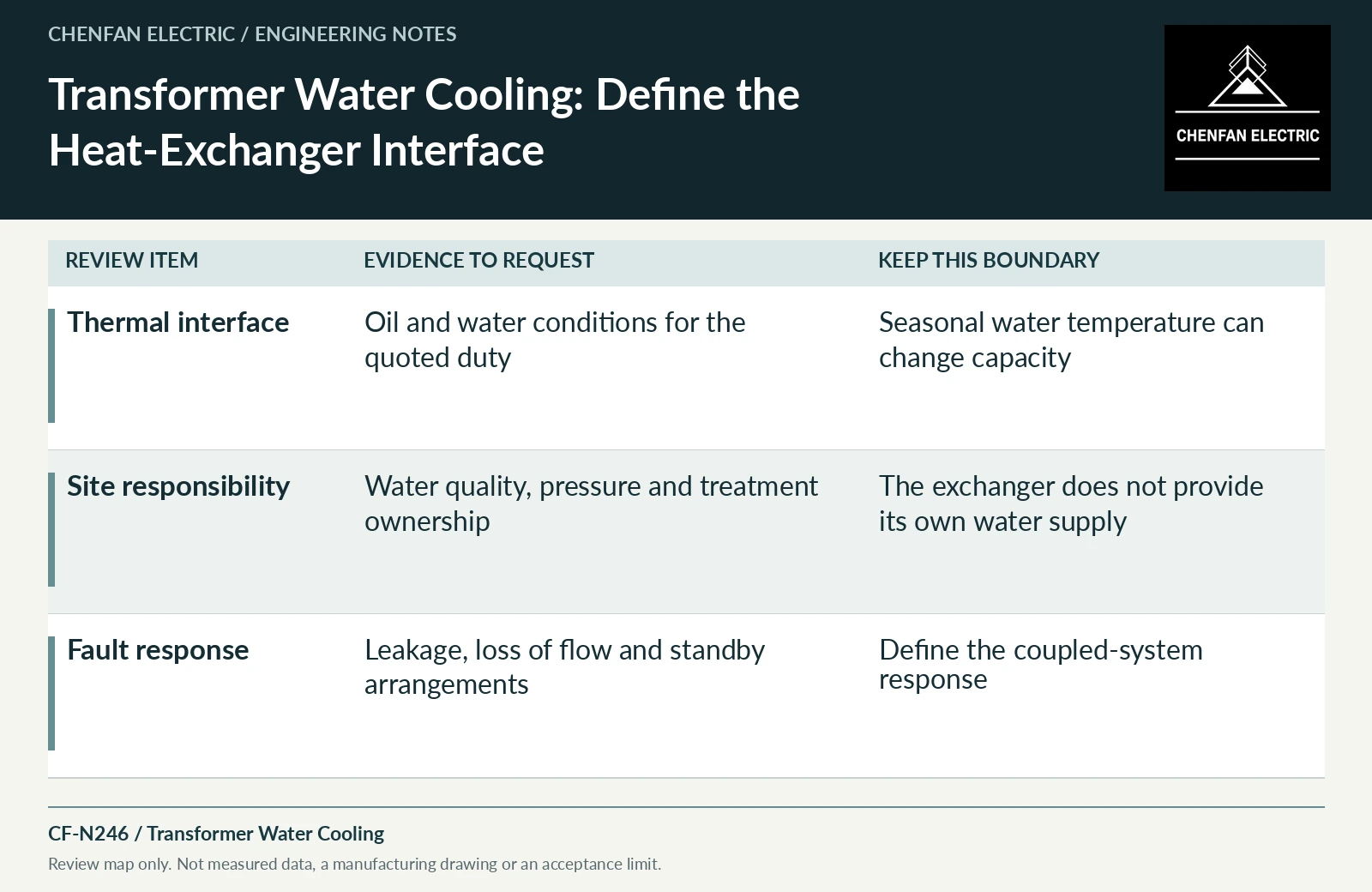
| Thermal interface | Oil and water conditions for the quoted duty | Seasonal water temperature can change capacity |
| Site responsibility | Water quality, pressure and treatment ownership | The exchanger does not provide its own water supply |
| Fault response | Leakage, loss of flow and standby arrangements | Define the coupled-system response |
References and scope
- IEC 60076-2:2011 — Temperature rise for liquid-immersed transformersPublic standard abstract · Temperature-rise requirements, cooling identification and the distinction between test conditions and installed duty.
- IEEE C57.91-2025 — Loading Mineral-Oil-Immersed Transformers and Step-Voltage RegulatorsPublic standard abstract · Mineral-oil loading, thermal duty and loading beyond nameplate; do not transfer the scope automatically to ester or dry-type equipment.
- IEEE C57.165-2024 — Temperature Monitoring of Liquid-Immersed TransformersPublic standard abstract · Temperature-monitoring methods for liquid-immersed transformers and their measurement/model boundaries.