

A wastewater-plant transformer should be located and specified using the atmosphere at the actual equipment position, not the plant name alone. Process gases, moisture, flooding and cable routes can create different exposure zones. The best solution may involve separating electrical equipment from a severe atmosphere rather than relying only on stronger coatings after the layout is fixed.
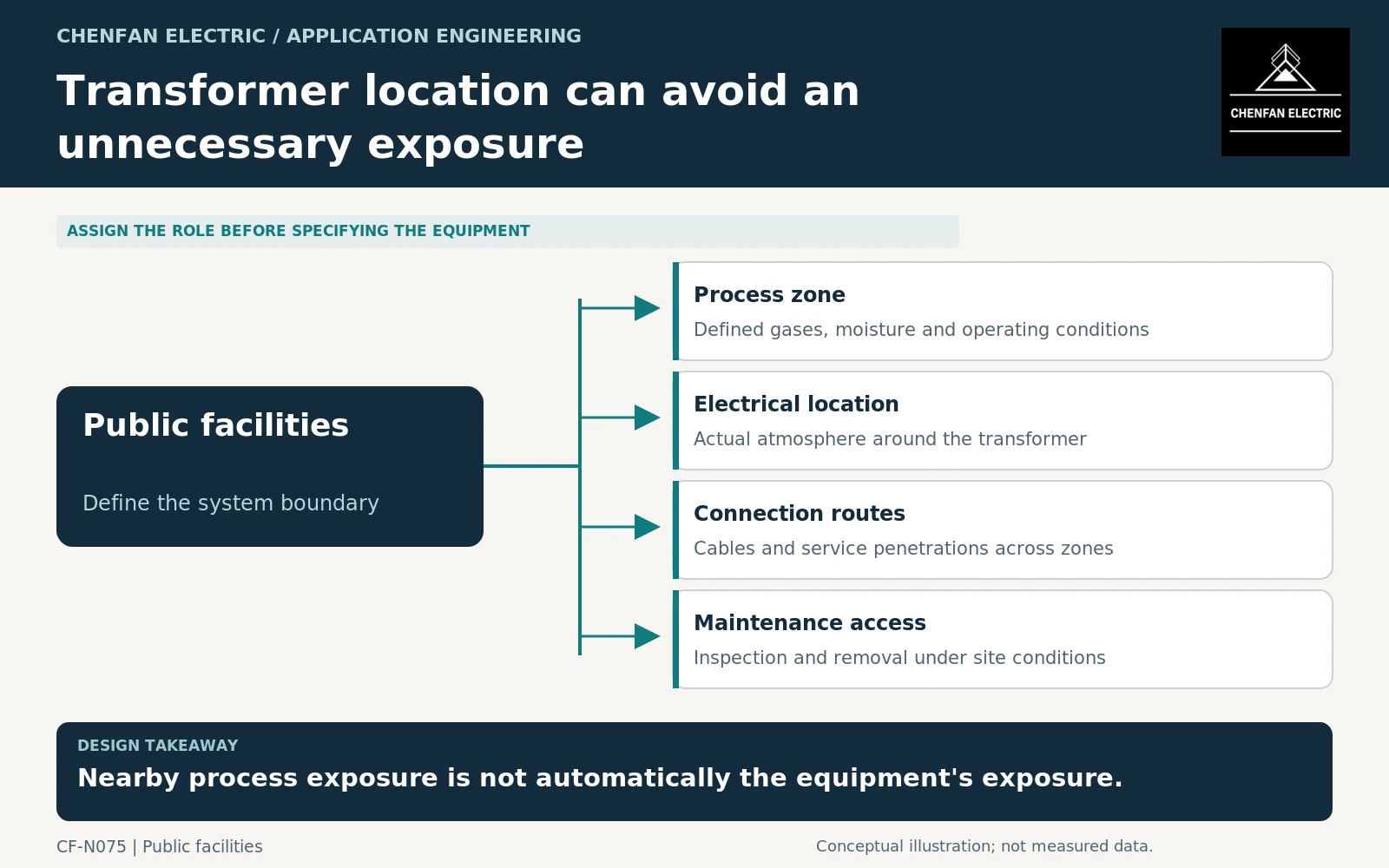
Map exposure and service boundaries together
Obtain the process and site assessment for relevant gases, humidity, wetting and flood conditions. Identify whether the transformer is inside a process area, in a separate electrical building or outdoors with a different exposure.
Do not assume that every location near wastewater treatment has the same corrosive or hazardous atmosphere. Any hazardous-area classification requires a separate specialist assessment under applicable project requirements; this article does not classify the site or approve equipment for such an area.
General transformer requirements provide an equipment framework, while the project must state the actual unusual service conditions. [1]
A location decision should also consider cable length, access and the continuity of essential process loads. Moving equipment away from an exposure can create other interfaces that need evaluation rather than being treated as a free improvement.
Review more than the painted enclosure
Corrosive exposure can affect cooling equipment, terminals, glands, fasteners, seals and controls as well as the main enclosure. Ask for a material and protective-system schedule that identifies what is covered and what remains customer supplied.
ISO 12944-2 provides environmental classification for corrosion protection of steel structures within its scope. It is not a complete chemical-compatibility certificate for a wastewater electrical assembly or a guarantee of service life. [2]
Enclosure ingress protection is a separate requirement. IEC 60529 does not establish resistance to every gas, condensation cycle or flood event. [3] An IP label should therefore not replace the atmosphere and water-exposure review.
A useful boundary map shows the transformer environment, the routes by which cables and services cross into other zones, and the locations of auxiliaries that must remain available. Low-mounted controls or cable trenches may face a different water risk from the transformer body.
Tie maintenance and continuity to the chosen location
The layout should permit inspection, cleaning and approved repair of exposed components. If the protection concept depends on maintenance, identify how that work can be performed without creating an unacceptable loss of process service.
Record the removal route and the systems that must be isolated for replacement. A transformer in a protected room may still be difficult to replace if the access route is later blocked by process equipment or pipework.
The electrical duty should be specified independently through the pump, blower, drive and auxiliary load schedule. Environmental suitability does not establish capacity, and adequate MVA does not establish material compatibility.
The procurement package should combine the exposure map, material schedule, equipment layout and operating-load cases. Assign responsibility for each unresolved boundary instead of describing all environmental work as “by others.”
The final acceptance question is location-specific: does the proposed assembly, installed where shown and maintained as assumed, address the stated atmosphere and water conditions while supporting the required process service? That is more defensible than ordering a generic wastewater-duty transformer and expecting a coating upgrade to solve every site interface.
Core procurement checkpoint: Define preservation for the supplied parts, not the whole plant
For a wastewater project, identify which core components and hardware are included and how they will be protected before assembly. Electrical-steel coating, hardware finish and finished-enclosure protection should remain separate specifications. Core inspection documents can establish agreed manufacturing conformity, but they do not qualify the completed transformer or installation for an unspecified corrosive or hazardous atmosphere.
For the core enquiry: Supplied-part schedule; steel/coating requirement; hardware finishes; packing/storage conditions; complete-equipment environmental qualification owner.