

A cold-storage transformer’s restoration duty can differ significantly from normal cycling. After a common power interruption, several compressors and auxiliaries may request operation together, while the facility requires a prolonged recovery period. The specification should include the actual restart sequence and failure behavior rather than relying on the diversity observed during stable operation.
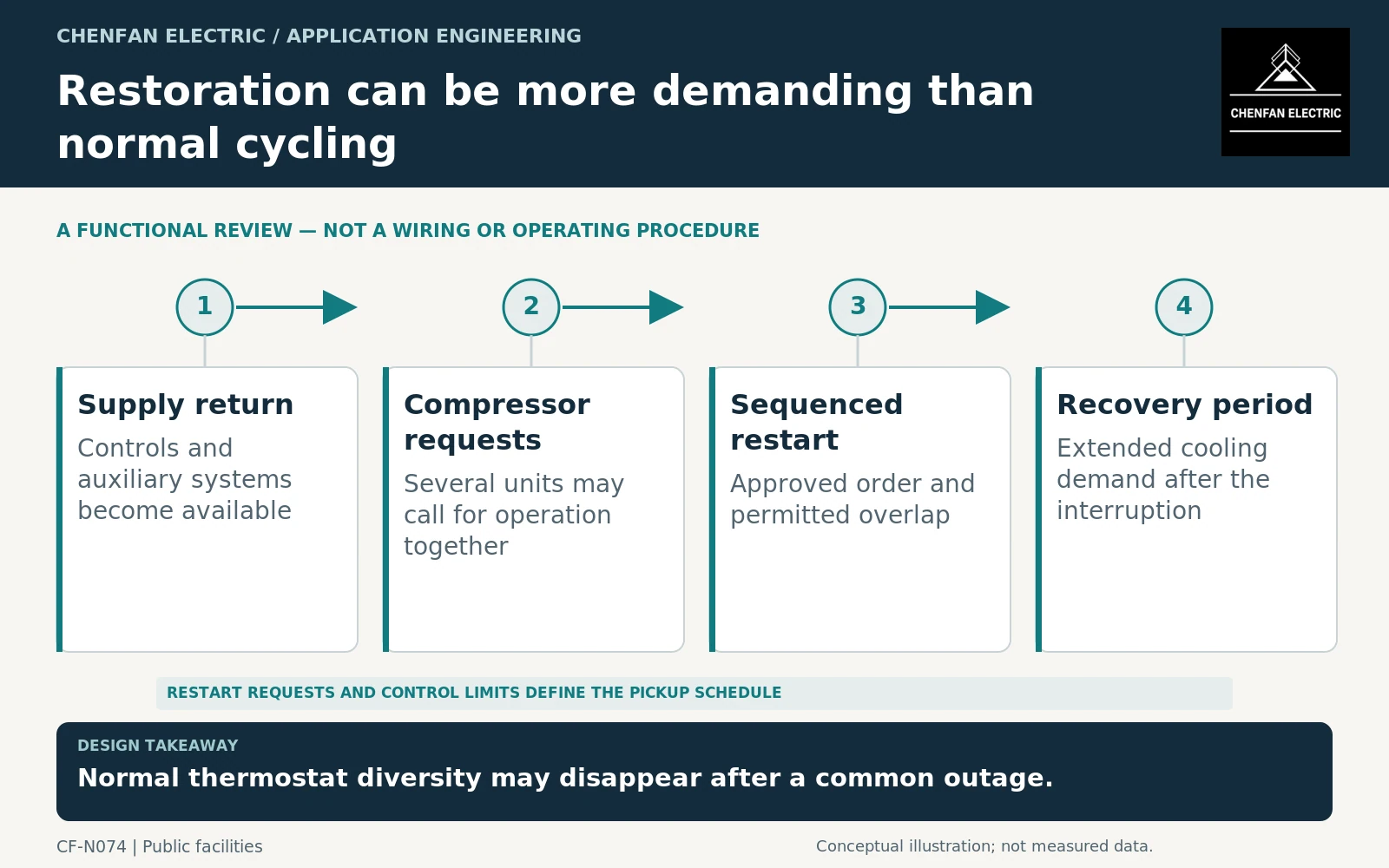
Identify what restarts and what waits
List compressors, evaporator and condenser fans, pumps, controls, lighting and defrost equipment supplied by the transformer. Record starting methods and the conditions under which each load is enabled after power returns.
The refrigeration control design should state any delays, interlocks and permitted overlap. This article does not prescribe compressor restart timing or process operating procedures; those must come from the equipment and refrigeration design.
Motor-starting analysis tools explicitly consider starting methods and sequence-of-events behavior. Their relevance is the need for a coordinated model of the motors and source, not evidence that a particular cold store has already been assessed. [1] [2]
Do not assume normal diversity survives the outage
During steady operation, individual thermostats and process conditions may spread demand over time. A common outage can align recovery requests. Whether that creates a severe electrical case depends on the implemented sequence and the actual load state.
General transformer application guidance addresses loading and voltage behavior, but the site must supply the restoration cases. [3]
An illustrative case could involve one compressor starting while several others are already running, followed by sustained recovery demand. Another could involve loss of the sequencing controller and its documented fallback. These are case definitions, not recommended start orders.
The study should also identify the source: utility, generator or another configuration. A sequence acceptable on one source may need review on a weaker alternative.
Separate the start event from the recovery plateau
Voltage response during acceleration and transformer heating during extended recovery are different questions. Both matter. A short event that is thermally acceptable may still disturb other equipment, while a successful start does not prove that the following hours of high load are covered.
Include any defrost or auxiliary demand permitted during recovery. Do not add mutually exclusive loads as though they always coincide, but retain the controls that enforce the exclusion.
Use the applicable transformer loading framework with actual ambient, initial temperature and cooling conditions. Mineral-oil loading guidance provides one defined approach; it is not a universal emergency allowance for refrigeration recovery. [4]
Make the restoration state part of procurement
The transformer enquiry should include normal duty, approved restart combinations, sustained recovery demand and relevant alternate-source cases. Ask the supplier for the parameters needed by the motor and system studies and confirmation of the resulting equipment duty.
Acceptance should compare the implemented refrigeration sequence with the assessed one. Controller changes, additional compressors or a revised defrost policy can alter the restoration case without materially changing average energy consumption.
The operating handover should identify which restrictions are required to keep the electrical duty within the approved envelope. Those restrictions must remain compatible with the refrigeration process and product-protection requirements defined by the responsible specialists.
A useful transformer specification therefore covers both the stable cold store and the recovering cold store. Treating the latter as an afterthought can leave the most coordinated load event in the facility outside the original design basis.
Core procurement checkpoint: Do not treat restart success as a material property
A cold-storage restart sequence needs the equipment and network checks described above. The core supplier should receive the transformer’s approved magnetic design and any agreed inspection requirements, not a request to guarantee restart from steel grade alone. Where replacement units are planned, preserve drawing revision and dimensional interfaces so that repeat cores match the intended winding and clamp assembly.
For the core enquiry: Approved transformer/core design; replacement interface dimensions; material specification; inspection records; owner of restart-sequence validation.