


Transformer Core Engineering Notes · CF-N235
Vacuum drying and vapour-phase drying are process descriptions, not quality grades. Vapour-phase processing uses a heating medium to transfer heat and normally includes vacuum stages; it is not simply the opposite of vacuum drying. The buyer should compare process suitability, control and endpoint evidence for the actual active part, rather than choosing by equipment name.
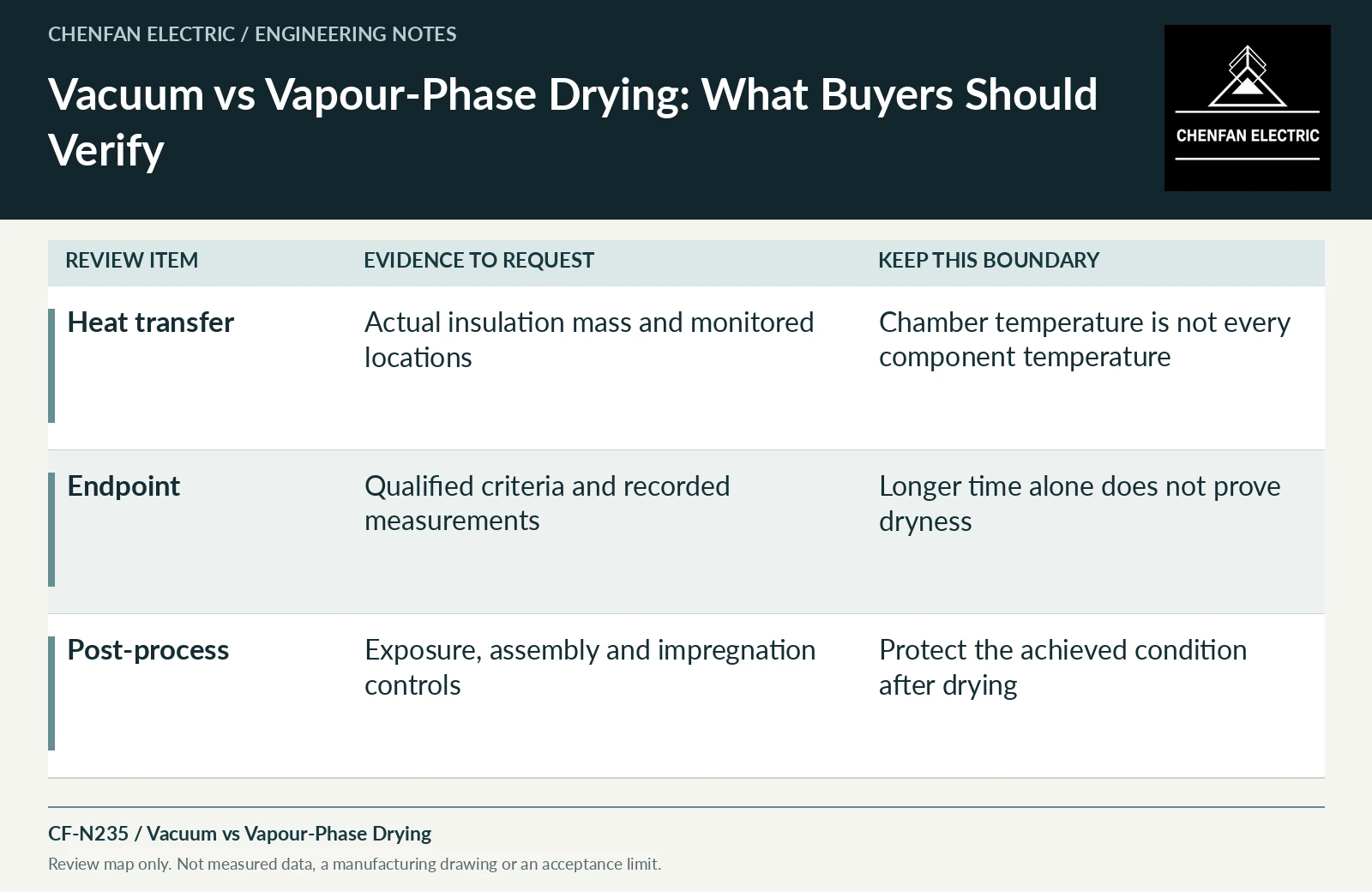
Ask how heat reaches the insulation
Removing moisture requires appropriate heat transfer as well as pressure conditions. A large active part contains different insulation thicknesses and thermal paths. The process must avoid leaving slow-heating regions inadequately treated while other regions approach their material limits. Request the process qualification and the basis for representative temperature monitoring. Chamber temperature alone does not demonstrate the condition of every internal paper or pressboard component.
Match the process to the materials and equipment
The chosen materials, adhesives, coatings and any already installed accessories must tolerate the approved process. Mechanical capability also matters when vacuum is applied to a vessel or transformer tank. A process that works for one assembly may not be suitable for another configuration with different insulation mass or sensitive components. Do not prescribe temperatures, vacuum levels or heating-medium conditions without the responsible manufacturer’s validated procedure and equipment limitations.
Review endpoint evidence instead of cycle duration alone
A long cycle is not automatically a successful cycle. Ask which measurements indicate progress and completion, how instrument accuracy is controlled and how abnormal trends are handled. Relevant evidence may include temperature history, pressure behaviour and extracted moisture, depending on the qualified process. The acceptance criteria must come from that process, not from a generic number of hours. Keep the active-part identity linked to its actual production record.
Protect the result after the dryer opens
Post-drying handling, assembly exposure and impregnation are part of the overall moisture-control chain. A well-controlled drying cycle can be undermined by uncontrolled exposure afterwards. Define the storage atmosphere, permitted work conditions and the response if those conditions are exceeded. Weidmann’s moisture guidance emphasizes the effect of moisture on insulation dimensions and integrity. Process selection should therefore be judged together with the subsequent handling plan and final acceptance evidence.
| Review item | Evidence to request | Boundary to preserve |
|---|---|---|
| Heat transfer | Actual insulation mass and monitored locations | Chamber temperature is not every component temperature |
| Endpoint | Qualified criteria and recorded measurements | Longer time alone does not prove dryness |
| Post-process | Exposure, assembly and impregnation controls | Protect the achieved condition after drying |
References and scope
- Moisture protection of transformer insulation materialsManufacturer technical page · Moisture-sensitive handling, storage and protection of cellulosic insulation.
- IEEE C57.162-2025 — Interpretation of Moisture Related Parameters in Liquid Immersed Transformers and ReactorsPublic standard abstract · Moisture-related interpretation for liquid-immersed transformers; this is not a DGA guide.
- IEEE C57.100-2022 — Thermal Evaluation of Insulation Systems for Liquid-Immersed TransformersPublic standard abstract · Thermal evaluation of insulation systems for liquid-immersed transformers; not a dry-type qualification reference.