


Transformer Core Engineering Notes · CF-N236
A drying endpoint should indicate that the approved process objective has been achieved for the specific active part. Elapsed time is only one process record. Without temperature, pressure and moisture-related evidence appropriate to the process, a statement that an assembly spent a certain number of hours in the dryer does not establish its final insulation condition.
Separate a recipe from a completion criterion
A validated process may specify heating stages, pressure stages and minimum durations. Those instructions describe how the process is run. Completion evidence explains why the particular load is ready to proceed. The two should be linked but not confused. Ask which endpoint criteria are mandatory and how deviations are evaluated. An operator’s statement that the normal recipe was followed is not equivalent to a record showing that all required conditions were achieved.
Know what each instrument actually measures
A chamber pressure reading, an extracted-water measurement and a component temperature describe different aspects of the process. Instrument location, calibration and the system’s leak behaviour affect interpretation. A low pressure does not alone prove that internal solids are dry, and a declining extraction rate may require context. The process engineer should define how the measurements are combined and what abnormal patterns require investigation rather than automatic release.
Tie the record to the actual load
Different insulation masses, thicknesses and assembly arrangements can require different process treatment. Record the active-part identity, loading arrangement and any significant deviation from the qualified reference. Do not use another transformer’s successful chart as evidence for the current unit. Where multiple assemblies share a cycle, the monitoring and acceptance basis should explain how the least favourable relevant condition is addressed. This is a process-verification question, not a universal numerical threshold.
Define release and rework responsibilities
The manufacturing plan should identify who reviews the cycle record and what happens if an endpoint or instrument requirement is not met. Retesting, extended processing or engineering assessment must follow the approved procedure. After release, preserve the achieved condition during handling and impregnation. The final quality record should show both the completed drying evidence and the subsequent exposure history, so a later insulation issue can be investigated without guessing what happened between stages.
| Review item | Evidence to request | Boundary to preserve |
|---|---|---|
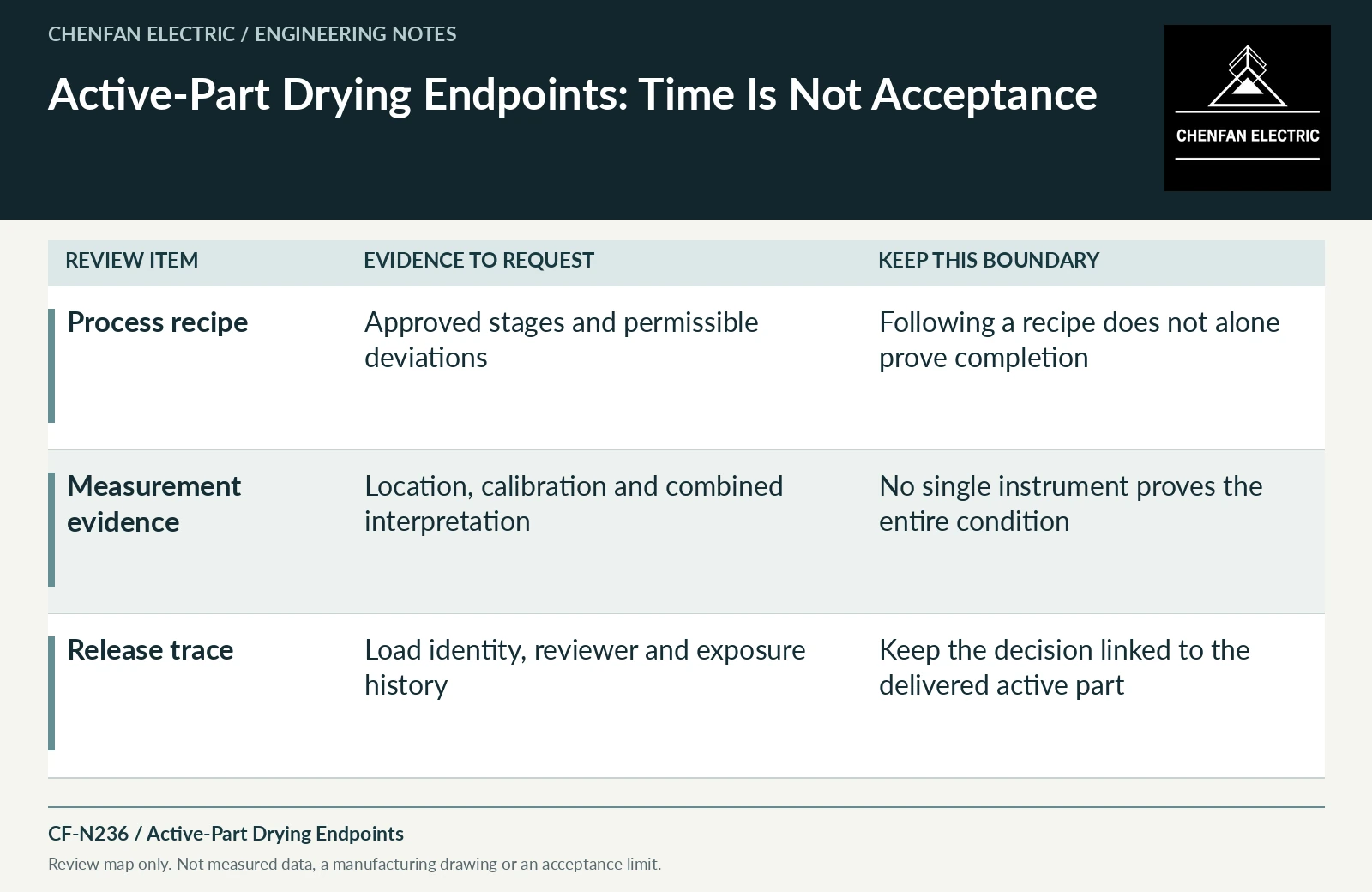
| Process recipe | Approved stages and permissible deviations | Following a recipe does not alone prove completion |
| Measurement evidence | Location, calibration and combined interpretation | No single instrument proves the entire condition |
| Release trace | Load identity, reviewer and exposure history | Keep the decision linked to the delivered active part |
References and scope
- IEEE C57.162-2025 — Interpretation of Moisture Related Parameters in Liquid Immersed Transformers and ReactorsPublic standard abstract · Moisture-related interpretation for liquid-immersed transformers; this is not a DGA guide.
- Moisture protection of transformer insulation materialsManufacturer technical page · Moisture-sensitive handling, storage and protection of cellulosic insulation.
- IEEE C57.100-2022 — Thermal Evaluation of Insulation Systems for Liquid-Immersed TransformersPublic standard abstract · Thermal evaluation of insulation systems for liquid-immersed transformers; not a dry-type qualification reference.