

A temperature dip after a drying-stage pressure change does not necessarily mean the heat supply failed. Evaporation consumes latent heat, and the material can cool while water is being removed. The temperature seen by a surface sensor may differ from the interior where moisture remains. [1]
Write the heat and water terms together
A simplified local balance is C dT/dt = Q̇in − Q̇loss − ṁwhfg. C is in J/K, temperature on a consistent kelvin or Celsius scale, time in seconds, heat rates in watts, water rate in kg/s and latent heat in J/kg. The phase-change heat demand is a separate thermal term; transport and boundary conditions still determine evaporation. [2]
Pressure, temperature and material moisture affect evaporation and transport. Heat conduction into the interior can limit how quickly latent heat is replenished. A single chamber temperature does not describe that local balance.
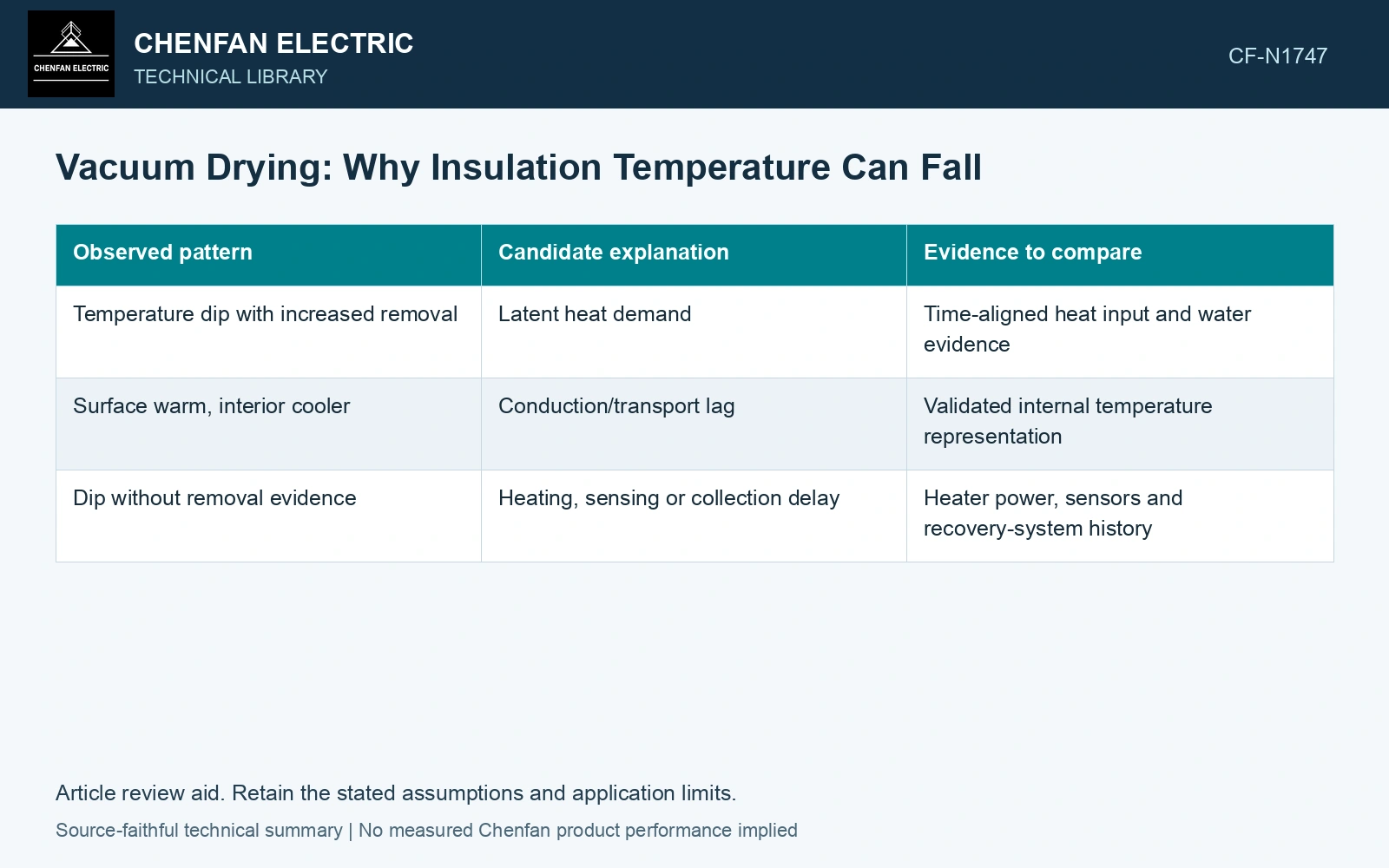
| Observed pattern | Candidate explanation | Evidence to compare |
|---|---|---|
| Temperature dip with increased removal | Latent heat demand | Time-aligned heat input and water evidence |
| Surface warm, interior cooler | Conduction/transport lag | Validated internal temperature representation |
| Dip without removal evidence | Heating, sensing or collection delay | Heater power, sensors and recovery-system history |
Do not assign a unique cause from one trace
Collected water can lag evaporation, and sensor contact can change during heating. Compare timing with the condenser system and verify the temperature channel before attributing a dip solely to moisture removal.
Likewise, a rising temperature can occur because evaporation slows, but it does not prove the centre has reached an accepted moisture condition. Heat and dryness need related, distinct evidence.
Compare the inferred cooling rate with time-aligned heater power and material temperature channels before diagnosing a failed heater.
Compare latent demand with available heating
Assume evaporation is 0.010 kg/s with latent heat 2.3 MJ/kg and local heat input is 15 kW. Latent demand is 23 kW, leaving an 8 kW deficit before other transfers. For assumed effective heat capacity 0.8 MJ/K, initial cooling rate is 0.010 K/s. Check local heat paths and moisture evidence rather than treating temperature dip as a failed heater.
References
- Y. Brahami, A. Betie, F. Meghnefi, I. Fofana and Z. Yeo, Development of a Comprehensive Model for Drying Optimization and Moisture Management in Power Transformer Manufacturing, Energies 18, 789, 2025. DOI: 10.3390/en18040789.
- U.S. Department of Energy, DOE-HDBK-1012/2-92, Thermodynamics, Heat Transfer, and Fluid Flow, Volume 2, 1992.