

Review a rating increase against the new current, loading and cooling envelope. Use the heat run to establish the represented component temperatures, then check the leads, contacts and other limits affected by that duty. [1]
The rating-change review should start with the new duty: terminal voltages, currents, load partition, harmonics, tap range, environmental conditions and required cooling availability. A single increase in the kVA figure conceals those inputs.
Identify the thermal duty the run actually represented
Check measured losses, winding currents and cooling operation against the proposed continuous duty. Review winding average, oil and relevant local component temperatures. Additional cooling can improve bulk oil temperature while an internal lead, tap contact or poorly cooled region remains limiting.
If the run represents one tap, load partition or cooling configuration, state the basis for covering the other permitted cases. A thermal model used for that extension should be supported by relevant measurements rather than by the rating label alone.
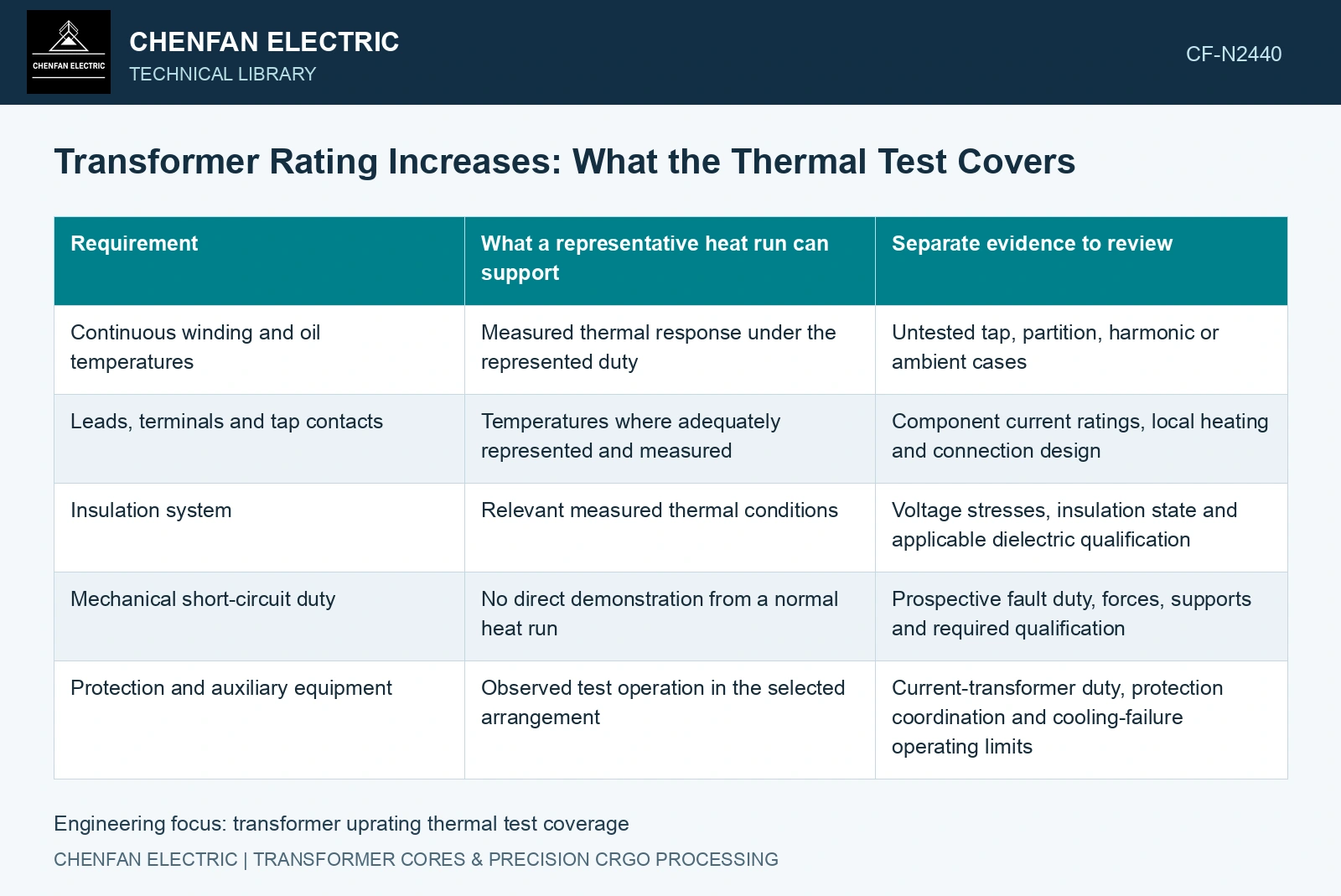
Keep the other qualification evidence visible
| Requirement | What a representative heat run can support | Separate evidence to review |
|---|---|---|
| Continuous winding and oil temperatures | Measured thermal response under the represented duty | Untested tap, partition, harmonic or ambient cases |
| Leads, terminals and tap contacts | Temperatures where adequately represented and measured | Component current ratings, local heating and connection design |
| Insulation system | Relevant measured thermal conditions | Voltage stresses, insulation state and applicable dielectric qualification |
| Mechanical short-circuit duty | No direct demonstration from a normal heat run | Prospective fault duty, forces, supports and required qualification |
| Protection and auxiliary equipment | Observed test operation in the selected arrangement | Current-transformer duty, protection coordination and cooling-failure operating limits |
Use the review matrix to assign the evidence needed for consequential changes under the applicable equipment requirements and change assessment.
Use the actual electrical system for fault-duty questions
A higher rating label does not determine prospective short-circuit current on its own. The supply network, transformer impedance and connection conditions matter. Likewise, retaining the operating voltage and frequency can leave the principal flux condition similar while higher current increases winding and connection heating.
Review the new operating envelope rather than scaling every requirement by the ratio of the two ratings. Different parts respond to different electrical, thermal and mechanical quantities.
Electrical heat input and temperature are different quantities: conduction, convection, radiation and thermal storage determine the resulting component temperatures. [2]
Quantify the current increase before extending the rating
Assume voltage and winding resistance at the comparison temperature are unchanged while rated current rises by 10%. The constant-resistance load-loss term rises by 1.10²−1 = 21%. The heat run must represent that new input and its component distribution; a previous acceptable oil rise does not close the higher-current lead/contact duty.
References
- IEC, IEC 60076-2:2011, Power transformers — Part 2: Temperature rise for liquid-immersed transformers.
- U.S. Department of Energy, DOE-HDBK-1012/2-92, Thermodynamics, Heat Transfer, and Fluid Flow, Volume 2, 1992.