

Account for thermal memory when ambient changes during a heat run. The reference changes immediately while stored heat drives a slower component response [1]. A normalization therefore needs the measured history and supported dynamics.
Keep the rise definition of the governing temperature-rise procedure [2] separate from a diagnostic ambient-normalization model. Identify each reported quantity and correction; the dynamic model does not replace the required test method.
The equipment responds to past ambient conditions
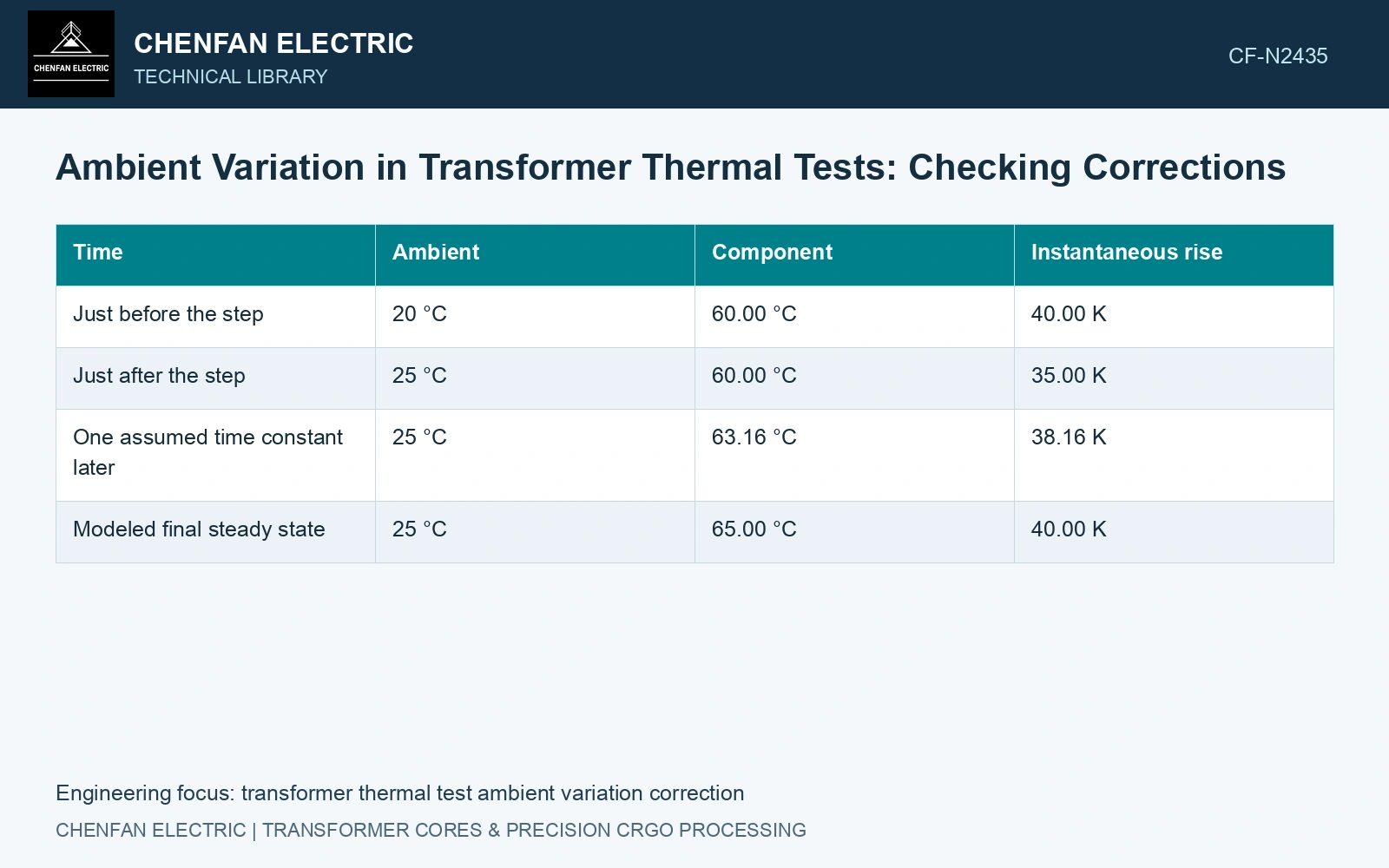
Consider an illustrative first-order node with constant losses and conductance. It starts at60°C in20°C ambient, giving a steady rise of40K. Ambient then steps to25°C. The node temperature is initially still60°C, so the instantaneous rise becomes35K.
With a thermal time constant τ, the component response is T(t) =60 +5(1 − e−t/τ) °C. Its rise against the new ambient is40 −5e−t/τ K. The values demonstrate an assumed linear model at fixed input; they are not a generic transformer correction formula.
| Time | Ambient | Component | Instantaneous rise |
|---|---|---|---|
| Just before the step | 20 °C | 60.00 °C | 40.00 K |
| Just after the step | 25 °C | 60.00 °C | 35.00 K |
| One assumed time constant later | 25 °C | 63.16 °C | 38.16 K |
| Modeled final steady state | 25 °C | 65.00 °C | 40.00 K |
Test the correction against an independently supported model
For a proposed normalization, identify the ambient input, time response and physical assumptions. Check whether losses, fluid properties and cooling performance remain sufficiently constant for the model. A time constant fitted only to remove an inconvenient temperature trend is not an independent validation.
Separate different thermal nodes where the evidence requires it. Oil, winding and structural temperatures may respond differently to the same ambient change. Applying one lag model to every channel can remove a real local anomaly or introduce another.
In this assumed linear node, the energy balance is C dT/dt = P − G(T − Ta), with τ = C/G [1]. Changing Ta therefore changes the heat-removal term before the stored energy and component temperature have responded.
Check the one-time-constant result
For the stated assumed 20-to-25 °C ambient step, component temperature after one time constant is 60+5(1−exp(−1)) = 63.16 °C and rise is 38.16 K. The unchanged eventual 40 K rise does not make the instantaneous 35 K rise a steady result. Preserve the lag when testing a proposed normalization.
Retain the trace that the correction changes
Keep the original component and ambient channels, corrected series, correction parameters and time alignment together. Mark fan, pump and heating changes so the model does not attribute all variation to ambient. Propagate the uncertainty of the ambient input and model parameters into the normalized result.
References
- U.S. Department of Energy, DOE-HDBK-1012/2-92, Thermodynamics, Heat Transfer, and Fluid Flow, Volume 2, 1992.
- IEC, IEC 60076-2:2011, Power transformers — Part 2: Temperature rise for liquid-immersed transformers.