


Transformer Core Engineering Notes · CF-N257
A thermal ageing calculation estimates a defined insulation-ageing measure using a chosen model. It does not predict the calendar date on which the complete transformer will fail. The result becomes useful when the insulation system, temperature history, model parameters and uncertainty remain visible alongside the reported loss-of-life or equivalent-ageing figure.
Name the ageing model and insulation system
Identify the guide edition and the material or insulation system to which the selected parameters apply. A model associated with one paper-liquid system should not be transferred unchanged to another simply because both transformers have the same MVA rating. Distinguish laboratory thermal-endurance evidence from the operational loading model. Where an OEM uses a different justified model, retain its assumptions and approval basis rather than relabelling it as a generic standard result.
Use the relevant temperature history
Ageing models can be strongly temperature-dependent, so a calculation based on an average temperature may differ materially from one using the actual sequence. State whether the input is a predicted hot spot, a direct sensor location or another estimate. Include missing-data treatment and the initial thermal state where needed. A precise cumulative total is not meaningful if the underlying temperature quantity has been misidentified.
Separate thermal ageing from total asset risk
Moisture, oxygen exposure, mechanical events and accessory failures are not automatically represented by a simple thermal-ageing total. Neither does a low calculated thermal exposure demonstrate that a transformer is free of defects. Keep condition assessment and operating history alongside the model result. An estimated fraction of thermal life used should not be converted directly into a guaranteed number of remaining service years.
Report sensitivity instead of false precision
Show how plausible changes in hot-spot estimates or important model parameters affect the conclusion. Record the reference life basis and the integration interval. When comparing operating strategies, use the same justified model and clearly identified input changes. The most defensible output is often a relative assessment of specified alternatives, with stated limitations, rather than a single remaining-life number presented without context.
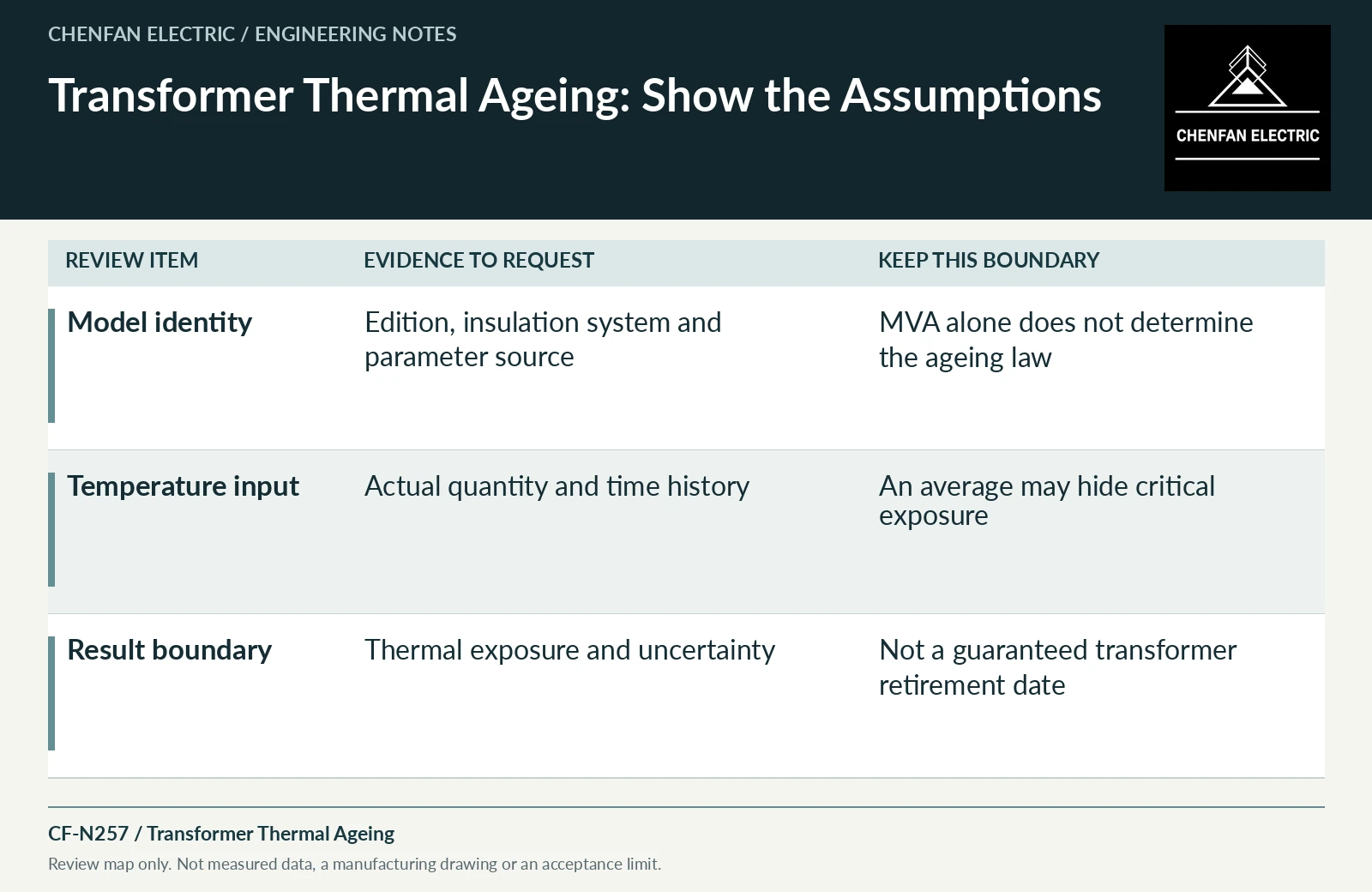
| Review item | Evidence to request | Boundary to preserve |
|---|---|---|
| Model identity | Edition, insulation system and parameter source | MVA alone does not determine the ageing law |
| Temperature input | Actual quantity and time history | An average may hide critical exposure |
| Result boundary | Thermal exposure and uncertainty | Not a guaranteed transformer retirement date |
References and scope
- IEEE C57.91-2025 — Loading Mineral-Oil-Immersed Transformers and Step-Voltage RegulatorsPublic standard abstract · Mineral-oil loading, thermal duty and loading beyond nameplate; do not transfer the scope automatically to ester or dry-type equipment.
- IEC 60076-7:2018 — Loading guide for mineral-oil-immersed power transformersPublic standard abstract · Mineral-oil transformer loading and thermal-ageing framework, not a universal asset-life prediction.
- IEEE C57.100-2022 — Thermal Evaluation of Insulation Systems for Liquid-Immersed TransformersPublic standard abstract · Thermal evaluation of insulation systems for liquid-immersed transformers; not a dry-type qualification reference.
- IEC 60076-14:2013 — Liquid-immersed power transformers using high-temperature insulation materialsPublic standard abstract · High-temperature insulation materials in liquid-immersed transformer systems; no automatic dry-type or retrofit rating transfer.