


Transformer Core Engineering Notes · CF-N260
A temperature-rise test documents performance under a defined configuration and test method. It is not a universal certificate for every related design or operating state. When a supplier proposes to extend an existing result to a new transformer, ask which changes are being bridged, which physical relationships support the extension and where additional evidence is needed.
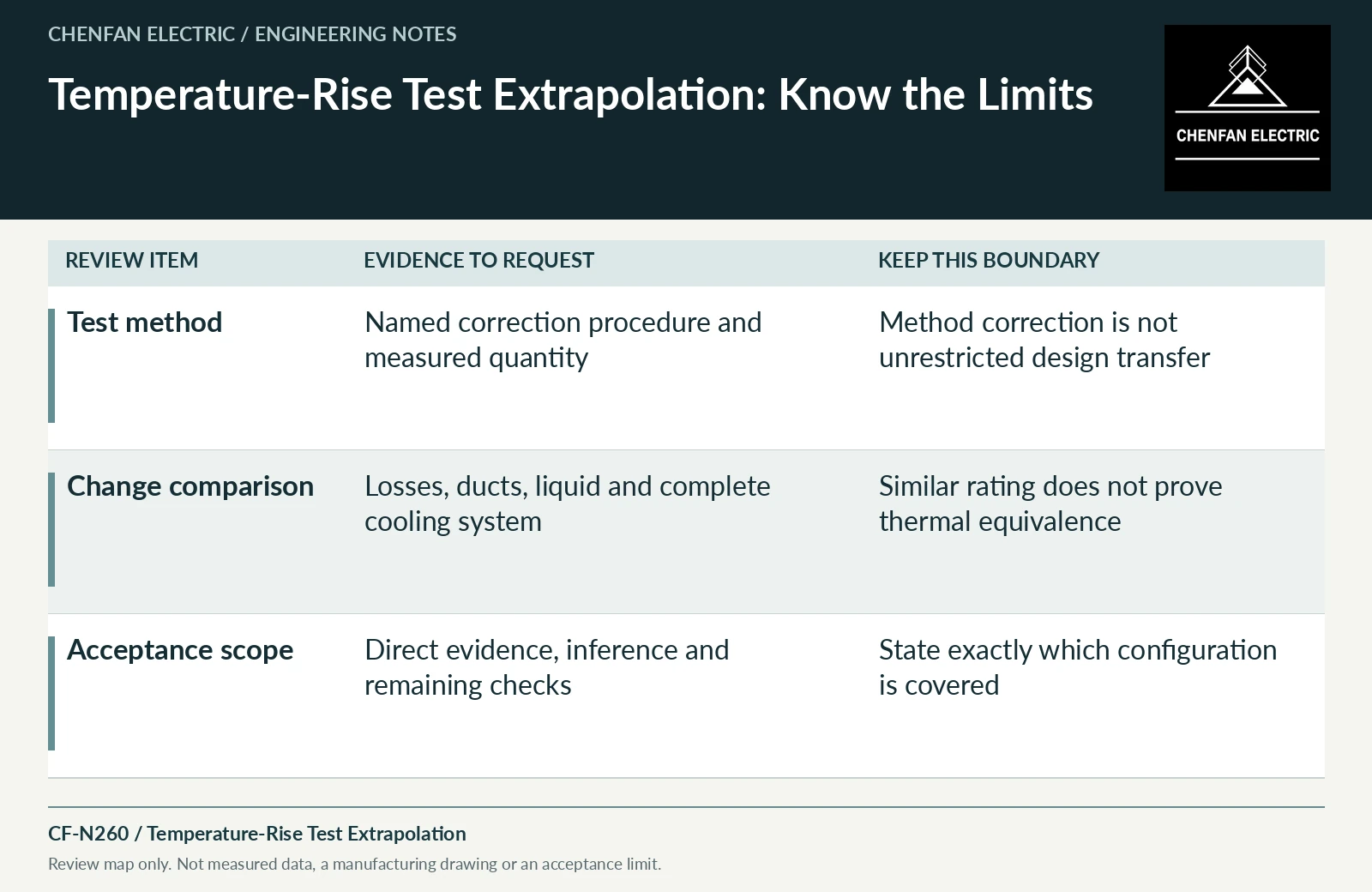
Distinguish correction from design transfer
Corrections or extrapolations prescribed by an applicable test method address specified conditions within that method. They should not be confused with applying one transformer’s result to another design. Identify the exact procedure, measured quantities and permitted range of the calculation. A report containing a corrected average winding temperature does not, by itself, prove a local hot spot or the performance of a different winding arrangement.
List the configuration differences
Compare losses, conductor geometry, ducts, liquid, radiators, pumps, fans and enclosure conditions between the tested and proposed units. Include controls and the cooling equipment required for each rating. Similar MVA and external dimensions are insufficient evidence of thermal similarity. A compact comparison table should identify whether each change affects heat generation, internal transfer, external rejection or the measurement basis.
Check interacting changes, not only individual ones
A small increase in losses and a small reduction in cooling space can combine unfavorably. Assess the proposed configuration as a whole instead of approving each change against a different earlier design. Retain uncertainty and margin in the thermal model. Where the supporting evidence is weak or outside the validated range, the responsible engineer should identify the additional calculation, component information or temperature-rise testing required.
Keep the acceptance statement narrow and traceable
The final statement should name the tested unit, proposed unit, drawing revisions and operating states covered by the assessment. Explain what has been directly tested and what has been inferred. Use the applicable liquid-immersed or dry-type test framework without claiming to have verified inaccessible standard clauses from an abstract. A clear boundary is more useful than a blanket statement that the whole product family is thermally proven.
| Review item | Evidence to request | Boundary to preserve |
|---|---|---|
| Test method | Named correction procedure and measured quantity | Method correction is not unrestricted design transfer |
| Change comparison | Losses, ducts, liquid and complete cooling system | Similar rating does not prove thermal equivalence |
| Acceptance scope | Direct evidence, inference and remaining checks | State exactly which configuration is covered |
References and scope
- IEC 60076-2:2011 — Temperature rise for liquid-immersed transformersPublic standard abstract · Temperature-rise requirements, cooling identification and the distinction between test conditions and installed duty.
- IEC 60076-11:2018 — Dry-type transformersPublic standard abstract · Dry-type requirements and classification within the standard’s voltage/product scope; not a blanket reference for every LV product.
- IEEE C57.165-2024 — Temperature Monitoring of Liquid-Immersed TransformersPublic standard abstract · Temperature-monitoring methods for liquid-immersed transformers and their measurement/model boundaries.
- IEC 60076-1:2011 — Power transformers: GeneralPublic standard abstract · General transformer scope, interfaces and controlled equipment specification.