

Transformer Core Engineering Notes · CF-N261
Cast-resin and vacuum-pressure-impregnated winding constructions are manufacturing approaches, not universal rankings of transformer quality. The useful comparison is between complete offered insulation systems in the intended environment. Material qualification, thermal design, contamination exposure, mechanical support and maintainability should be reviewed together before choosing a construction label.
Describe the offered construction precisely
Ask which windings and components are cast, impregnated or otherwise insulated. Suppliers can use different combinations within one transformer. Identify the resin or varnish system, conductor arrangement and the relevant qualification evidence without assuming that every product using the same process name has identical properties. A photograph of an encapsulated coil does not establish the environmental capability of leads, terminals or other exposed parts.
Compare complete-system evidence
Review dielectric, temperature-rise and applicable environmental or fire-behaviour evidence for the offered dry-type design. IEC 60085 distinguishes thermal classification of an insulating material from that of an insulation system; a resin’s class alone does not qualify the complete winding. Use IEC 60076-11 within its dry-type scope and control design or process changes. Keep the evidence traceable to the materials, winding construction and manufacturing process actually offered.
Match exposure and cooling requirements
Specify humidity, condensation, dust, salt or chemical exposure as applicable, including conditions before energization. Review how the complete enclosure and ventilation arrangement protects the equipment while removing heat. Encapsulation of a winding does not eliminate every contamination or condensation risk. Conversely, an exposed construction should not be rejected solely by appearance if appropriate system evidence and installation conditions support its use.
Include service consequences in the decision
Discuss inspection access, cleaning restrictions, repair strategy and replacement lead times with the OEM. The ability to replace a winding depends on the design and service arrangement, not only the process name. Compare lifecycle obligations explicitly rather than claiming one construction is maintenance-free. The preferred bid is the one supported for the site’s actual duty and owner capabilities, with clear evidence and exclusions.
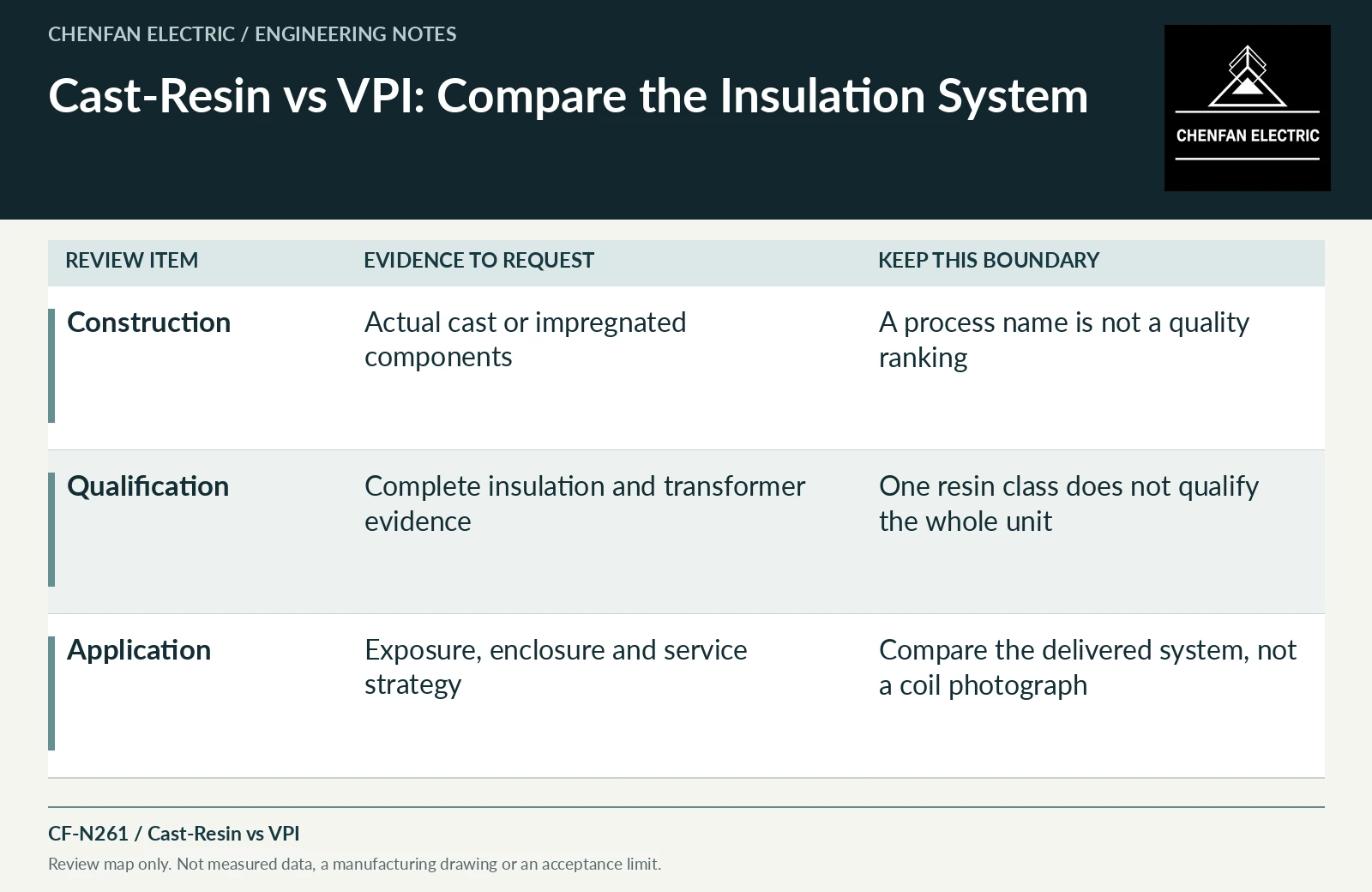
| Review item | Evidence to request | Boundary to preserve |
|---|---|---|
| Construction | Actual cast or impregnated components | A process name is not a quality ranking |
| Qualification | Complete insulation and transformer evidence | One resin class does not qualify the whole unit |
| Application | Exposure, enclosure and service strategy | Compare the delivered system, not a coil photograph |
References and scope
- IEC 60076-11:2018 — Dry-type transformersPublic standard abstract · Dry-type requirements and classification within the standard’s voltage/product scope; not a blanket reference for every LV product.
- IEC 60085:2007 — Thermal evaluation and designationPublic standard abstract · Distinguishes the thermal classification of an insulating material from an insulation system.