

Sympathetic inrush is a transient magnetizing response in an already energized transformer caused by the energization of another unit through a coupled network. The study must represent both magnetic circuits and their shared source impedance. Treating the operating transformer as a fixed load removes the mechanism that needs to be assessed.
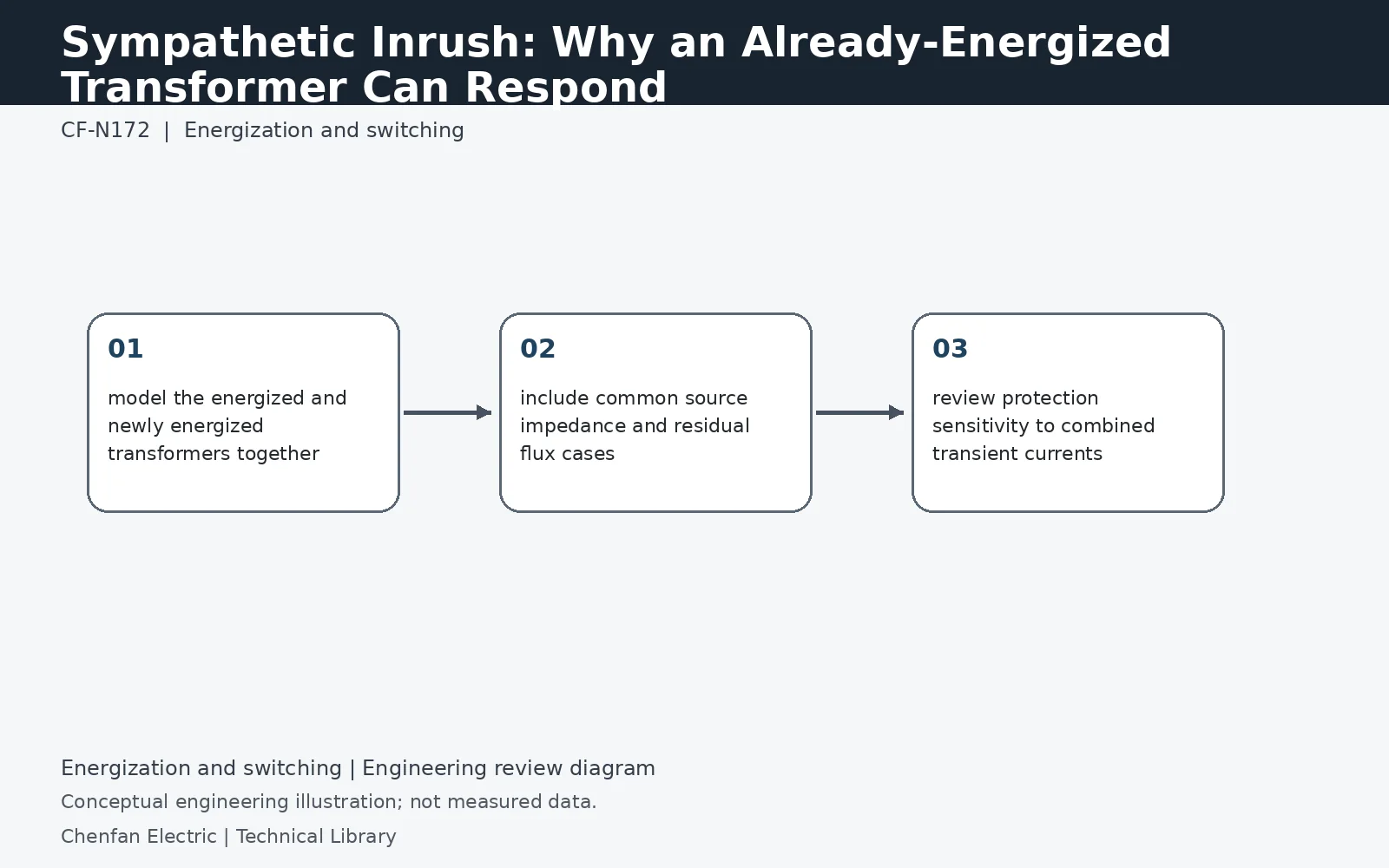
The common source couples the two magnetic responses
When the newly connected transformer draws asymmetric magnetizing current, the voltage drop across shared source impedance can distort the voltage applied to another transformer already in service. The integral of that disturbed voltage changes the operating unit's flux trajectory. It can therefore develop an additional transient magnetizing current even though its own breaker did not operate. The coupling depends on the actual electrical path; the units do not have to be physically adjacent to share a relevant source impedance.
Do not replace the operating transformer with fixed kW and kvar
A constant-power or passive-load representation omits the magnetic nonlinearity that produces the sympathetic response. Include the operating transformer's magnetizing branch, initial steady-state flux and connected load, as well as the new unit's residual-flux assumptions. Core construction and winding connections can affect the response. Compare branch currents separately, since an acceptable total source current can conceal a concerning current or protection response in one transformer.
Review duration and relay behavior in both units
The interaction can alter how long transient currents persist, so analysis should extend beyond the first peak. Retain currents and voltages at the CT/VT locations used by the relevant relays and check the applicable inrush-security logic. A successful standalone energization study for the new transformer does not establish security of the existing unit. Document the transformer combinations and source states covered so a future bank addition does not silently fall outside the assessed scope.
Technical reference framework
[1] CIGRE Technical Brochure 568 — Transformer energization in power systems: A study guide.
[2] IEC 60076-8:1997 — Application guide.