

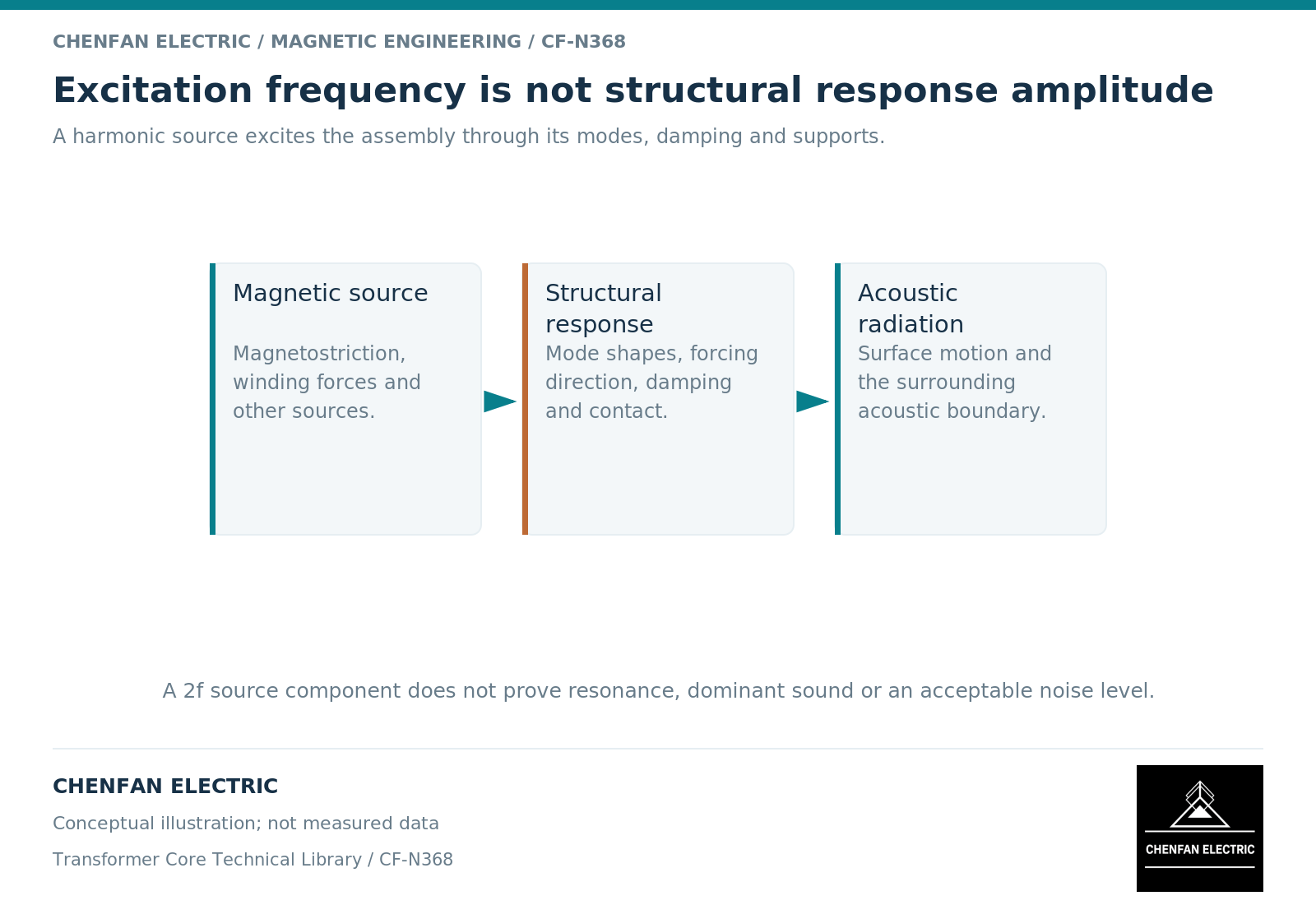
Magnetic excitation frequency and structural natural frequency are different quantities. The first describes the time variation of a driving mechanism; the second belongs to the mechanical system. Resonance becomes relevant when an excitation component couples strongly to a structural mode near its natural frequency. Neither frequency alone predicts the resulting vibration or sound.
Identify the source before interpreting the spectrum
Core magnetostriction, winding electromagnetic forces and auxiliary equipment can all contribute to transformer noise. A published transformer load-noise study separates these sources and models the transfer from electromagnetic force through mechanical motion to acoustic radiation. [1]
For a simple symmetric quadratic response to a sinusoidal magnetic quantity, doubling of frequency follows mathematically. For example, sin²(ωt) = [1 − cos(2ωt)]/2. This explains why twice-frequency components are important in some idealized mechanisms, not why every transformer sound must contain only that component.
Waveform distortion, magnetic bias, material nonlinearity, mechanical asymmetry and auxiliary equipment can introduce additional components. A measured spectral peak should be linked to an operating condition and source hypothesis rather than automatically labeled “core resonance.”
Distinguish forcing from the transfer function
A simple linear single-degree-of-freedom illustration gives displacement amplitude proportional to force amplitude divided by the magnitude of k − mω² + j cω, where k is stiffness, m mass, c damping and j the imaginary unit. The expression shows why changing support stiffness or damping can change response without changing the forcing frequency.
A real core and active part have multiple modes and distributed forces. The spatial overlap between force and mode shape matters: a strong local force may couple weakly to one mode and strongly to another. Electromagnetic force calculations therefore need a compatible structural representation. [2]
The sound radiated from a tank is a further transfer process. A reduction in one measured vibration component is not automatically the same reduction in overall sound power.
Compare operating changes without mixing causes
| Changed condition | Potentially changed part of the problem |
|---|---|
| Voltage waveform | Magnetic excitation and its harmonic content |
| Load current | Winding forces and load-related fields |
| Support arrangement | Stiffness, damping and mode shapes |
| Temperature | Material and contact properties |
| Cooling equipment state | Additional independent excitation |
Hold the other conditions constant where practical when comparing evidence. Otherwise an apparent material improvement may be a support change or a different operating state.
A frequency sweep in a model should state what is swept. Sweeping an imposed force frequency differs from changing transformer supply frequency at constant voltage, because the latter also changes magnetic excitation. A comparison that silently changes volts per hertz confounds the two effects.
Retain a source-to-response record
Record the source waveform or force distribution, structural boundary conditions, damping basis, mode identification and acoustic reporting metric. For measurements, include sensor location, direction, operating state and the distinction between vibration and sound quantities.
The practical output is a traceable explanation of which excitation couples to which response. It is not a universal instruction to tighten clamps, add mass or change the step-lap arrangement. Those modifications affect a coupled design and require evidence that they address the identified mechanism without compromising another function.
References
[1] M. Kavasoglu, R. Haettel and C. H. Ploetner / ABB. Prediction of Transformer Load Noise (2010).
[2] David Meeker. Finite Element Method Magnetics User Manual.