


Transformer Core Engineering Notes · CF-N284
Seismic suitability is an assembly and installation question, not just a tank-strength statement. Bushings, radiators, supports, connected conductors and anchorage can respond differently during an event. The responsible engineers should define the site demand and performance objective, then examine the complete installed configuration and the evidence supporting each critical interface.
Define the qualification basis
The qualified structural and electrical designers must define site demand, installation conditions and required post-event function. Where IEEE seismic qualification is specified, identify IEEE 693-2018 together with applicable IEEE 693a-2024 amendments; the amendment explicitly includes transformer and appendage topics. A bare acceleration number is incomplete. Record the assessment method and exact configuration. This article supplies no universal seismic coefficient, qualification level or equipment-specific certification.
Include mounted components and supports
A bushing or radiator mounted above the main base can experience a response different from that at the foundation. Review the mounting structure, brackets and component evidence together. An isolated component test may not automatically cover a different support arrangement. The OEM should identify which accessories and structural details are included in its assessment and what site-installed items remain outside the supplied evidence.
Coordinate external connections and displacement
Connected buses, cables and pipes can impose forces or restrict movement. Their supports may respond differently from the transformer, making relative displacement important. Ask the conductor and pipe designers to coordinate allowable forces, movement and electrical clearances with the OEM. A flexible-looking connection does not prove adequate movement capacity or low transmitted force under the specified event.
Verify the installed configuration
Anchorage, support elevations, accessory substitutions and connection details must match the accepted assessment. Keep an as-built record and review deviations before claiming the installation is covered. A report for a similar transformer should identify the justified differences rather than be used as a generic seismic certificate. The final responsibility matrix should close the gaps between equipment qualification and the civil installation.
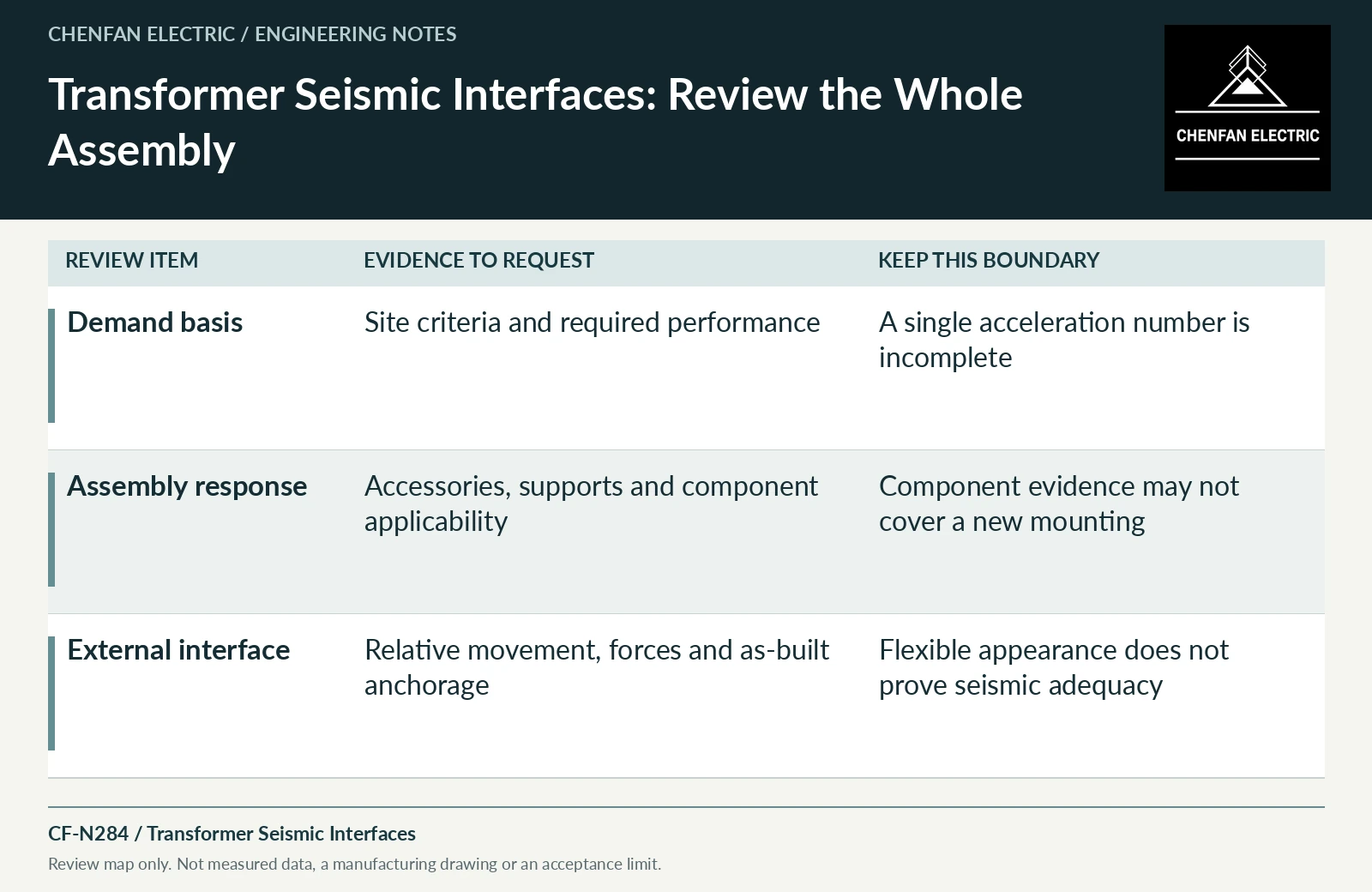
| Review item | Evidence to request | Boundary to preserve |
|---|---|---|
| Demand basis | Site criteria and required performance | A single acceleration number is incomplete |
| Assembly response | Accessories, supports and component applicability | Component evidence may not cover a new mounting |
| External interface | Relative movement, forces and as-built anchorage | Flexible appearance does not prove seismic adequacy |
References and scope
- IEEE 693-2018 — Seismic design of substationsPublic standard abstract · Substation seismic design and equipment qualification framework; site criteria and the exact assembly must be specified.
- IEEE 693a-2024 — Amendment 1 to IEEE 693-2018Public standard abstract · Amendment covering transformers, selected appendages and qualification-related topics; read with the base standard as applicable.
- IEC 60076-1:2011 — Power transformers: GeneralPublic standard abstract · General transformer scope, interfaces and controlled equipment specification.