

Re-energization after an interruption depends on the electrical, magnetic and mechanical states that remain in the installation. Residual core flux, trapped charge and rotating-machine voltage are not interchangeable. The study must define the interruption and source-return conditions instead of assuming that an unpowered transformer starts from zero flux.
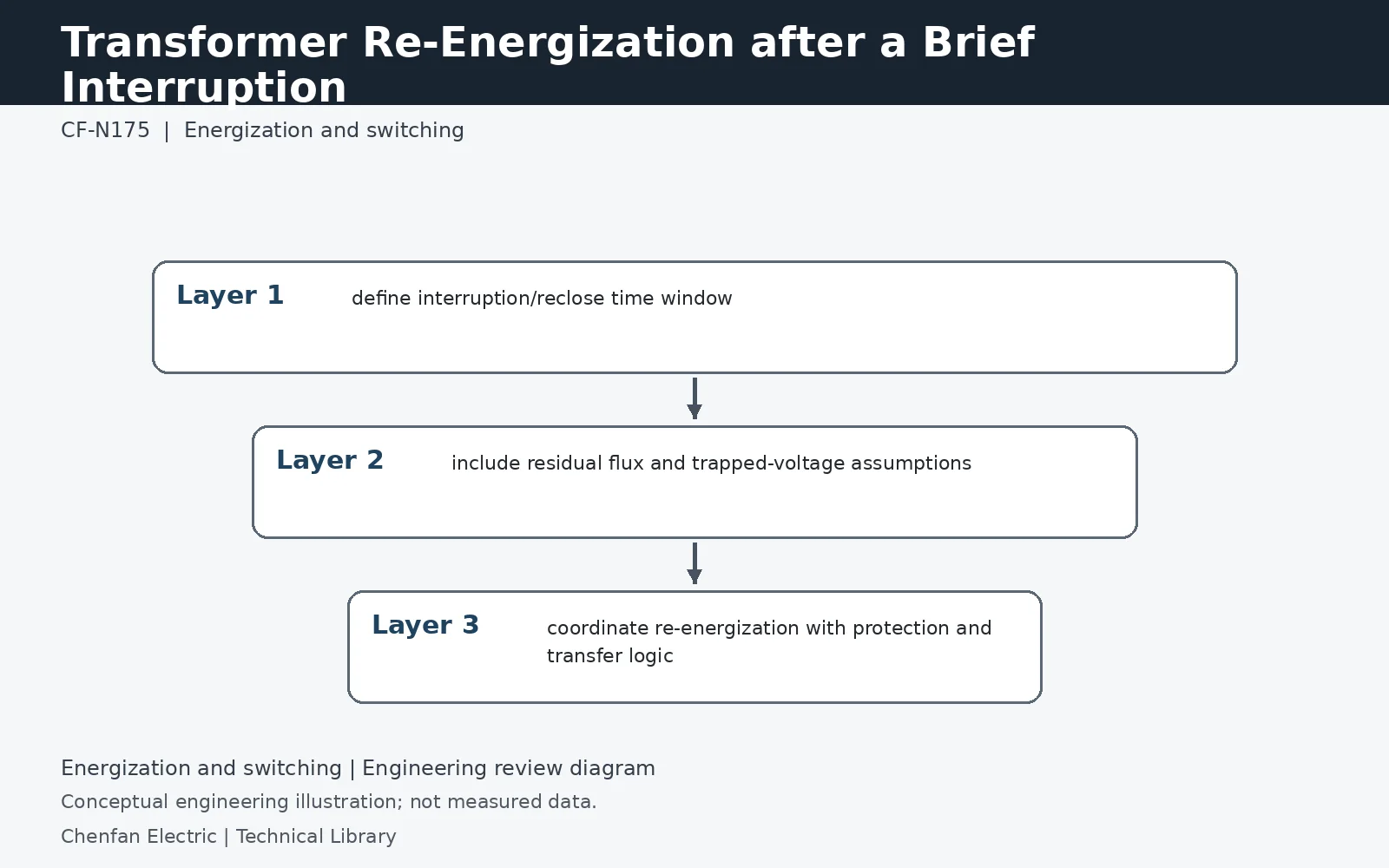
Elapsed time does not prove the core has zero residual flux
Residual core flux and electrical voltage are different state variables. Voltage on a disconnected capacitance may decay through a discharge path, while remanent flux can persist in the magnetic material. A long interruption therefore does not automatically justify a zero-flux initial condition, and a short interruption can retain additional electrical or mechanical states. Define the initial magnetic assumptions separately from the measured or modeled residual bus voltage.
Connected motors can keep a bus electrically active
Rotating machines can contribute a decaying voltage whose magnitude, frequency and phase evolve after source interruption. Capacitors and converter DC links can introduce other retained-energy or restart conditions. The re-energization study should identify which equipment remains connected and how its controls respond to the interruption. Treating the downstream network as a discharged passive load may miss a voltage difference or protection issue when the source returns.
Test a range of interruption and recovery cases
Use the credible interruption durations, source-return phase conditions and breaker timing, not only one nominal reclose delay. Preserve the transformer state at opening and its state immediately before re-energization. Evaluate current, voltage recovery and relay security for the resulting cases. The engineering output should constrain the authorized restoration scheme and identify unsupported scenarios; it must not be presented as a universal waiting time that makes re-energization safe.
Technical reference framework
[1] CIGRE Technical Brochure 568 — Transformer energization in power systems: A study guide.
[2] IEC 60076-8:1997 — Application guide.